

Technology adoption rarely follows the path suggested by a market-size forecast. A solution may have a large addressable market but struggle to convert interest into purchases because the target customer is not ready, the buying process is too complex, the value proposition is unclear or the route to market does not match how enterprises purchase technology.
India’s cloud market demonstrates the scale of the underlying opportunity. Gartner forecasts Indian public-cloud spending at $17.5 billion in 2026, up 28.1% from 2025. It also identifies growing demand for AI-ready infrastructure, application modernisation, digital sovereignty and consumption-based IT models.
AI adoption is moving in the same direction. Deloitte’s 2026 India research reports significant or full AI usage among 40% of respondents, compared with approximately 28% globally, while at-scale adoption is strongest in product development at 62%, strategy and operations at 56%, marketing and sales at 55%, and supply chain at 48%.
The commercial question is therefore increasingly about execution: which customers should be approached first, through which channels, and with what proposition?
Technology Buyers Are Not One Market
Different customers can experience the same technology very differently.
A large enterprise may have an established procurement function, dedicated technology teams and extensive integration requirements. A mid-market company may prioritise implementation speed and lower upfront costs. A regulated business may value security, governance and data residency more heavily than functionality.
The TMT research reinforces this complexity. Enterprise technology transactions can involve an average of 22 stakeholders and influencers, spanning IT, FinOps, privacy, cybersecurity, compliance and business leadership.
That makes customer segmentation a commercial requirement rather than a marketing exercise.
The Value Proposition Needs to Match the Buying Trigger
A technology product can be described through its features, but customers usually purchase because something needs to change.
A cybersecurity solution may be purchased because incident-response time is becoming unacceptable. A cloud optimisation platform may be purchased because infrastructure costs are eroding margins. An AI workflow solution may be purchased because manual processing is constraining growth.
The strongest value propositions therefore translate technology capability into a measurable business outcome.
The TMT research identifies this shift toward metrics such as cost reductions per transaction, shorter compliance cycles and smaller manual-review queues.
Route to Market Can Determine Adoption Speed
A product’s distribution strategy can be as important as its functionality.
Direct enterprise sales can provide control over complex accounts but require long sales cycles and significant customer acquisition resources. Channel partnerships can accelerate access to established customer bases but reduce control over positioning and economics.
Cloud marketplaces offer another route. The TMT research notes that technology vendors can use hyperscaler marketplaces to access pre-committed enterprise cloud spending and potentially reduce procurement friction.
The right channel depends on the product, buyer, implementation requirements and level of trust required before purchase.
Building a Technology Go-to-Market Assessment
A technology go-to-market assessment consulting framework should connect four commercial decisions.
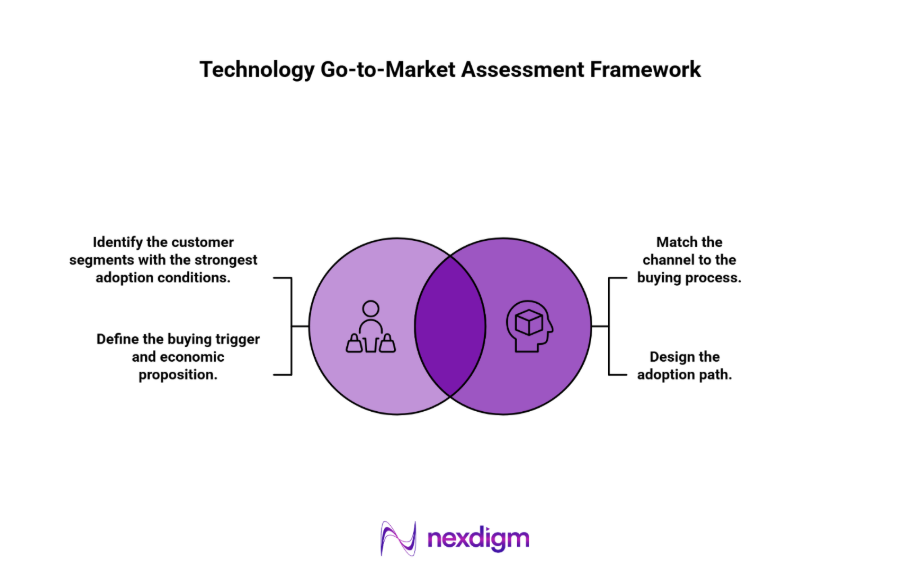
- Identify the customer segments with the strongest adoption conditions.
Assess company size, industry, technology maturity, regulatory environment, budget availability and urgency of the underlying business problem. The objective is to identify customers that can buy and implement, not simply customers that express interest. - Define the buying trigger and economic proposition.
Determine what causes the customer to initiate a purchase and quantify the value created. This can include cost savings, productivity, revenue expansion, risk reduction or faster execution. - Match the channel to the buying process.
Evaluate direct sales, distributors, system integrators, cloud marketplaces, strategic partnerships and digital self-service. The correct channel depends on transaction complexity and the amount of implementation support required. - Design the adoption path.
Technology adoption often requires a progression from proof of concept to pilot to production. Assess the barriers at each stage, including integration, data readiness, security reviews, procurement and internal sponsorship.
The TMT research highlights the importance of this readiness gap. Globally, 34% of enterprises are scaling AI into production, but only 6% report fully AI-ready data architecture.
A go-to-market strategy that ignores these barriers may generate leads without producing production deployments. A rather expensive way to discover that the customer needed six months of data preparation first.
Adoption Is Ultimately a Commercial System
Technology companies therefore need to treat adoption as the interaction of customer readiness, value proposition, channel and implementation.
The strongest opportunity may not be the largest customer segment. It may be the segment where the problem is urgent, the economic value is measurable, procurement is manageable and the technology can be implemented without excessive friction.
Nexdigm Case: Prioritising Technology Customers and Routes to Market
A technology provider assessed 8 customer segments across 6 markets, interviewing 2,800 technology decision-makers and evaluating 32 acquisition channels. Nexdigm identified 3 priority segments, reducing projected customer-acquisition costs by 19% and increasing qualified-lead conversion by 24%.
Nexdigm’s technology go-to-market assessment consulting helps companies identify priority customer segments, buying triggers, value propositions, channels, competitive dynamics and adoption barriers.
To take the next step, simply visit our Request a Consultation page and share your requirements with us.
Harsh Mittal
+91-8422857704