

Emerging technology markets rarely become investable simply because the underlying technology works. Investors need evidence that a technical capability can become a repeatable product, reach a sufficiently large customer base, defend its position, and generate returns at scale.
That distinction is becoming more important as technology investment broadens beyond conventional software. In 2025, AI firms accounted for 61% of global venture capital investment, receiving $258.7 billion of the $427.1 billion invested globally. At the same time, capital is moving into robotics, space technologies, quantum computing, advanced manufacturing and other technology-intensive sectors.
The question for investors is therefore shifting from which technologies appear promising to which technologies can support scalable business models.
Technology Momentum Is Only the First Investment Signal
Funding itself can reveal where investor conviction is forming, but it does not establish commercial viability. OECD data shows that AI investment has become increasingly concentrated in large transactions, with deals above $100 million accounting for approximately 73% of AI investment value in 2025. IT infrastructure and hosting alone attracted $109.3 billion during the year.
This concentration creates an important distinction between technological momentum and investable opportunity.
A technology may attract significant capital because it requires enormous infrastructure investment. Another may receive less funding because it is earlier in its commercialization cycle. Comparing them purely on funding volume can therefore produce misleading conclusions.
McKinsey’s 2026 technology outlook illustrates this broader transition. Five areas, including agentic software development, AI infrastructure, AI for scientific discovery and engineering, space technologies and robotics, were on track to more than double their 2026 investment compared with 2025.
The relevant question is what happens after the funding round.
From Technical Breakthrough to Commercial Adoption
Commercializing technology requires navigating four distinct thresholds: technical feasibility, practical application relevance, favorable unit economics, and scalable defensibility.
Deep tech highlights why these stages cannot be treated uniformly. India illustrates the sector’s momentum, drawing nearly $28 billion across more than 2,100 deals since 2016 and $1.2 billion for AI in 2025 across areas like robotics, semiconductors, and biotech.
However, applying conventional software timelines to these domains is misleading: whereas standard software can monetize rapidly, deep tech demands significantly longer R&D cycles, heavier capital investment, and prolonged commercialization pathways.
The Business Model Determines Where Capital Can Scale
Investors must evaluate the underlying economic architecture of an emerging technology rather than its technical capability alone. AI infrastructure thrives on heavy compute demands, robotics carries substantial hardware and servicing costs, and quantum computing faces prolonged commercialization horizons despite attracting $12.6 billion in 2025.
Commercial viability hinges on four core variables: technology readiness, customer demand, unit economics, and defensibility. Furthermore, as highlighted by the World Economic Forum, future value will increasingly stem from technology convergence across areas like AI, robotics, energy, and quantum systems, rather than isolated breakthroughs.
What Investors Need to Establish Before Scaling Capital
A technology opportunity assessment should answer several commercial questions:
- Market creation: Is the technology creating a new market or competing for an existing budget?
- Customer economics: What measurable financial or operational benefit does adoption create?
- Adoption readiness: Are customers technically, financially and operationally prepared to deploy it?
- Revenue architecture: Is monetization based on subscriptions, transactions, hardware sales, licensing, usage or recurring services?
- Capital intensity: How much additional funding is required before the business reaches meaningful commercial scale?
- Competitive defensibility: Can intellectual property, data, infrastructure, distribution or switching costs protect the business?
- Scale pathway: Can the model expand geographically, across customer segments or into adjacent applications?
- Exit potential: Are strategic acquisitions, private-equity investment or public markets realistic routes for investors?
These questions separate a technology trend from a commercially actionable investment thesis.
Nexdigm’s Emerging Technology Investment Attractiveness Framework
Nexdigm Technology Investment Ecosystem Assessment can assess emerging technology opportunity through a structured investment lens:
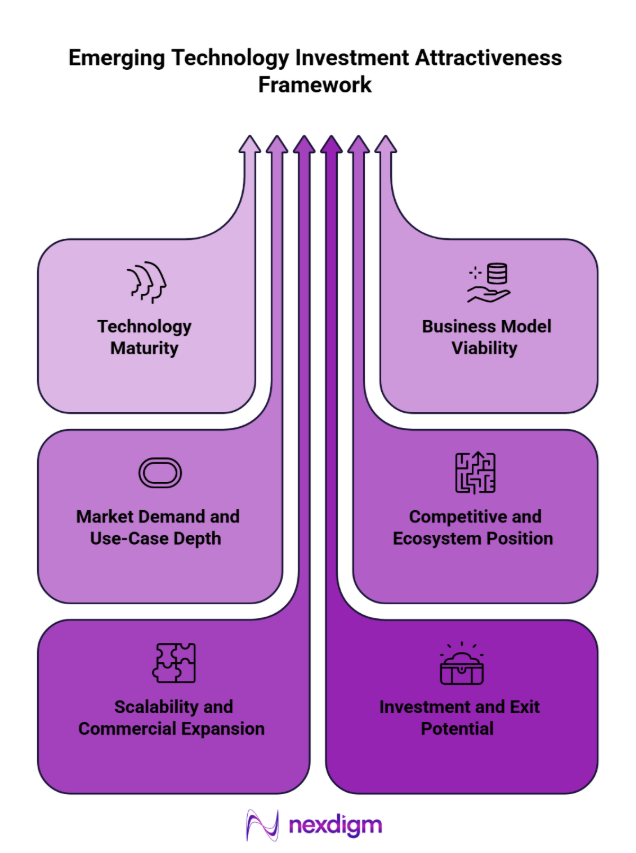
- Technology Maturity
Assess technology readiness, deployment stage, reliability, IP position and development requirements. - Market Demand and Use-Case Depth
Measure addressable demand, customer pain points, adoption triggers and the number of commercially relevant applications. - Business Model Viability
Evaluate pricing architecture, revenue recurrence, gross-margin potential, customer acquisition economics and capital requirements. - Competitive and Ecosystem Position
Map incumbents, startups, technology substitutes, suppliers, strategic partners and barriers to entry. - Scalability and Commercial Expansion
Test whether the model can move from pilots to repeatable deployment and expand across geographies, industries or use cases. - Investment and Exit Potential
Assess funding requirements, likely investor appetite, follow-on capital availability, strategic acquisition interest and potential exit pathways.
This framework helps investors move from technology scanning to opportunity prioritization, identifying where technical momentum is supported by a credible route to commercial scale.
Case Study: Technology Portfolio Reallocation
An investor assessed 15 emerging technology opportunities across AI, robotics, quantum and industrial automation. Three exceeded 20% projected five-year revenue CAGR, 65%+ gross margins and identifiable enterprise demand, concentrating 70% of planned capital into those categories.
As technology cycles accelerate, investors need market intelligence that can distinguish early technical momentum from durable commercial opportunity.To understand emerging technology markets, competitive dynamics, customer demand and investment potential, Nexdigm can support the assessment of opportunities from market sizing and competitive benchmarking through business-model evaluation and growth strategy.
To take the next step, simply visit our Request a Consultation page and share your requirements with us.
Harsh Mittal
+91-8422857704