

Technology markets are expanding, but the direction of that expansion is becoming increasingly uneven. Global information technology expenditure is projected to reach $6.37 trillion in 2026, representing 14.2% annual growth. Yet the underlying segments are moving at very different speeds. Data-centre systems are forecast to grow from $506 billion in 2025 to $822 billion in 2026, while Infrastructure-as-a-Service is expected to reach $287 billion. Enterprise software is projected at $1.47 trillion, whereas IT services are growing at a considerably slower 5.3%.
For technology companies, this creates a more complicated market-entry and investment environment. A growing technology market does not automatically mean every segment, geography or customer group offers equivalent commercial potential. The important question is where spending is moving, what is driving that movement, and whether customer readiness is sufficient to convert demand into revenue.
Technology Investment Is Moving Toward Infrastructure
The strongest growth is currently concentrated around the infrastructure required to support AI and data-intensive workloads. Data-centre systems are forecast to grow 62.5% in 2026, driven by accelerated GPU and ASIC clusters, high-density cooling, power delivery and facility retrofits. AI-optimised IaaS spending is projected to reach $42 billion, representing 96% year-over-year growth.
This reflects a broader change in enterprise technology investment. Organisations are increasingly securing compute and data capacity before deploying applications at scale. That creates opportunities for infrastructure providers, cloud platforms, data-centre operators and specialised technology vendors, while putting pressure on businesses whose propositions depend on slower-moving technology budgets.
India provides another indication of this shift. Public cloud spending is projected to reach $17.5 billion in 2026, with IaaS growing 40%, PaaS 25.4% and SaaS 18.9%. India also generates nearly 20% of global digital data while accounting for only around 3% to 4% of global installed data-centre capacity.
The resulting opportunity is substantial, but infrastructure constraints, data sovereignty and power availability can determine where investment actually materialises.
Growth Does Not Mean Every Customer Is Ready
The AI market illustrates why adoption needs to be separated from commercial readiness. Global AI spending is forecast to reach $2.7 trillion in 2026, growing 49.5%. However, only 34% of enterprises are scaling AI initiatives into production, while just 6% report that their data architecture is fully ready to support AI at scale.
This gap changes the addressable market for technology providers. A business may express interest in an AI solution while lacking the data architecture, security controls, infrastructure or organisational processes required to deploy it.
For vendors, this means that market potential should be assessed through customer readiness as well as market size. The most attractive segment may not be the largest one. It may be the segment where the business problem is sufficiently urgent and the customer environment sufficiently mature to support adoption.
Where Does a Technology Entrant Actually Have Room to Compete?
Enterprise software presents another challenge. The market is forecast to reach $1.47 trillion in 2026, but established platforms such as Microsoft, Salesforce, ServiceNow, SAP and Oracle are embedding AI and autonomous capabilities into existing enterprise environments.
This makes competitive analysis central to market assessment. A new technology solution may appear differentiated when compared with specialist competitors but face significant substitution risk from an incumbent feature that is already bundled into a customer’s technology stack.
Technology market assessment therefore needs to examine:
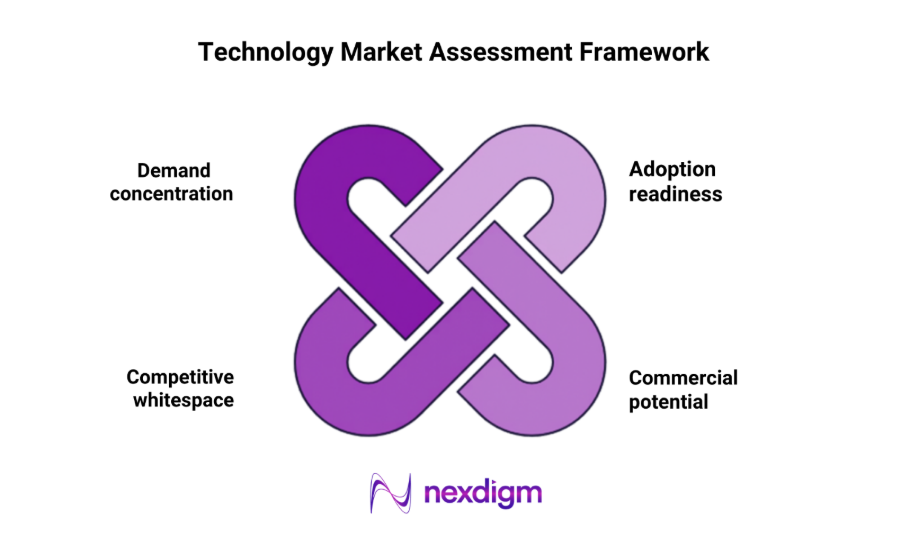
- Demand concentration. Which technology segments, use cases and customer groups are receiving incremental investment?
- Adoption readiness. Which customers have the infrastructure, data, budgets and organisational capacity required to purchase and implement the solution?
- Competitive whitespace. Where are incumbents strong, and where do customers still face workflow, interoperability or capability gaps?
- Commercial potential. What combination of market size, pricing, adoption, sales cycles and implementation economics can support a viable business?
Nexdigm’s technology market assessment services bring these dimensions together through market sizing, customer research, competitive benchmarking, pricing analysis and commercial opportunity assessment. The objective is to identify where demand is structurally strong and where an entrant can realistically establish a position.
The Commercial Opportunity Is Becoming More Specific
Technology demand is increasingly concentrated around measurable operational needs. Autonomous AI agents, for example, are projected to grow from approximately $16 billion in 2025 to $29 billion in 2026, representing 81.3% growth.
That growth creates opportunities, but also raises questions around infrastructure costs, workflow integration, data governance and pricing. Technology providers therefore need a market view that connects adoption with the economics of deployment.
A useful market assessment should ultimately establish which segment to pursue, which customers to prioritise, what proposition to take to market and how much commercial investment is justified.
Nexdigm Case: Identifying High-Potential Technology Segments
A technology provider assessed 7 segments across 5 markets, combining 2,400 enterprise responses with 85 competitor benchmarks. Nexdigm identified AI infrastructure and data-centre solutions as priorities, with projected demand growth of 24% and 19%, respectively.
Nexdigm’s technology market assessment services help businesses evaluate market attractiveness, demand, competition, customer readiness, pricing and commercial potential before committing resources to a new opportunity.
To take the next step, simply visit our Request a Consultation page and share your requirements with us.
Harsh Mittal
+91-8422857704