

Technology startups expand faster when they follow structured market entry and commercialization planning instead of relying only on product innovation. A strong Technology startup market entry strategy helps startups identify the right customer segments, test demand, define pricing, select sales channels, and position their solutions clearly in competitive markets. As part of a broader market entry strategy, commercialization planning connects product development with revenue generation by turning ideas into scalable business models.
It helps startups reduce launch risks, improve investor confidence, build early customer traction, and create a practical roadmap for entering, growing, and sustaining new technology markets.
Recent startup research shows that nearly 42% of startups fail because there is no clear market need, while around 29% fail due to cash or funding challenges. Other business survival data indicates that about one in five new businesses fail within the first year.
Identifying High-Potential Customer Segments for Startup Growth
Identifying high-potential customer segments helps technology startups focus on buyers with strong demand, clear pain points, higher adoption potential, and better revenue opportunities during market entry.
-
Customer Need Analysis
Studies buyer problems, unmet needs, usage gaps, and willingness to adopt new technology solutions in target markets.
-
Market Size Evaluation
Assesses segment size, growth potential, spending capacity, competition level, and revenue opportunity for startup expansion.
-
Buyer Persona Development
Defines ideal customers by demographics, industry, role, budget, behavior, pain points, and decision-making patterns.
-
Adoption Readiness Assessment
Evaluates how quickly each segment may accept, purchase, and use the startup’s technology solution.
Nexdigm’s Strategic Advisory for Reducing Startup Market Entry Risks
Nexdigm’s strategic advisory helps technology startups reduce market entry risks by assessing demand, competition, pricing, customer segments, and commercialization readiness. It supports structured planning, validates business assumptions, identifies entry barriers, and helps startups prioritize suitable markets, channels, and growth models for faster and more sustainable expansion.
Nexdigm’s Commercialization Planning Support for Startup Technology Firms
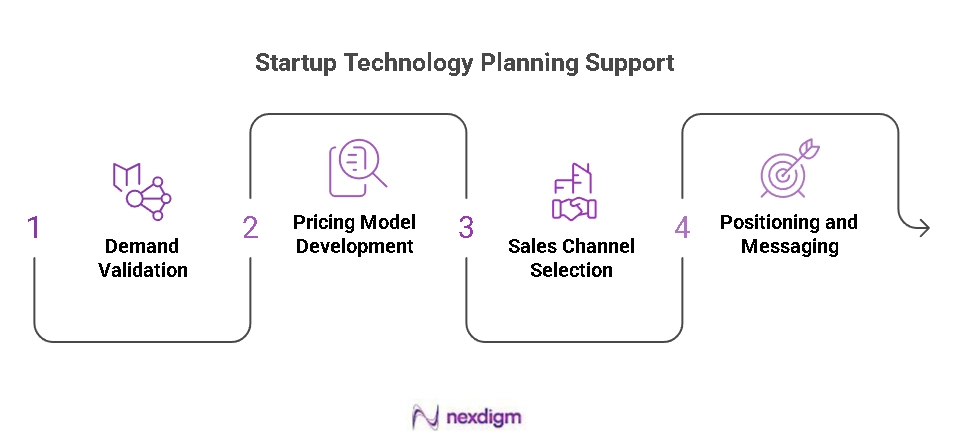
Nexdigm’s commercialization planning support helps early-stage technology firms validate demand, define pricing, select sales channels, refine positioning, and convert innovative solutions into scalable revenue opportunities:
-
Demand Validation
Assesses customer needs, market gaps, adoption potential, and willingness to pay before commercial launch.
-
Pricing Model Development
Defines suitable pricing structures based on customer value, competition, affordability, margins, and revenue scalability.
-
Sales Channel Selection
Identifies direct, digital, partner-led, or distributor-based channels to improve startup reach and customer acquisition.
-
Positioning and Messaging
Refines product positioning, value proposition, and customer messaging to improve differentiation in competitive technology markets.
Nexdigm’s case:
Nexdigm helped an early-stage technology firm strengthen its commercialization planning before market entry. By validating customer demand, refining pricing, identifying priority sales channels, and improving launch messaging, Nexdigm helped the company reduce go-to-market risks by 28%, improve early customer inquiries by 40%, and increase pilot conversion rates by 32% within six months.
To take the next step, simply visit our Request a Consultation page and share your requirements with us.
Harsh Mittal
+91-8422857704