

A technology environment built around a small number of suppliers can appear efficient. Fewer contracts simplify administration, integrated platforms reduce the number of systems employees need to manage, and consolidated purchasing may improve negotiating leverage. The difficulty emerges when the organisation becomes too dependent on those providers.
A major service outage, contractual dispute, price increase or change in product strategy can affect several business functions simultaneously. Replacing a deeply embedded platform may also require significant migration expenditure and operational disruption. A technology supplier diversification strategy helps organisations examine these dependencies and determine where additional suppliers, alternative technologies or stronger exit arrangements could improve resilience.
When Consolidation Starts Creating Exposure
Supplier consolidation is often pursued to simplify procurement and improve commercial terms. It can be beneficial when multiple contracts cover overlapping services or when a preferred provider offers a broader, well-integrated portfolio.
However, concentration becomes a concern when several critical services depend on the same vendor, infrastructure ecosystem or technology architecture. An organisation may have multiple software agreements but still rely heavily on one provider’s identity system, cloud environment or integration framework.
This creates a distinction between the number of suppliers and the level of actual dependency. A business with 20 technology vendors may still face substantial concentration risk if its most important systems rely on two interconnected platforms.
Procurement teams need to understand not only who supplies each service, but also how those services depend on one another.
Where Technology Supplier Dependency Develops
- Cloud and infrastructure concentration: Hosting critical workloads with one cloud provider can simplify architecture, but it may also increase exposure to outages, regional disruptions, pricing changes and migration constraints. Multi-cloud or hybrid approaches can provide alternatives, although they introduce additional management and integration requirements.
- Software platform dependency: Enterprise applications often become embedded in business processes, data structures and employee workflows. Proprietary configurations, custom integrations and specialised skills can make switching vendors difficult even when alternative products are available.
- Cybersecurity and identity ecosystems: Identity management, endpoint protection, security monitoring and access control tools may be closely connected. Concentrating these capabilities within one ecosystem can simplify administration, but organisations should understand the consequences of a supplier-level disruption or security incident.
- Specialist service providers: Some businesses depend on a small number of vendors for application maintenance, systems integration, data processing or technical support. The loss of a specialist provider may create immediate resource gaps if knowledge and documentation are not maintained internally.
Diversification Does Not Mean Adding Vendors Everywhere
A common mistake is to treat supplier diversification as a simple target for increasing the number of providers. Additional suppliers can create their own problems, including duplicated licences, fragmented support, inconsistent security controls and higher integration costs.
The decision should be based on the nature of the dependency and the value of having an alternative. For some services, maintaining a second qualified supplier may improve resilience. For others, contractual safeguards, data portability and a tested exit plan may provide a more practical solution.
The organisation should also distinguish between active dual sourcing and contingency sourcing. Active dual sourcing distributes business across multiple providers. Contingency sourcing maintains an alternative that can be activated if the primary supplier becomes unavailable. The appropriate model depends on the service’s criticality, switching complexity and cost of maintaining spare capacity.
How to Build a Diversification Strategy
Map the current supplier ecosystem
Begin with a consolidated view of technology suppliers, services, contracts and dependencies. The mapping should identify which applications rely on particular cloud environments, identity providers, integration tools and specialist service partners.
It should also distinguish direct suppliers from underlying providers. A software vendor may depend on a third-party cloud host, while a managed service provider may use subcontractors for monitoring or support. These indirect relationships can create concentration that is not visible in the primary contract register.
Identify critical concentration points
Assess the potential impact of losing a supplier or platform. Consider the number of business functions affected, the sensitivity of information involved, recovery requirements and the time needed to migrate to an alternative.
Concentration analysis should include commercial exposure as well. A supplier representing a large share of technology expenditure may have considerable influence during renewal negotiations, particularly when switching costs are high.
Evaluate alternative suppliers
Market research can help identify providers with comparable capabilities, geographic coverage and service maturity. However, alternatives should be assessed for actual substitutability rather than superficial product similarity.
A replacement cloud platform may require application redesign. An alternative enterprise software provider may not support existing integrations. A second cybersecurity supplier may introduce overlapping tools without reducing the underlying risk.
Technical compatibility, implementation capacity, commercial viability and support availability should all be considered.
Design the sourcing and transition model
Once viable alternatives have been identified, procurement teams can determine whether to pursue dual sourcing, contingency arrangements, workload distribution or contractual improvements.
The transition model should specify how data, applications and operational responsibilities would move if the primary supplier became unavailable. It should also address staff training, documentation, testing and the costs of maintaining alternative capacity.
Review the strategy over time
Supplier markets change through acquisitions, product discontinuation, pricing revisions and shifts in technology architecture. Diversification plans should therefore be reviewed periodically and whenever a critical vendor undergoes a material change.
The Commercial Trade-Offs of a Diversified Supplier Base
Maintaining multiple providers can improve negotiating leverage and reduce dependence, but it may also reduce volume discounts and increase administrative overhead. Different platforms can require additional integration work, specialised skills and separate support arrangements.
The financial assessment should compare these costs with the potential consequences of concentrated exposure. For critical services, the value of resilience may justify a higher operating cost. For less important applications, diversification may offer limited benefit.
Contract negotiations can also reduce dependency without requiring an immediate supplier change. Data portability, open standards, transition assistance, reasonable termination provisions and transparent renewal terms can make future switching more practical.
How Nexdigm Supports Technology Supplier Diversification
Nexdigm supports organisations through supplier landscape research, market intelligence, vendor benchmarking and procurement strategy analysis. Its work can help clients identify concentrated supplier categories, assess alternative providers, compare commercial and technical capabilities, and evaluate sourcing options that improve resilience without creating unnecessary complexity.
Technology Supplier Diversification Framework
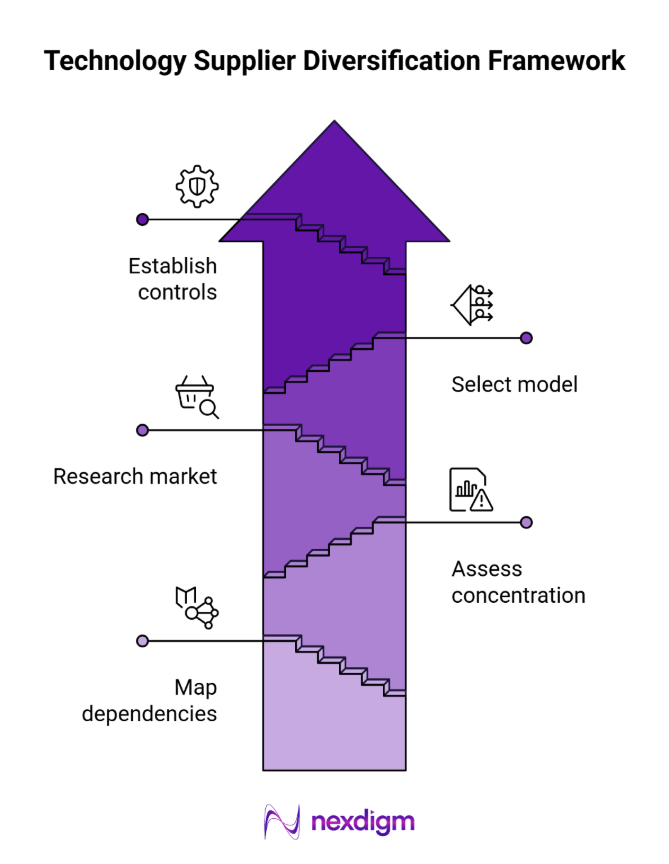
- Map supplier dependencies: Identify critical platforms, service providers, subcontractors, technology relationships and expenditure concentration.
- Assess concentration risk: Evaluate operational impact, switching costs, supplier bargaining power and the availability of alternatives.
- Research the supplier market: Identify credible alternative vendors and compare their technical, commercial and operational capabilities.
- Select the diversification model: Determine whether dual sourcing, contingency suppliers, workload distribution or stronger contractual protections are appropriate.
- Establish ongoing resilience controls: Maintain transition plans, portability requirements, supplier reviews and periodic dependency assessments.
Nexdigm’s Case Study: Reducing Enterprise Technology Dependency
Nexdigm mapped 21 technology suppliers across eight critical service categories, identified six concentration risks and assessed 14 alternative providers. The research supported a diversification roadmap covering four priority technology areas.
To take the next step, simply visit our Request a Consultation page and share your requirements with us.
Harsh Mittal
+91-8422857704