

An enterprise’s compliance position can be affected by the technology providers it relies on. A cloud platform may process customer information across several jurisdictions, a software supplier may have access to confidential business records, and a managed service provider may administer systems subject to strict security requirements. Even when these activities are outsourced, the organisation must understand the associated obligations and determine whether its vendors meet the necessary standards.
A technology vendor compliance analysis helps businesses evaluate supplier controls, certifications, regulatory exposure and contractual commitments. It provides a basis for determining whether a provider is suitable for a particular service, data category or operating environment.
Compliance Is Not a Single Certification
Technology vendors often present certifications and audit reports as evidence of their compliance capabilities. These documents can be useful, but they do not automatically establish that a supplier meets every requirement relevant to a particular customer.
A certification may apply only to specific locations, business units, systems or services. Its scope may exclude the product being purchased or the subcontractor handling a critical part of the service. Similarly, a vendor may comply with one security framework while lacking controls required under another regulatory regime.
Procurement teams should therefore begin with the organisation’s own obligations. A financial institution, healthcare provider and manufacturing business may have different requirements for data handling, operational resilience, access control and third-party oversight. The supplier assessment must reflect the actual service and the regulatory environment in which it will operate.
Four Dimensions of Technology Vendor Compliance
Security controls and independent assurance
The first area of review is the supplier’s information security programme. Organisations should examine identity management, privileged access, encryption, vulnerability management, security monitoring, incident response and employee awareness.
Independent assurance can help validate these controls. Depending on the service, relevant evidence may include ISO/IEC 27001 certification, SOC 2 reports or assessments mapped to recognised security frameworks. However, procurement teams should review the scope, reporting period, exceptions and any complementary controls expected from the customer.
The distinction matters because a document showing that a supplier has undergone an audit is not the same as confirmation that the service being purchased is covered by it.
Data protection and privacy obligations
Technology vendors may collect, process, store or transfer personal and commercially sensitive information. The organisation should understand the supplier’s role in data processing, the purposes for which information is used and the locations in which it is handled.
The review should consider data minimisation, retention, deletion, access rights, breach notification and the use of subprocessors. Cross-border data transfers may introduce additional legal requirements, depending on the jurisdictions and data categories involved.
Contractual documentation should make responsibilities clear. Organisations need to know who manages data subject requests, how incidents are reported and what happens to information when the agreement ends.
Regulatory and industry-specific requirements
A supplier’s compliance obligations may extend beyond general information security. Technology providers serving regulated industries may need to support requirements relating to financial services, healthcare information, critical infrastructure, consumer protection or digital operations.
The assessment should identify which requirements apply to the service and whether the vendor can provide evidence of relevant controls. Where the supplier supports several industries, its general compliance programme should not be assumed to satisfy every customer’s sector-specific obligations.
Subcontractor and supply chain compliance
A vendor’s own compliance position may depend on the controls maintained by its subcontractors. Cloud hosting, customer support, data processing and software development may involve multiple third parties.
Organisations should establish which subcontractors are involved, what access they receive and how the primary vendor monitors their performance. The assessment should also examine whether customers receive advance notice of material subcontractor changes and have appropriate rights to raise objections or request further information.
A More Reliable Way to Assess Compliance Evidence
A useful compliance review connects each requirement to a specific piece of evidence. Instead of accepting a broad statement that a supplier follows recognised standards, procurement teams should establish which controls are relevant, how they are implemented and how their effectiveness is demonstrated.
For critical suppliers, this may involve reviewing independent audit reports, penetration testing summaries, business continuity test results, privacy documentation and incident management procedures. Evidence should be assessed for its date, scope and relevance to the contracted service.
Gaps should be recorded according to their potential impact. A missing document may be an administrative issue, while an inadequate access control or unclear data transfer arrangement may require corrective action before the supplier can be approved.
Organisations should also avoid treating compliance as a one-time onboarding activity. Regulations, vendor architectures and subcontracting arrangements change. Periodic reviews and event-based reassessments are necessary to maintain visibility.
Turning Compliance Findings into Contractual Safeguards
The results of a vendor compliance analysis should influence the contract. Relevant provisions may address security requirements, data processing, breach notification, audit access, subcontractor approval, regulatory cooperation and termination rights.
Service-level agreements should also reflect the operational importance of the technology. A critical infrastructure provider may need clearly defined availability commitments, recovery obligations and escalation procedures. A supplier handling sensitive information may require additional reporting and assurance obligations.
Where a supplier cannot meet a requirement immediately, the organisation should document the gap, its potential consequences, the corrective action expected and the conditions under which the risk may be accepted. This makes compliance decisions traceable rather than leaving them to informal assurances.
How Nexdigm Supports Technology Vendor Compliance Research
Nexdigm supports organisations through supplier intelligence, market research, compliance-focused vendor assessment and commercial analysis. Its research can help clients examine technology providers, compare their compliance positioning, identify potential gaps and understand how supplier capabilities align with enterprise requirements.
Technology Vendor Compliance Assessment Framework
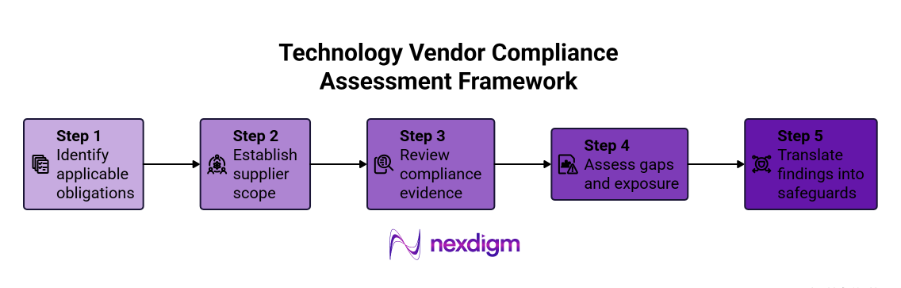
- Identify applicable obligations: Map security, privacy, regulatory and industry-specific requirements relevant to the service.
- Establish supplier scope: Determine which legal entities, services, locations and subcontractors are involved.
- Review compliance evidence: Examine certifications, independent reports, security policies, privacy documentation and audit findings.
- Assess gaps and exposure: Evaluate missing controls, unresolved exceptions, data transfer risks and subcontractor dependencies.
- Translate findings into safeguards: Define remediation requirements, contractual protections and ongoing monitoring arrangements.
Nexdigm’s Case Study: Reviewing Technology Vendor Compliance
Nexdigm assessed 13 technology vendors against 24 compliance and security criteria, reviewed evidence across six control areas and identified five suppliers requiring additional validation before contract approval.
To take the next step, simply visit our Request a Consultation page and share your requirements with us.
Harsh Mittal
+91-8422857704