

Technology procurement decisions frequently involve suppliers offering products and services that appear similar but follow very different commercial structures. One vendor may provide a lower software licence price while charging separately for implementation and support. Another may offer an integrated package with higher upfront costs but fewer additional service requirements. Infrastructure providers may price capacity differently, while managed service suppliers may use fixed monthly fees, consumption-based charges or resource-based billing.
A technology vendor pricing comparison helps organisations understand these differences and evaluate supplier proposals on a consistent commercial basis. It is particularly useful when procurement teams are assessing competing platforms, negotiating enterprise agreements or reviewing existing technology contracts.
Why Headline Prices Can Be Misleading
Technology proposals rarely contain every cost associated with operating a solution. The initial quotation may exclude integration, migration, training, maintenance, additional environments, premium support or future capacity requirements.
Licensing models can also make comparisons difficult. A software platform priced per user cannot be compared directly with one charging per transaction or application without understanding the expected usage. Similarly, infrastructure pricing needs to account for capacity, availability, storage performance and data transfer.
The challenge is not simply to collect supplier quotations. Procurement teams need to establish a common set of assumptions and identify the costs that may arise throughout the contract period.
Four Commercial Areas to Compare
Software licensing and subscriptions
Software suppliers may charge through perpetual licences, annual subscriptions, usage-based pricing or enterprise agreements. Procurement teams should examine the licensing metric, product editions, minimum commitments, renewal provisions and price escalation clauses.
The comparison should also account for additional modules and support services. A lower base subscription may become less competitive when essential functionality requires separate licences.
Infrastructure and consumption costs
Infrastructure proposals may include servers, storage, networking, cloud services or data centre capacity. Relevant pricing variables include capacity, performance, availability, deployment region, power consumption and maintenance requirements.
Consumption-based models require particular attention because costs can change with usage. Organisations should evaluate normal operating conditions as well as periods of peak demand. For cloud and managed infrastructure, charges for data movement, backup, monitoring and support should be included.
Implementation and professional services
Technology deployment often requires architecture design, integration, configuration, migration, testing and training. These services may be priced as fixed-fee projects, time-and-materials engagements or resource-based contracts.
Procurement teams should compare the scope of work rather than simply compare hourly rates. A supplier offering a lower daily rate may require more implementation days or additional specialist resources. Proposals should clearly identify deliverables, assumptions, dependencies and change-request procedures.
Maintenance, support and service commitments
Ongoing support can materially influence the economics of a technology contract. Organisations should review service hours, response times, escalation procedures, upgrade support and the treatment of critical incidents.
Support packages should be compared against operational requirements. Premium support may be justified for business-critical systems, while lower service tiers may be sufficient for non-critical applications. The decision should reflect business impact rather than default to the most expensive option.
Building a Comparable Pricing Model
A robust comparison begins by defining a common scope. All vendors should be asked to price the same functional requirements, expected usage, deployment conditions and service levels. Where suppliers offer different technical approaches, the comparison should document the assumptions and limitations rather than force an artificial equivalence.
Total cost of ownership should be calculated over a consistent period. It may include:
- Initial purchase or subscription charges.
- Implementation, integration and migration expenses.
- Recurring licences, infrastructure and support.
- Usage-based charges and expected capacity growth.
- Upgrade, training, maintenance and exit costs.
Scenario analysis can improve the assessment. Procurement teams may compare expected costs under baseline usage, higher demand and lower demand. This is especially important when contracts include minimum spending commitments or variable consumption charges.
Negotiating Beyond the Unit Price
Supplier negotiations should address the commercial terms that influence long-term flexibility. These may include volume discounts, price protection, renewal caps, payment schedules, minimum commitments, service credits and termination rights.
Bundled proposals require particular scrutiny. A package may appear attractive because it combines software, infrastructure and support, but procurement teams should establish the value of each component and identify whether the organisation is paying for overlapping services.
It is also useful to examine supplier incentives and implementation dependencies. Discounts linked to a particular deployment model or product bundle may create additional costs later if the organisation changes its architecture. Contractual flexibility should therefore form part of the commercial evaluation.
Connecting Pricing with Supplier Value
The lowest-priced proposal is not necessarily the most competitive. A supplier may offer better reliability, stronger technical support or lower implementation risk, resulting in a more favourable overall cost of ownership.
Organisations should evaluate pricing alongside product performance, service quality, vendor stability, integration requirements and roadmap alignment. The result should be a commercial assessment that explains not only which proposal costs less, but why a particular supplier offers stronger value under the organisation’s operating conditions.
How Nexdigm Supports Technology Vendor Pricing Research
Nexdigm supports procurement teams through market intelligence, supplier benchmarking, pricing research and commercial analysis. Its work can help organisations compare technology vendor proposals, understand pricing structures, assess contractual conditions and identify opportunities to improve sourcing outcomes across software, infrastructure and services.
Technology Vendor Pricing Evaluation Framework
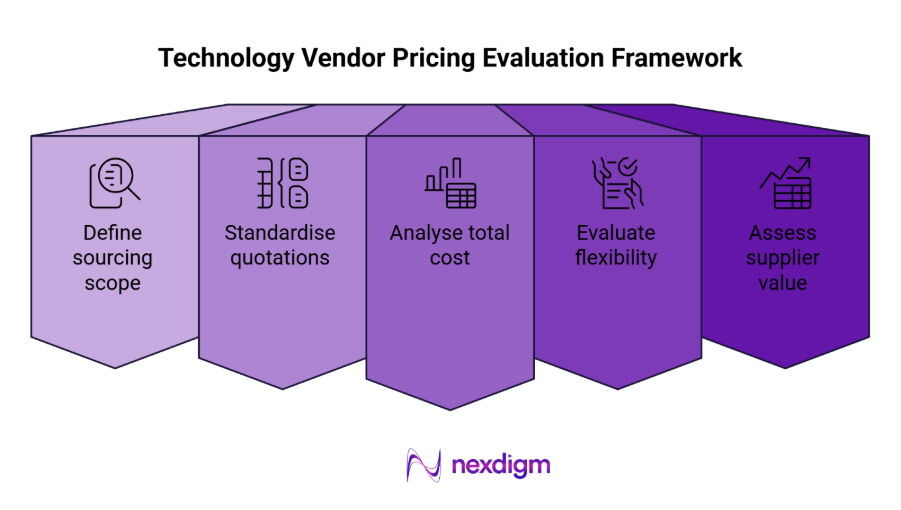
- Define the sourcing scope: Document required products, services, usage levels, technical specifications and service expectations.
- Standardise supplier quotations: Ensure proposals use consistent assumptions, contract periods and pricing units.
- Analyse total cost of ownership: Include licences, infrastructure, implementation, support, maintenance and exit costs.
- Evaluate commercial flexibility: Compare discounts, renewal provisions, minimum commitments, escalation clauses and service credits.
- Assess overall supplier value: Balance pricing against performance, delivery capability, operational risk and long-term flexibility.
Nexdigm’s Case Study: Comparing Technology Vendor Commercial Models
Nexdigm evaluated 13 technology suppliers across four cost categories, normalised 21 commercial proposals and assessed three-year ownership costs. The analysis identified four proposals with stronger cost and contractual alignment for further negotiation.
To take the next step, simply visit our Request a Consultation page and share your requirements with us.
Harsh Mittal
+91-8422857704