

An enterprise may have strong internal security controls, reliable infrastructure and carefully designed continuity plans, yet remain exposed to disruption through an external technology supplier. A cloud provider outage, a compromised software update, a failed implementation partner or the sudden withdrawal of a critical service can affect operations well beyond the vendor relationship itself.
These dependencies are becoming harder to manage as organisations rely on interconnected platforms, outsourced services and specialised technology providers. A technology vendor risk assessment helps businesses identify where supplier weaknesses could affect operational continuity, information security, regulatory obligations and long-term technology resilience.
The Risk Often Sits Outside the Immediate Contract
Traditional supplier reviews tend to focus on financial stability, delivery performance and contractual obligations. These remain relevant, but technology vendors introduce additional forms of exposure.
A software provider may have access to sensitive business information. A managed service provider may administer critical infrastructure. A cloud platform may host applications that cannot be moved quickly to another environment. Even a supplier that does not directly handle confidential data may provide a component essential to a business-critical system.
The first task is therefore to understand the supplier’s actual role in the technology environment. Procurement teams should map which services the vendor supports, what information it can access, which systems depend on it and what would happen if the service became unavailable.
This exercise can reveal dependencies that are not obvious from the contract value. A relatively small supplier may represent a significant operational risk if it provides a specialised integration or maintains a critical application.
A Practical View of Technology Vendor Exposure
Technology vendor risk can be examined through several connected areas.
- Cybersecurity and information security: Assess the supplier’s access controls, encryption practices, vulnerability management, incident response arrangements and approach to securing its own technology environment. Organisations should also understand whether the supplier uses subcontractors with access to systems or data.
- Operational continuity: Examine service availability, disaster recovery arrangements, backup procedures, recovery objectives and the supplier’s ability to maintain services during infrastructure failures. A business should know how critical operations would continue if the vendor experienced a prolonged outage.
- Financial and commercial stability: Evaluate the supplier’s financial condition, ownership structure, revenue concentration and ability to sustain the service. Financial distress, acquisition or strategic withdrawal can affect product support, pricing and service continuity.
- Technology and product dependency: Consider proprietary architectures, limited interoperability, data portability and the availability of alternative suppliers. A vendor may be operationally reliable today but still create long-term dependency if migrating away would require extensive redevelopment.
- Regulatory and third-party exposure: Assess the supplier’s compliance obligations, data processing locations, subcontracting practices and exposure to regulatory changes. The organisation remains accountable for understanding how outsourced services affect its own compliance position.
Which Vendors Should Receive the Most Attention?
Not every supplier requires the same level of scrutiny. Applying identical assessment procedures to every technology contract can consume resources without improving risk visibility.
A more effective approach is to classify suppliers according to criticality. Vendors supporting core business applications, identity systems, payment processing, cloud infrastructure or sensitive information should receive deeper assessment than providers delivering non-essential tools.
The classification should consider the impact of service interruption, the sensitivity of information accessed, the availability of alternatives and the time required to transition to another provider.
For critical suppliers, organisations should seek evidence rather than rely entirely on questionnaires. This may include independent security reports, business continuity test results, audit findings, incident records and details of subcontractor controls. Evidence should be reviewed for relevance, scope and recency. A certification alone does not establish that every service used by the organisation is adequately protected.
From Risk Identification to Business Continuity
Identifying a risk has limited value unless the organisation knows how it will respond. Each critical supplier assessment should connect identified weaknesses with practical mitigation measures.
For example, dependence on a single cloud provider may require stronger backup arrangements, tested data export procedures or an alternative recovery environment. Weak subcontractor visibility may require additional contractual disclosure and audit rights. Concerns about supplier financial stability may justify contingency planning and a review of transition options.
Risk assessments should also be repeated when circumstances change. New product deployments, ownership changes, security incidents, contract renewals and material changes to data processing can alter a supplier’s risk profile.
Procurement, IT, cybersecurity, legal and business continuity teams should share responsibility for this process. Each function sees a different part of the exposure, and a supplier’s risk cannot be understood through commercial evaluation alone.
The Commercial Dimension of Vendor Risk
Risk management should influence contract design. Agreements with critical technology suppliers should address incident notification, service levels, audit rights, data handling, subcontracting, business continuity, termination assistance and data return.
Organisations should also examine how vendors communicate product end-of-life decisions, security updates and material changes to service architecture. These issues can affect the cost and feasibility of maintaining a supplier relationship over time.
A supplier offering a competitive price may still create an expensive relationship if its controls are weak or its exit arrangements are inadequate. The relevant question is whether the commercial value justifies the exposure and whether the organisation has credible ways to manage it.
How Nexdigm Supports Technology Vendor Risk Assessment
Nexdigm supports organisations through supplier intelligence, market research, commercial analysis and vendor risk research. Its work can help clients assess supplier landscapes, identify concentration and dependency risks, examine market alternatives and build a more informed view of technology vendor resilience.
Technology Vendor Risk Assessment Priorities
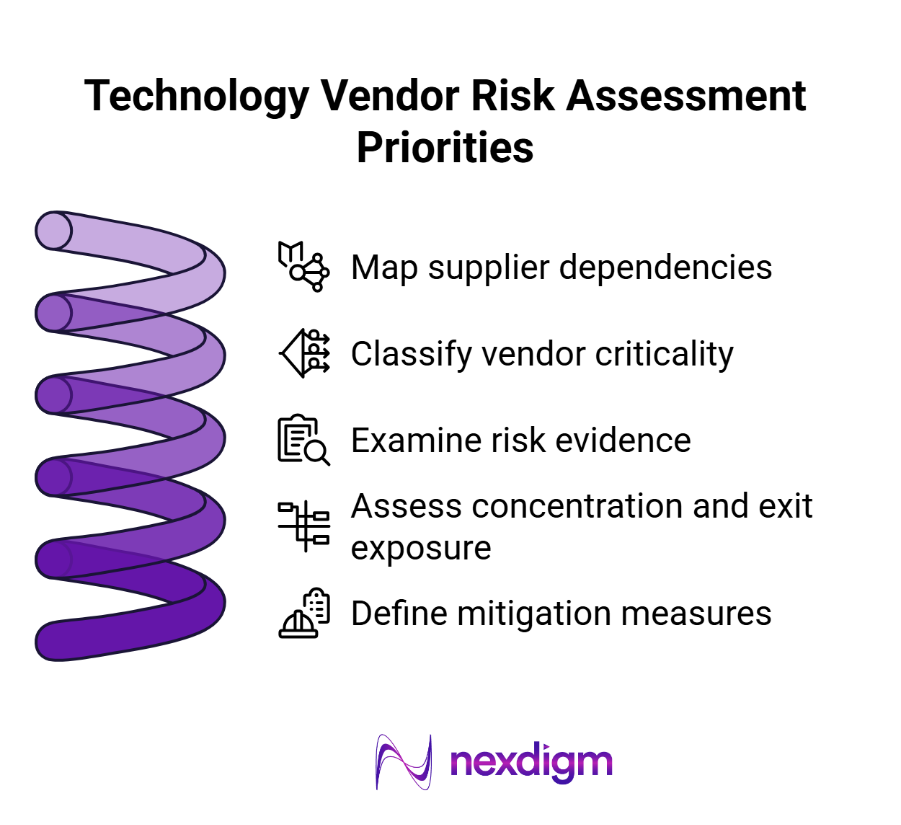
- Map supplier dependencies: Identify critical services, systems, data access, subcontractors and operational relationships.
- Classify vendor criticality: Evaluate the business impact of disruption and the availability of alternative suppliers.
- Examine risk evidence: Review security controls, continuity arrangements, financial indicators and compliance documentation.
- Assess concentration and exit exposure: Identify proprietary dependencies, migration barriers and single-provider reliance.
- Define mitigation measures: Establish contractual safeguards, contingency plans, monitoring requirements and reassessment triggers.
Nexdigm’s Case Study: Assessing Technology Supplier Exposure
Nexdigm assessed 16 technology suppliers across five risk categories, mapped dependencies affecting nine business-critical systems and identified seven priority exposures. The assessment supported targeted due diligence and continuity planning.
To take the next step, simply visit our Request a Consultation page and share your requirements with us.
Harsh Mittal
+91-8422857704