

Telecom customers rarely experience a network as a single product. They experience it through coverage at home, performance in crowded locations, the reliability of video calls, the price of their plan, bundled services, customer support and the quality of digital interactions around the account.
That makes customer demand more complicated than measuring willingness to upgrade to a faster network.
Ericsson ConsumerLab’s research on differentiated connectivity found that four in ten 5G users were no longer willing to accept best-effort performance. Thirty-five percent showed growing interest in enhanced connectivity beyond standard 5G, while GenAI users demonstrated willingness to pay premiums for performance-assured connectivity.
The implication is that network quality remains fundamental, but expectations are becoming more specific.
Speed gets attention. Reliability shapes experience.
Speed remains a visible measure of network quality, but it does not fully explain customer satisfaction.
Ericsson’s earlier 5G ConsumerLab research found that indoor 5G coverage was considered more important than speed or battery life among early adopters. Its studies also found that customers increasingly expect consistent connectivity in locations where digital activity is particularly important.
The newer differentiated-connectivity research reinforces that pattern. High-traffic environments such as stadiums, transport hubs and retail centers can create particularly visible performance problems, with 42% of surveyed 5G users expecting more reliable experiences in such locations.
This changes the customer-demand question.
Instead of asking whether customers want faster networks, operators need to understand where reliability matters, which applications require performance assurance and which customers will pay for differentiated service levels.
Bundles are becoming part of the value equation
Telecom plans increasingly compete through combinations of connectivity and digital services.
Streaming, cloud storage, gaming, cybersecurity, entertainment and other services can increase perceived value without requiring the operator to compete exclusively on network speed or headline data allowances.
Ericsson’s consumer research has previously found that consumers value 5G plans bundled with digital services and can be willing to pay premiums when the service proposition is sufficiently differentiated.
The commercial question is therefore whether a bundle creates incremental willingness to pay or merely adds services customers could obtain elsewhere.
That distinction requires customer-level research.
Customer expectations are becoming more segmented
A useful telecom demand map can separate customers according to the job they need connectivity to perform.
Heavy mobile-data users may prioritize sustained performance and reliability. Remote workers may place greater value on stable video conferencing and indoor coverage. Gamers may value latency. Households may prioritize FWA reliability and bundle economics. High-value enterprise users may require security, dedicated capacity or service-level commitments.
These segments can respond very differently to the same network proposition.
Building a telecom customer demand assessment
A structured telecom customer demand assessment consulting approach can connect those differences through six dimensions.
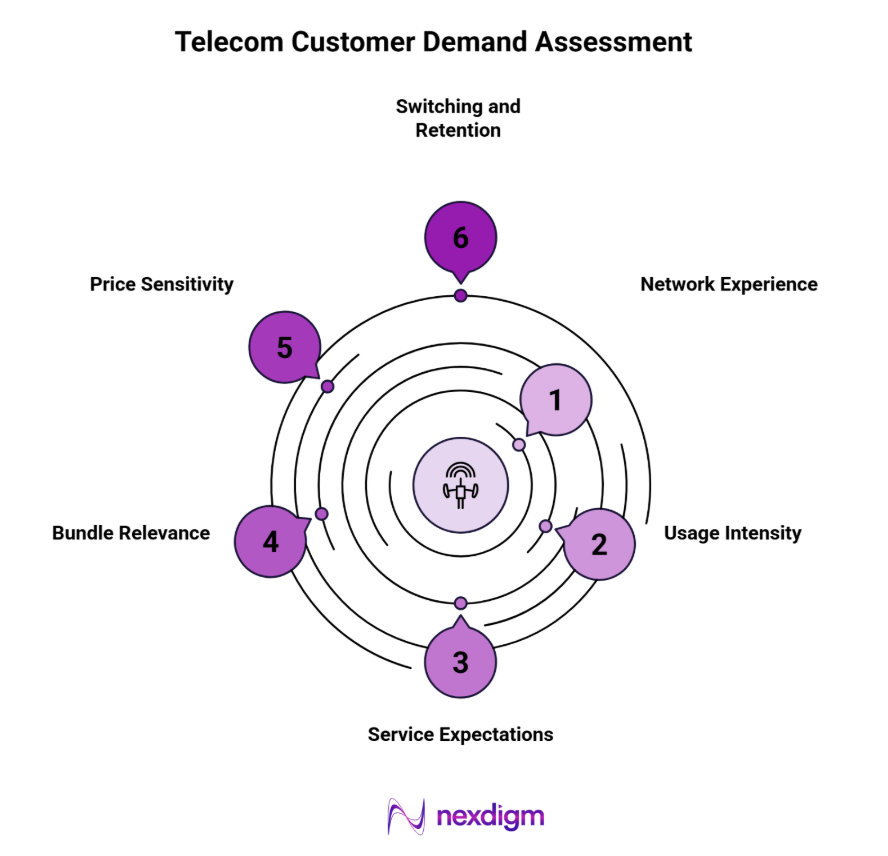
- Network experience
Measure perceived speed, coverage, latency, reliability and performance across locations and applications. - Usage intensity
Map data consumption, video, gaming, cloud applications, enterprise applications and other high-bandwidth activities. - Service expectations
Assess customer expectations around installation, complaint resolution, billing, self-service and technical support. - Bundle relevance
Determine which digital services create genuine incremental value and which are viewed as unnecessary additions. - Price sensitivity
Test willingness to pay across different combinations of speed, reliability, data allowances, content and service features. - Switching and retention
Measure the factors most likely to trigger upgrade, downgrade, churn or migration to another provider.
Ericsson’s 5G maturity research illustrates why this integrated approach matters. Providers identified as 5G Pacesetters scored better with consumers across network quality, innovative services, devices, customer service and tariff plans, rather than relying on a single performance variable.
From satisfaction measurement to proposition design
Customer research becomes more valuable when it can translate expectations into product decisions.
If customers value reliability more than additional headline speed, investment priorities may change. If certain segments are willing to pay for differentiated performance during high-demand events, operators can explore premium connectivity. If bundles increase perceived value without increasing willingness to pay, the proposition may need restructuring.
The research should therefore connect stated preference with actual behaviour.
This can involve customer segmentation, conjoint analysis, willingness-to-pay testing, churn modelling, usage analysis, mystery shopping and competitor benchmarking.
What operators should be able to see
The final output should show where expectations are rising, which customer segments are underserved, what attributes influence willingness to pay and where the existing proposition falls short.
That creates a bridge between network investment and commercial strategy.
Telecom customer demand is increasingly about the quality of the experience created around connectivity. Speed remains visible, but reliability, service, digital convenience and differentiated performance increasingly determine whether customers perceive enough value to upgrade or remain loyal.
Nexdigm Case: Telecom Customer Demand
A mobile operator with 12M subscribers faced 18% annual churn among high-value users. Nexdigm surveyed 2,400 customers across 6 segments, finding reliability and service gaps behind 64% of stated churn intent and identifying 3 premium propositions.
To take the next step, simply visit our Request a Consultation page and share your requirements with us.
Harsh Mittal
+91-8422857704