

Telecom markets have historically been measured through subscribers, connectivity penetration, average revenue per user and network coverage. Those indicators remain important, but they increasingly describe the scale of the network rather than the full revenue opportunity available to operators.
GSMA estimates that mobile technologies and services generated $7.6 trillion in economic value globally in 2025, equivalent to 6.4% of global GDP, with that contribution expected to reach $11.3 trillion by 2030. At the operator level, 45% identify monetization as a strategic priority, with partnerships across hyperscalers, AI providers and technology companies becoming increasingly relevant.
The next telecom opportunity is therefore increasingly connected to what networks enable.
From connectivity to programmable services
5G creates the technical foundation for differentiated services, but infrastructure alone does not establish a new revenue pool.
Ericsson’s 2026 research found that 90% of surveyed telecom executives were confident about capturing new revenue opportunities, while roughly 70% had not yet started implementing technologies they considered critical to that growth. Private 5G and enterprise connectivity ranked as the leading growth area, cited by 49% of respondents, followed by tailored consumer and enterprise digital services at 44%.
That gap between opportunity recognition and commercial implementation is significant.
It suggests that telecom growth assessment needs to examine not only network capability, but also enterprise demand, use-case economics, sales models, partnerships and implementation readiness.
Potential revenue pools include:
- Enterprise connectivity
SD-WAN, managed connectivity, secure access and dedicated enterprise networks can generate higher-value relationships than standardized consumer connectivity. - Private 5G
Industrial environments such as manufacturing, logistics, healthcare and large campuses can justify differentiated connectivity where reliability, latency and security have measurable operational value. - Network slicing
Network slicing enables operators to configure logical networks for different performance requirements. GSMA identifies potential applications across manufacturing, healthcare, smart cities, public safety and immersive digital services. - Network APIs
APIs can expose capabilities such as authentication, location, security and differentiated connectivity to developers and enterprises. Ericsson describes this as a route to new revenue models through subscriptions and API usage. - AI-enabled infrastructure
Operators can participate in emerging AI ecosystems through connectivity, edge infrastructure, data centers and services optimized for AI workloads. GSMA’s 2026 Mobile Economy report identifies AI connectivity and AI compute as emerging revenue models for operators.
The commercial opportunity needs more than a technology map
A telecom growth opportunity assessment services approach should examine where technical capability meets a sufficiently valuable customer problem.
A practical framework can be built around four questions.
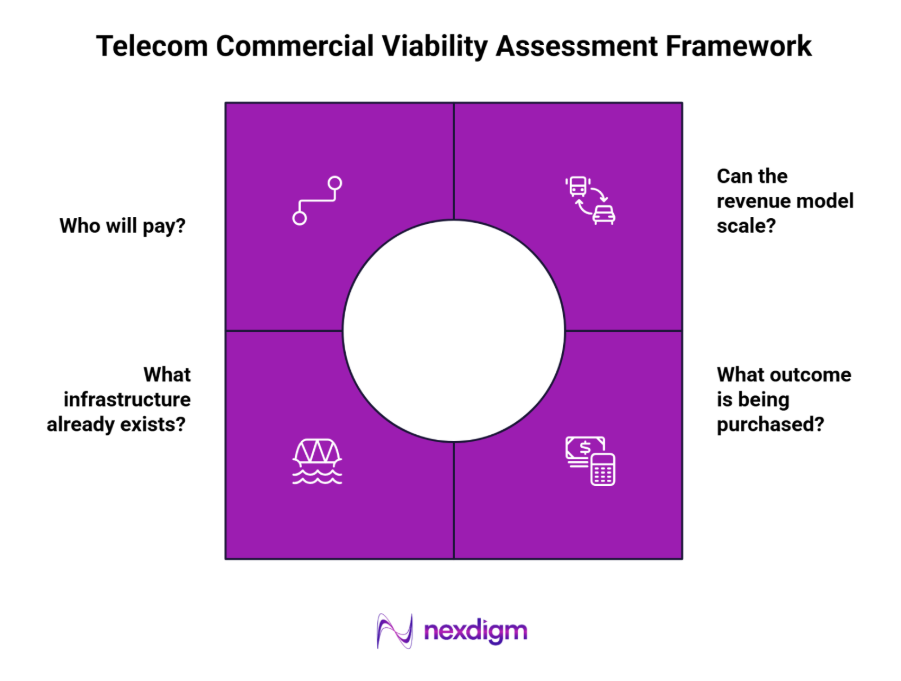
- Who will pay?
Segment consumer, enterprise and public-sector demand separately. Enterprise opportunities often require longer sales cycles but can support higher-value contracts and broader service bundles. - What outcome is being purchased?
A factory may value reduced downtime, a logistics company may value real-time visibility, and an application developer may value reliable authentication. Connectivity becomes commercially interesting when its economic effect can be quantified. - What infrastructure already exists?
Assess network coverage, 5G SA availability, edge capacity, API exposure and partner ecosystem maturity. India, for example, is projected to exceed 1.1 billion 5G subscriptions by 2031, representing 81% penetration. - Can the revenue model scale?
Evaluate subscription, usage-based, API, managed-service and outcome-linked models. A technically viable service can remain commercially limited if every deployment requires extensive customization.
Where growth can become repeatable
Telecom opportunity assessment ultimately needs to distinguish between a demonstration and a scalable revenue pool.
GSMA’s 2026 work on private 5G emphasizes that commercial value depends on moving beyond proof of concept toward real-world deployment, interoperability and measurable business impact.
The strongest opportunities are therefore likely to sit where network capabilities can be packaged into repeatable propositions for clearly defined industries, customer segments or developer ecosystems.
That requires a market view combining network maturity, customer demand, competitive intensity, partner availability and unit economics. Subscriber growth provides the foundation. Commercial analysis determines what can be built on top of it.
Nexdigm Case: Enterprise Telecom Expansion
A telecom operator with 19M subscribers generated 14% of revenue from enterprise services. Nexdigm evaluated 7 industries and 12 connectivity use cases, identifying private 5G and network APIs as priority pools with a projected $420M five-year opportunity.
To take the next step, simply visit our Request a Consultation page and share your requirements with us.
Harsh Mittal
+91-8422857704