

Telecom pricing is becoming harder to design because customers no longer consume connectivity in one uniform way. Heavy data users, voice-led customers, households using fixed wireless access, enterprise accounts and premium 5G users have different requirements and different willingness to pay.
This is becoming particularly relevant in India. TRAI’s tariff database currently contains more than 27,000 tariff records, covering prepaid and postpaid offers, validity periods, data allowances and different service categories. The regulatory environment is also changing. TRAI’s 2026 tariff amendments and recent voice-and-SMS requirements are adding another dimension to how operators structure consumer plans.
At the same time, mobile traffic continues to rise. The TMT research used for this assessment places global 5G subscriptions at approximately 3.3 billion in Q2 2026, with mobile traffic exceeding 220 exabytes per month, up 23% year over year.
The commercial challenge is therefore not simply setting a higher or lower tariff. It is determining which combination of price, allowance, validity and service features produces sustainable value across customer segments.
Why Tariff Structures Are Becoming More Segmented
Traditional mobile plans bundled voice, SMS and data into relatively standard packages. That structure made pricing easier to communicate, but it also meant that customers could pay for services they barely used.
The recent regulatory shift toward voice-and-SMS-only options makes this segmentation more explicit. TRAI has directed major operators to offer voice-and-SMS-only vouchers corresponding to existing validity periods, including shorter-duration options.
This creates several distinct customer economics.
A basic voice user may value affordability and validity more than data volume. A heavy-data user may be more responsive to monthly data thresholds, 5G access and bundled entertainment. A household using FWA may evaluate the service against fixed broadband alternatives rather than mobile plans.
Enterprise customers present another pricing structure entirely, where reliability, latency, service-level agreements and security can matter more than raw data allowances.
The Real Pricing Benchmark Is the Customer’s Alternative
Telecom tariff benchmarking becomes less useful when it simply compares headline prices.
A ₹399 plan from one operator may appear cheaper than a ₹449 plan from another, but the comparison changes when validity, daily data, OTT benefits, 5G access, voice allowances and network experience are considered together.
The same applies at the enterprise level. A private 5G service should not necessarily be benchmarked against a consumer mobile tariff. Its relevant alternatives may include fibre, Wi-Fi, private LTE, leased connectivity or industrial network infrastructure.
The objective of tariff research should therefore be to establish the customer’s reference price and the economic value of the service package rather than simply identify the lowest market price.
Telecom Tariff Feasibility Framework
A robust telecom tariff market feasibility consulting approach can be structured around five connected assessments.
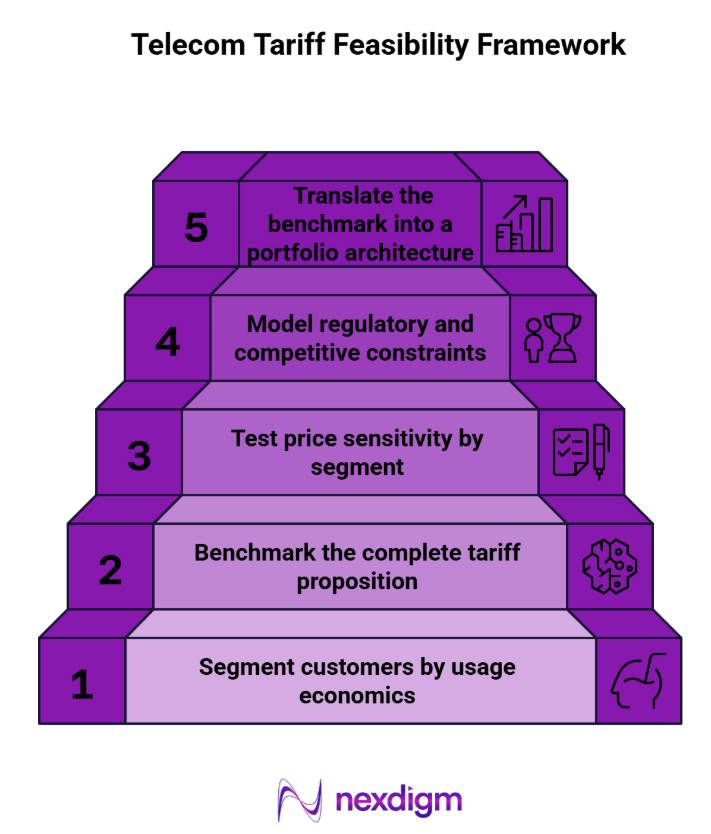
- Segment customers by usage economics.
Start by separating customers according to data consumption, voice dependence, device type, location, income, household requirements and business use. The objective is to identify segments with materially different willingness to pay.
This is especially important when data usage is becoming increasingly concentrated among heavy users. A single tariff architecture can leave revenue on the table among premium users while overcharging low-usage customers. - Benchmark the complete tariff proposition.
Compare price, validity, data allocation, voice and SMS, 5G access, OTT benefits, device bundling and other inclusions. The benchmark should also account for effective monthly cost rather than headline recharge price.
TRAI’s tariff database provides a large base for this exercise, with thousands of filed plans that can be filtered by service type, price, validity and data characteristics. - Test price sensitivity by segment.
Price elasticity is rarely uniform across a customer base. Some customers may reduce usage or downgrade when prices rise, while others may remain because switching costs or network preferences are high.
Conjoint research, willingness-to-pay studies and simulated plan selection can establish which combinations of price and benefits customers actually prefer. - Model regulatory and competitive constraints.
Tariff feasibility must account for regulatory requirements as well as competitor response. The 2026 voice-and-SMS requirements demonstrate how regulation can alter the structure of the available tariff portfolio.
The assessment should therefore test how new plans affect existing customer migration, ARPU, churn and cannibalisation across the portfolio. - Translate the benchmark into a portfolio architecture.
The final step is determining how many plans the operator actually needs. A portfolio with too many overlapping offers creates customer confusion and internal cannibalisation. Too few plans leave distinct willingness-to-pay segments insufficiently addressed.
The optimal structure should define entry, mainstream, premium and specialised propositions with clear differences in value and economics.
Where 5G Changes the Pricing Equation
5G creates additional room for differentiated pricing because connectivity can increasingly be sold around performance rather than volume.
The TMT research identifies 71% of global FWA providers as deploying 5G and reports 84 commercial 5G standalone network-slicing offerings, up from 65 earlier in 2026.
For operators, this creates opportunities to develop pricing around guaranteed latency, enterprise SLAs, private networks, FWA and specialised applications.
India’s 5G subscription base reached approximately 430 million at the end of 2025, according to the report, with the number projected to reach 1.1 billion by 2031.
Tariff strategy therefore needs to anticipate a market where connectivity is increasingly segmented according to use case and performance requirements.
Nexdigm Case: Rebuilding a Multi-Segment Telecom Tariff Portfolio
An operator benchmarked 36 competing plans across 5 customer segments, combining 4,200 consumer interviews with 18 months of recharge data. Nexdigm identified 3 underpriced segments, supporting a revised portfolio that increased projected ARPU by 11% while reducing plan overlap by 23%.
Nexdigm’s telecom tariff market feasibility consulting helps operators assess pricing, customer segmentation, competitive tariffs, willingness to pay, regulatory changes and portfolio economics.
To take the next step, simply visit our Request a Consultation page and share your requirements with us.
Harsh Mittal
+91-8422857704