

Telemedicine has moved from a pandemic-era access tool toward a more established component of healthcare delivery. In 2024, 80.0% of U.S. office-based physicians reported using telemedicine, compared with 86.5% in 2021. The American Medical Association similarly found that 71.4% of physicians reported using telehealth in 2024, substantially above the 25.1% reported in 2018.
The commercial opportunity is also expanding. The global telehealth market was estimated at $77.4 billion in 2025 and is projected to reach $187.5 billion by 2033, representing an 11.5% CAGR. Within healthcare software as a service, the global telemedicine segment was valued at approximately $5.25 billion in 2025 and is projected to reach $25.6 billion by 2033.
As adoption matures, platform selection is becoming less about simply enabling virtual consultations and more about how effectively a platform supports users, integrates with healthcare systems, meets compliance expectations, and creates sustainable commercial value. This makes telemedicine platform vendor analysis increasingly important for healthcare organizations evaluating digital-care investments.
Telemedicine Platforms Are Moving Beyond Virtual Visits
Telemedicine platforms increasingly connect with other healthcare technologies, making their value dependent on how well they fit into the broader care environment. Three areas are particularly important:
- EHR & System Integration: Assess how effectively platforms connect with EHRs, scheduling, patient records, and other systems to maintain continuity across care workflows.
- Connected Patient Experience: Evaluate how scheduling, communication, remote monitoring, payments, and patient engagement capabilities work together throughout the virtual-care journey.
- Operational Scalability: Examine whether platforms can support growing users, providers, specialties, locations, and virtual-care volumes without creating unnecessary workflow complexity.
Ultimately, platform value depends on how effectively individual capabilities work together to support a connected, scalable, and sustainable virtual-care model.
Telemedicine Platforms Must Balance Experience and Economics
As virtual care becomes a recurring part of healthcare delivery, organizations must balance patient and provider experience with operational and financial considerations. Platform selection increasingly depends on ease of use, reliability, integration, compliance, support, scalability, and total cost. A platform that performs well technically but requires extensive customization or creates workflow friction may offer less value than a solution with broader operational and commercial fit.
What Shapes Telemedicine Platform Fitness
Telemedicine vendor selection requires organizations to balance several considerations rather than prioritize a single platform feature. Functionality, user experience, integration, compliance, scalability, and commercial fit can influence how effectively a platform supports virtual-care objectives.
A structured evaluation can help organizations compare these dimensions consistently and understand which capabilities are most relevant to their operating model. Nexdigm can bring this broader perspective into the vendor evaluation process.
Nexdigm in Offering Industry-Led Telemedicine Expertise
Nexdigm can bring healthcare-specific context into telemedicine vendor evaluation, helping organizations assess platforms against the practical requirements of virtual-care delivery:
- Clinical Workflow Expertise: Evaluate how platforms support virtual consultations, clinical documentation, care coordination, specialty workflows, and provider requirements across different care settings.
- Patient & Provider Experience: Nexdigm can assess usability, accessibility, scheduling, communication, onboarding, and engagement to understand how effectively platforms support both sides of the virtual-care journey.
- Healthcare Technology Understanding: Examine EHR connectivity, interoperability, APIs, data exchange, remote monitoring, and integration requirements within broader healthcare technology environments.
- Operational & Commercial Perspective: Nexdigm can evaluate implementation complexity, scalability, support models, pricing structures, and lifecycle considerations to assess the broader business implications of platform selection.
This industry-led perspective helps organizations evaluate telemedicine vendors through the lens of healthcare delivery, technology integration, and commercial practicality, rather than relying solely on generic software comparisons.
Nexdigm’s Telemedicine Vendor Assessment Framework
Nexdigm can structure vendor assessment around the factors that determine whether a telemedicine platform is both technically capable and commercially viable:
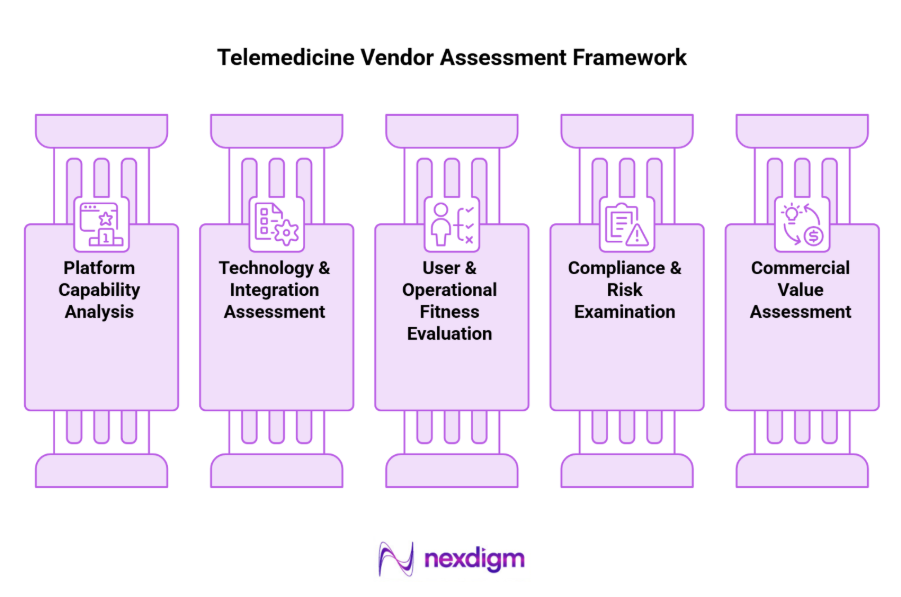
- Platform Capability: Compare virtual consultation, scheduling, communication, documentation, patient engagement, analytics, and related functionality.
- Technology & Integration: Assess EHR connectivity, APIs, interoperability, data exchange, remote monitoring, and compatibility with existing healthcare systems.
- User & Operational Fit: Evaluate patient and provider experience, workflow alignment, implementation complexity, scalability, training, and support requirements.
- Compliance & Risk: Examine privacy, security, data governance, consent, authentication, and other requirements relevant to virtual-care environments.
- Commercial Value: Compare pricing models, implementation costs, recurring fees, support structures, customization, and lifecycle economics.
This framework helps translate telemedicine platform vendor analysis into a structured comparison of capability, fit, risk, and commercial value.
Nexdigm’s Case
Nexdigm supported a healthcare organization in evaluating 30 telemedicine platforms across functionality, user experience, integration, compliance, scalability, and commercial fit. The assessment identified 27% with stronger platform capabilities, 24% with broader integration potential, and 16% with more favorable commercial structures, helping the organization refine its shortlist and prioritize vendors for detailed evaluation.
To take the next step, simply visit our Request a Consultation page and share your requirements with us.
Harsh Mittal
+91-8422857704