

India’s temperature-controlled logistics sector is expanding as demand for pharmaceutical distribution, frozen foods, dairy, and perishable products increases. According to the Ministry of Food Processing Industries’ 2025–26 Annual Report, 301 integrated cold chain projects had been completed by December 2025, creating approximately 9.06 lakh metric tonnes of storage capacity and 1,525 reefer vehicles.
The National Centre for Cold-chain Development has also highlighted the growing need for refrigerated transportation and stronger infrastructure connectivity. As supply chains become more dependent on temperature-sensitive distribution, businesses must evaluate logistics providers beyond transportation costs.
Temperature controlled transport vendor benchmarking helps organisations compare service reliability, temperature management, delivery performance, and operational capabilities to identify suitable logistics partners.
Reliability as a Core Measure of Cold Chain Performance
Temperature-controlled transportation requires consistent operating conditions throughout the delivery journey. Equipment failures, route delays, inadequate monitoring, and poor handling can expose products to temperature deviations and quality risks. Businesses therefore need providers that combine suitable refrigerated vehicles, trained personnel, reliable tracking systems, and contingency arrangements to maintain product integrity across transportation networks.
What are the Performance Indicators That Influence Provider Selection
Before comparing logistics providers, businesses should examine three important performance dimensions:
- Temperature Consistency: Assess temperature monitoring, refrigeration performance, excursion reporting, and the ability to maintain required conditions throughout transit.
- Delivery Reliability: Examine on-time delivery rates, transit duration, route planning, vehicle availability, and responsiveness to unexpected disruptions.
- Operational and Compliance Standards: Evaluate vehicle maintenance, handling procedures, documentation, quality controls, and adherence to applicable regulatory requirements.
Together, these indicators provide a foundation for assessing supplier reliability and transportation performance.
Additional Considerations in Provider Evaluation
Beyond core performance indicators, businesses should assess how logistics providers respond to changing operational requirements. Organizations such as Nexdigm can support this evaluation by examining capacity scalability, disruption management, network flexibility, and service responsiveness. These factors help procurement teams distinguish providers that perform consistently under normal conditions from those capable of maintaining service levels during demand fluctuations or unexpected transportation disruptions.
How Nexdigm’s Expertise Strengthens Provider Evaluation
Nexdigm combines industry research, supplier intelligence, and procurement-focused analysis to help businesses evaluate temperature-controlled logistics providers beyond their stated service capabilities. Our temperature controlled transport vendor benchmarking can reveal differences in fleet readiness, temperature-monitoring infrastructure, geographic coverage, compliance practices, and commercial competitiveness. These insights help organisations identify suitable providers, assess supplier gaps, and make informed sourcing and partnership decisions.
Insights from Nexdigm’s Temperature Controlled Transport Vendor Benchmarking
Nexdigm’s benchmarking research can provide businesses with a comparative view of the temperature-controlled logistics provider landscape. Key insights can help organizations understand:
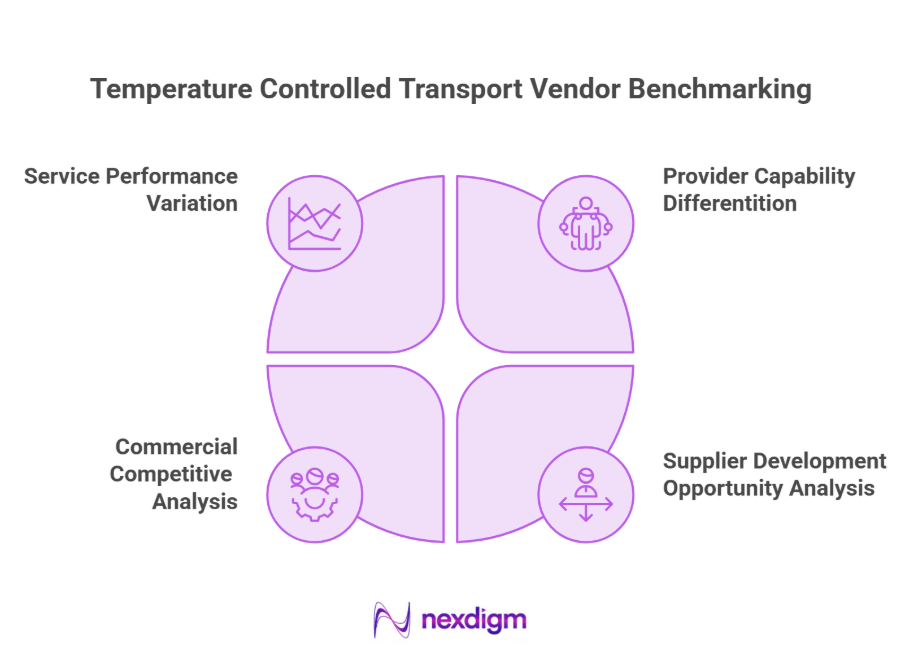
- Provider Capability Differences: How logistics providers compare in refrigerated fleet availability, temperature-monitoring systems, infrastructure, and geographic coverage.
- Service Performance Variations: Differences in delivery reliability, temperature consistency, operational responsiveness, and service commitments.
- Commercial Competitiveness: Variations in transportation pricing, contract terms, additional charges, and overall service value.
- Supplier Development Opportunities: Areas where providers can strengthen infrastructure, improve operational processes, and enhance service delivery.
These insights enable businesses to assess the supplier landscape more objectively and align logistics partner decisions with their operational and commercial priorities.
How Nexdigm’s Benchmarking Insights Strengthen Cold Chain Partnerships
Experts of Nexdigm can help businesses translate benchmarking findings into practical actions across key areas. This structured benchmarking helps businesses in the following ways:
- Informed Supplier Selection: Identifying logistics providers whose fleet capabilities, infrastructure, service quality, and geographic coverage align with business requirements.
- Performance Monitoring: Establishing relevant performance indicators to track temperature consistency, delivery reliability, vehicle maintenance, and service-level commitments.
- Supplier Improvement: Identifying operational gaps and areas where logistics partners can strengthen temperature monitoring, handling practices, and transportation efficiency.
- Long-Term Partnership Development: Evaluating supplier capabilities and scalability to build reliable logistics relationships that can support changing distribution requirements.
Through these applications, Nexdigm can help organisations improve supplier accountability, strengthen service consistency, and develop resilient temperature-controlled transportation networks.
Nexdigm’s Insights Building Long-term Cold Chain Value
Nexdigm’s benchmarking insights can help businesses build sustainable value by improving supplier accountability, strengthening operational efficiency, and identifying long-term improvement opportunities. By connecting market intelligence with procurement priorities, Nexdigm can support better logistics partnerships, informed decision-making, and resilient temperature-controlled transportation networks that remain aligned with evolving business and service requirements.
Nexdigm’s Case
A food processing company planning to expand its refrigerated distribution network wanted to identify logistics partners capable of supporting higher shipment volumes and wider regional coverage. Nexdigm’s supplier benchmarking identified 19% potential savings in transportation costs, 24% scope for improving fleet utilization, and 11% potential improvement in regional delivery coverage. These improvements led to efficient planning and distribution.
To take the next step, simply visit our Request a Consultation page and share your requirements with us.
Harsh Mittal
+91-8422857704