
Third-party logistics (3PL) providers help businesses manage transportation, warehousing, distribution, inventory handling and fulfilment without having to operate every logistics function internally. As supply chains expand across markets, organisations increasingly depend on external logistics partners to manage operational complexity and improve distribution efficiency.
However, selecting a 3PL provider involves more than identifying the largest operator or the lowest-cost supplier. Businesses must evaluate network scale, service quality, technology capabilities, operational flexibility and total logistics costs.
Why 3PL Provider Selection Matters
3PL providers differ in their operating models, geographical coverage and service specialisations.
Some focus on transportation management, while others offer integrated warehousing, fulfilment, freight forwarding and supply chain management. Their suitability depends on the complexity and scale of the organisation’s logistics requirements.
A provider with an extensive international network may be suitable for a multinational manufacturer, while a regional provider may offer better flexibility and cost efficiency for a business with concentrated distribution requirements.
Procurement teams should evaluate providers across four principal dimensions:
- Operational scale: Warehouse capacity, transportation network, geographical reach and shipment handling volumes.
- Service quality: Delivery accuracy, order fulfilment, inventory management and complaint resolution.
- Technology capabilities: Warehouse management systems, transportation management systems, shipment tracking and reporting.
- Cost efficiency: Storage charges, transportation costs, fulfilment fees, handling expenses and additional service charges.
Comparing 3PL Operating Models
Understanding the provider’s operating model is essential before comparing commercial proposals.
- Transportation-focused 3PLs: These providers manage freight movement, carrier coordination, distribution and transportation planning.
- Warehousing and distribution providers: Their services include inventory storage, order processing, picking, packing and dispatch.
- Integrated 3PL providers: These operators combine transportation, warehousing, fulfilment and supply chain management under a single service arrangement.
- Specialised 3PL providers: These providers serve specific industries or cargo categories, including pharmaceuticals, automotive components, cold-chain products and e-commerce.
The right operating model depends on whether an organisation needs an individual logistics function outsourced or an integrated service arrangement.
Evaluating Scale, Service Quality and Cost
Provider scale should be examined in relation to the organisation’s geographical footprint and operational requirements.
A large logistics network does not automatically guarantee strong service performance across every location. Procurement teams should examine actual warehouse availability, regional coverage, transport capacity and local operating capabilities.
Service quality should be measured through standard performance indicators, including:
- On-time delivery: Percentage of orders delivered within agreed timelines.
- Order accuracy: Percentage of orders fulfilled without picking, packing or documentation errors.
- Inventory accuracy: Difference between recorded inventory and physical stock.
- Fulfilment turnaround: Time taken between receiving an order and dispatching it.
- Damage and loss rates: Frequency of damaged, missing or incorrectly handled shipments.
- Issue resolution: Time required to resolve delivery exceptions and customer complaints.
Technology integration is another important consideration. Providers should demonstrate their ability to exchange data with enterprise resource planning systems, inventory platforms and order management applications.
Commercial benchmarking should evaluate the total cost of the outsourced service. This includes warehouse storage, labour, transportation, handling, technology charges, minimum volume commitments and contract exit costs.
The World Bank’s Logistics Performance Index also identifies logistics service quality, shipment tracking, customs efficiency and delivery timeliness as important dimensions of logistics performance.
Third Party Logistics Provider Benchmarking Framework
A structured third party logistics provider benchmarking exercise can help businesses compare providers across operational, technological and commercial requirements.
The assessment should follow six stages:
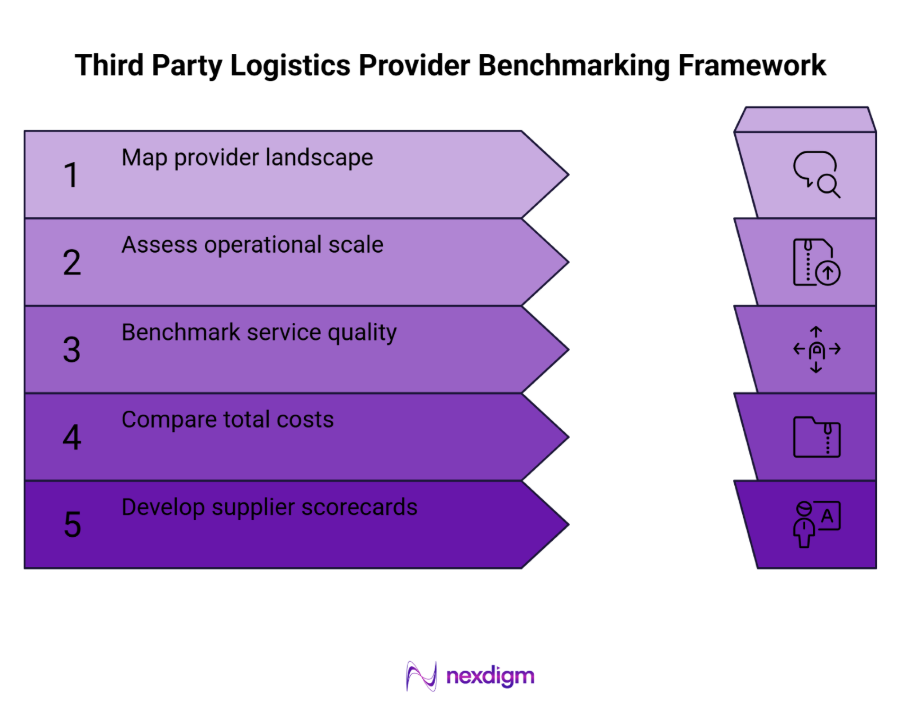
- Define logistics requirements: Identify warehouse locations, shipment volumes, distribution channels and service expectations.
- Map the provider landscape: Identify regional, national and international 3PL operators.
- Assess operational scale: Compare warehouse capacity, transportation networks and geographical coverage.
- Benchmark service quality: Evaluate delivery accuracy, inventory management, fulfilment performance and issue resolution.
- Compare total costs: Review storage, handling, transportation, technology and contractual charges.
- Develop supplier scorecards: Rank providers based on operational fit, service quality, scalability and commercial competitiveness.
Nexdigm can support organisations through 3PL market research, supplier benchmarking, logistics provider comparisons and procurement intelligence.
These assessments help businesses identify suitable outsourcing partners, understand cost structures and evaluate opportunities to improve supply chain performance.
Nexdigm’s Case Study
Nexdigm benchmarked 11 3PL providers across 4 distribution regions, evaluating warehouse capacity, fulfilment accuracy, transportation coverage and commercial terms. The assessment shortlisted 4 providers, identified a 16% cost variation across comparable service packages and helped the client establish standardised service-level benchmarks.
To take the next step, simply visit our Request a Consultation page and share your requirements with us.
Harsh Mittal
+91-8422857704