

The tire market is entering 2026 with relatively modest volume growth but significant differences across regions and channels. Michelin’s latest market data shows global passenger-car and light-truck replacement tire demand grew 1% in 2025, while original-equipment demand increased 2%. Its September 2026 update indicates replacement demand is still growing slightly on a year-to-date basis, although regional trends remain uneven.
The U.S. market illustrates the scale involved. USTMA’s July 2026 forecast projects 330.3 million tire shipments in 2026, down 1.8% from 2025, with replacement passenger tires alone accounting for approximately 218.3 million units. Truck replacement shipments are forecast to decline 7.1%, while OE truck shipments are expected to rise 6.2%.
Against this backdrop, tire supplier identification and benchmarking can help automakers, distributors, and aftermarket businesses distinguish suppliers based on manufacturing capability, quality consistency, delivery reliability, geographic reach, and commercial fit, not simply quoted price.
A Tire Supplier’s Strength Shows Up Across Multiple Dimensions
A supplier may offer competitive pricing but lack capacity flexibility. Another may have strong manufacturing capabilities but limited regional coverage. A third may provide excellent quality but carry higher logistics costs. Benchmarking brings these differences into one view, helping procurement teams understand where each supplier performs well, where gaps exist, and which supplier best fits a specific sourcing requirement.
Market Conditions Can Change the Right Supplier Choice
Supplier suitability can change as tire demand, raw-material costs, regional production economics, and customer requirements shift. A supplier that is commercially attractive today may not offer the same advantage under different market conditions. Procurement teams therefore need to consider not only current supplier performance, but also market outlook, capacity changes, input-cost movements, regional demand, and future sourcing requirements when evaluating potential suppliers.
Nexdigm’s Market-Led View of Tire Supplier Selection
Supplier performance cannot be viewed in isolation from the market in which the supplier operates. Nexdigm can combine supplier intelligence with market perspectives to help procurement teams understand how changing conditions may influence sourcing choices:
- Track Market Dynamics: Assess regional demand, production trends, capacity additions, raw-material movements, and competitive shifts affecting tire suppliers.
- Interpret Supplier Positioning: Understand how individual suppliers compare within their regional and product markets, including strengths, constraints, and growth direction.
- Anticipate Sourcing Changes: Identify how changes in capacity, costs, demand, or geographic conditions could affect future supplier attractiveness.
- Support Forward-Looking Decisions: Use market and supplier insights to inform sourcing allocation, supplier development, diversification, and future qualification decisions.
This strengthens tire supplier identification and benchmarking by combining current supplier performance with a forward-looking view of market and sourcing conditions.
Nexdigm’s Automotive Tire Supplier Benchmarking Analysis
Identifying the right suppliers requires a structured comparison of the market, capabilities, and commercial landscape. Nexdigm can support this process by assessing suppliers across:
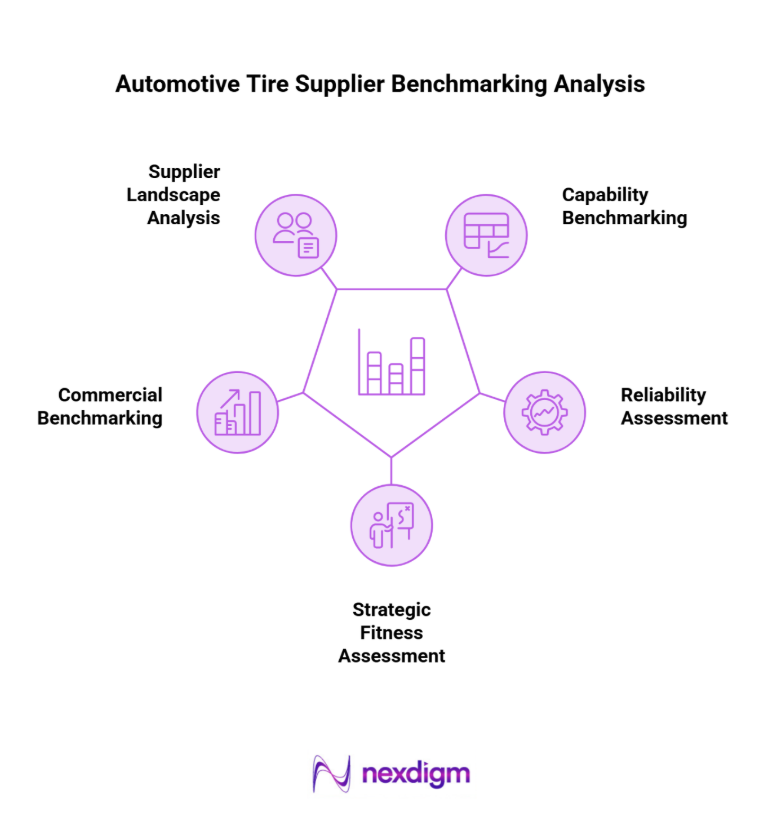
- Supplier Landscape: Identify relevant tire manufacturers and suppliers across target regions, product categories, and application segments.
- Capability Benchmarking: Compare manufacturing scale, technology, product range, quality systems, capacity, certifications, and operational capabilities.
- Commercial Benchmarking: Evaluate pricing, cost structures, logistics, payment terms, and total landed-cost considerations across comparable suppliers.
- Reliability Assessment: Examine delivery performance, supply continuity, production flexibility, geographic footprint, and capacity availability.
- Strategic Fit: Assess how each supplier aligns with sourcing requirements, regional needs, future volumes, and broader procurement objectives.
This structured tire supplier identification and benchmarking approach gives procurement teams a clearer basis for distinguishing capable suppliers from commercially attractive yet operationally constrained options.
How Nexdigm’s Supplier Benchmarks Create Procurement Advantage
A supplier benchmark becomes valuable when it changes how procurement teams allocate volumes, manage relationships, and plan future sourcing. Nexdigm can help translate benchmark findings into practical procurement actions:
- Strengthen Negotiating Position: Use supplier and market comparisons to establish stronger reference points for pricing, terms, and commercial discussions.
- Improve Allocation Decisions: Match sourcing volumes with suppliers based on capability, reliability, capacity, geographic coverage, and commercial performance.
- Focus Supplier Development: Identify specific capability or performance gaps where targeted supplier improvement could strengthen the sourcing base.
- Build Sourcing Flexibility: Use benchmark insights to identify qualified alternatives and reduce dependence on suppliers with concentrated capabilities or footprints.
This enables tire supplier identification and benchmarking to support not only supplier selection, but also better allocation, negotiation, development, and long-term sourcing strategy.
Nexdigm’s Case
An automotive manufacturer benchmarked 48 tire suppliers across six markets. Nexdigm identified 25% as strong-fit suppliers, while 19% required further capability validation. The assessment helped procurement refine its shortlist and identify opportunities for cost improvement, sourcing diversification, and stronger supply continuity.
To take the next step, simply visit our Request a Consultation page and share your requirements with us.
Harsh Mittal
+91-8422857704