

India’s tractor market is entering a more differentiated phase. Growth is no longer explained simply by adding more farmers to the ownership base. With domestic tractor retail reaching 996,633 units in 2025, up from 893,706 in 2024, the next opportunity is increasingly tied to replacement, farm consolidation, multi-crop usage, and access models.
The First-Time Buyer Is Only One Growth Pool
New ownership still matters in regions where mechanization is expanding, and farm incomes are improving. But the commercial question changes once tractor penetration rises. An OEM then has to identify households moving from animal or hired power to ownership, as well as existing owners whose machines are becoming economically inefficient.
That creates two different demand pools. First-time buyers are influenced heavily by affordability, horsepower requirements and access to finance. Replacement buyers are more sensitive to fuel efficiency, uptime, resale value, comfort and compatibility with newer implements.
Horsepower Is Becoming a Market Segmentation Question
The traditional tractor market can obscure substantial differences between applications.
A small farmer cultivating fragmented holdings may need a compact tractor for interculture, spraying and transport. A commercial farmer operating larger irrigated acreage may prioritise a higher-horsepower machine capable of handling rotavators, seed drills, trailers and harvesting support equipment.
Crop mix also changes the equation. Paddy, wheat and sugarcane require different combinations of pulling power, field speed and implement compatibility. Horticulture introduces another demand pocket, particularly for compact tractors that can operate between rows.
For an OEM, therefore, the relevant market is not simply “tractors sold in a district.” It is the number of farms whose crop economics can support a particular power class.
Replacement Demand Has Its Own Geography
The replacement cycle is particularly important in mature tractor markets. Older machines can remain operational for years, but rising maintenance costs, lower fuel efficiency and limited compatibility with newer implements eventually change the ownership calculation.
This makes installed-base mapping commercially valuable. A district with modest annual tractor sales may still represent a sizeable near-term opportunity if it has a large population of tractors aged 8–12 years. Conversely, a rapidly growing market dominated by recent purchases may offer greater long-term potential but lower immediate replacement demand.
Finance Can Shift the Addressable Market
Tractor affordability depends on more than sticker price. Financing availability, interest rates, down-payment requirements, seasonal cash flows and expected resale value influence whether farmers purchase, postpone or shift to used equipment.
The same tractor can therefore have very different addressable demand across two districts with similar cultivated acreage. A commercial assessment needs to model the monthly or seasonal repayment burden against crop income, rather than relying only on farm size.
Nexdigm’s Framework: Where the Next Tractor Opportunity Sits
Nexdigm’s tractor market opportunity analysis can convert these differences into a district-level demand map.
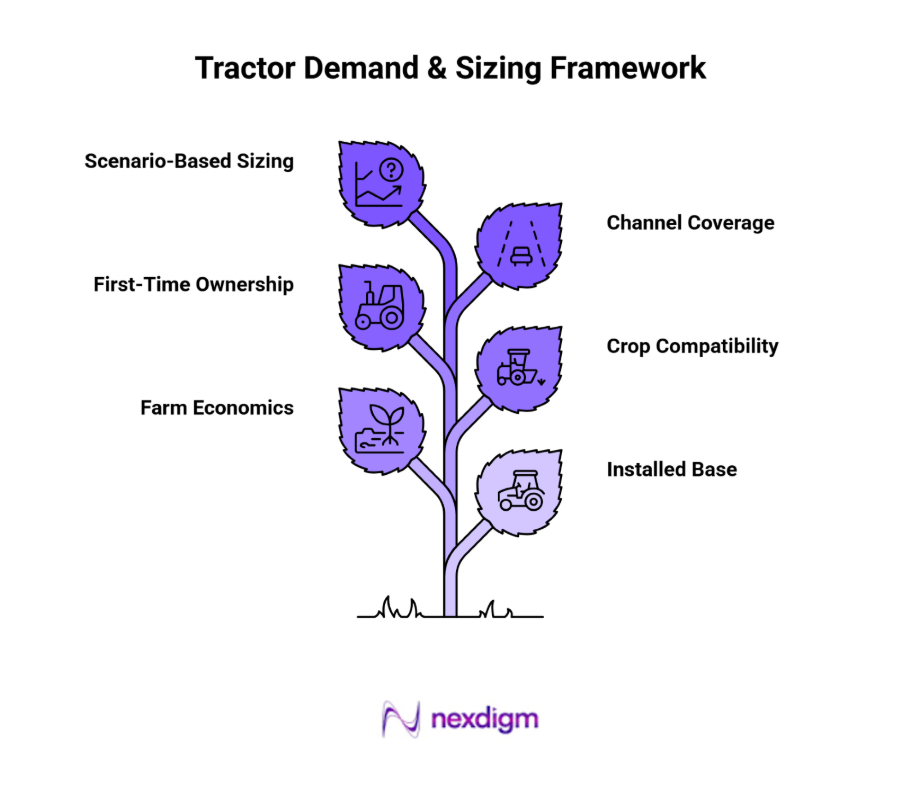
- Installed base and replacement mapping
Estimate tractor population by age, horsepower, brand and usage intensity to identify districts where replacement demand is likely to emerge. - Farm economics and affordability
Model cultivated acreage, crop margins, financing capacity and repayment economics to determine which farmer segments can support new ownership. - Crop and implement compatibility
Map crop cycles and dominant farm operations against horsepower requirements, implement penetration and annual tractor utilisation. - First-time ownership potential
Identify areas where mechanization gaps, custom-hiring costs and rising labour constraints create a financial case for moving from hired equipment to ownership. - Channel and financing coverage
Assess dealer density, service reach, financing penetration and used-tractor markets to determine whether demand can be converted into sales. - Scenario-based demand sizing
Test replacement timing, farm-income changes, financing conditions and mechanization rates to produce addressable demand under different market conditions.
The result is a commercial map showing where an OEM should prioritise dealerships, financing partnerships, product variants and replacement campaigns.
Nexdigm Converting the Installed Base into a Replacement Pipeline
A tractor manufacturer evaluated 11 districts with an installed base of approximately 84,000 tractors. The analysis identified 18,600 machines older than eight years, with annual maintenance costs 28% above newer models. A targeted replacement programme across 6,400 high-propensity farms generated a projected 1,920-unit annual sales opportunity, equivalent to approximately ₹165 crore in incremental revenue.
To take the next step, simply visit our Request a Consultation page and share your requirements with us.
Harsh Mittal
+91-8422857704