

Tractor selection increasingly depends on how well equipment matches farm size, crop requirements, terrain, and operating intensity. India’s tractor market recorded 79,285 retail registrations in October 2026, representing 3.1% year-on-year growth, according to the Federation of Automobile Dealers Associations (FADA). Mahindra accounted for 23.03% of registrations, followed by Swaraj at 17.92% and International Tractors at 13.07%.
These figures reflect a competitive supplier landscape, but market share alone cannot determine the right choice for every farm. Through tractor supplier benchmarking, Nexdigm helps agricultural businesses compare manufacturers, assess product suitability, and understand supplier capabilities against specific operating and commercial requirements.
Why Tractor Requirements Differ Across Farming Operations
A tractor suitable for a large mechanized farm may not be practical for small holdings or specialized crop operations. Horsepower, transmission, fuel efficiency, implement compatibility, turning radius, and ground clearance influence performance across different applications. Soil conditions, terrain, operating hours, and maintenance access also affect equipment suitability and ownership costs.
Considerations Before Comparing Tractor Suppliers
Selecting a suitable manufacturer requires a clear understanding of the intended application. Buyers should consider:
- Farm and Crop Compatibility: Match tractor horsepower, dimensions, and implement compatibility with farm acreage, crop patterns, and field operations.
- Operating Conditions: Evaluate traction, ground clearance, manoeuvrability, fuel consumption, and performance across soil types and terrain.
- Ownership and Support Requirements: Compare acquisition costs, maintenance needs, spare-parts availability, warranty coverage, and authorized service networks.
These considerations establish practical evaluation criteria before comparing individual manufacturers and their product portfolios.
Nexdigm’s Application-Led View of Tractor Manufacturers
Our expertise helps agricultural businesses examine tractor suppliers through the requirements of their intended applications. Our experts research manufacturers, product ranges, technical specifications, market positioning, and distribution presence. This enables organizations to understand which suppliers offer relevant equipment options across different farm sizes, crop types, and operating environments.
Comparing Tractor Portfolios Against Farm-Level Needs with Nexdigm
Rather than ranking manufacturers solely by market presence, our tractor supplier benchmarking can examine how their product portfolios address different agricultural requirements:
- Compact and Utility Tractors: Assess suppliers offering lower-horsepower models suited to smaller holdings, orchards, horticulture, and operations requiring manoeuvrability.
- Mid-Range Agricultural Tractors: Compare product capabilities for ploughing, cultivation, haulage, and multi-purpose field operations across medium-sized farms.
- High-Horsepower and Specialized Tractors: Examine manufacturers offering equipment for large-scale farming, demanding implements, heavy-duty applications, and specialized crop operations.
This comparison helps businesses identify manufacturers whose portfolios correspond with their intended equipment requirements.
How Nexdigm Translates Tractor Benchmarking into Supplier Selection Priorities
Our experts bring product comparisons, supplier capabilities, commercial positioning, and service network assessments together to help agricultural businesses make informed supplier selection decisions. Our research focuses on three areas:
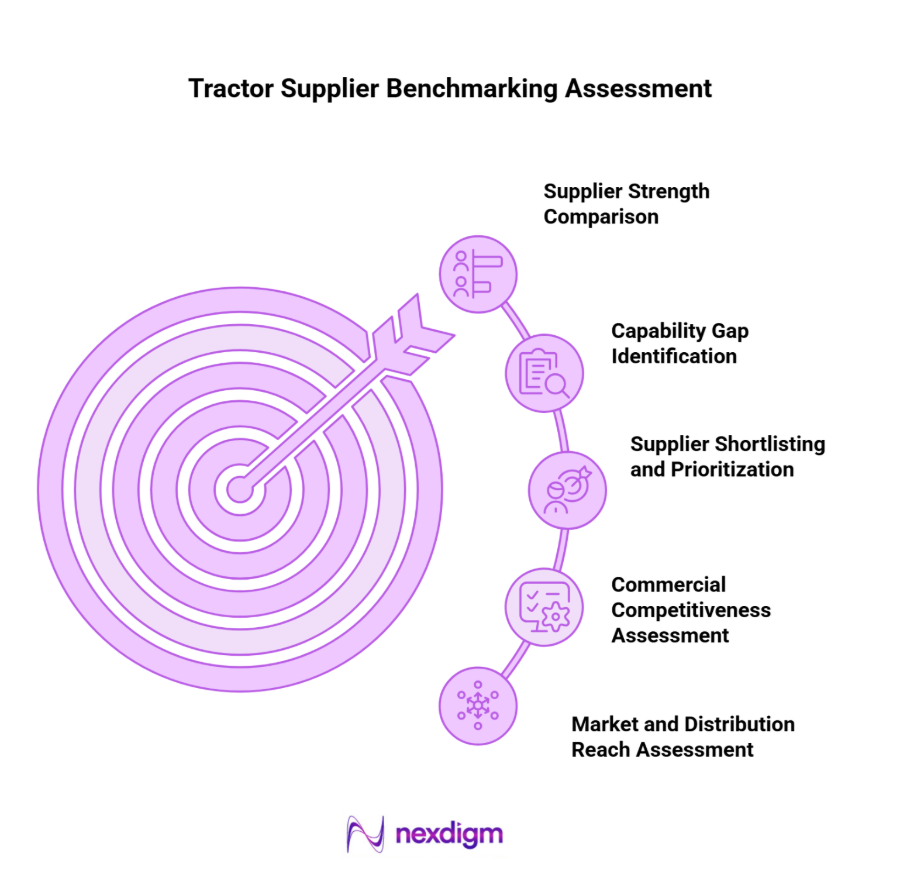
- Supplier Strength Comparison: Compare manufacturers across product portfolios, technical capabilities, manufacturing presence, and market positioning to identify competitive advantages.
- Capability Gap Identification: Highlight differences in product suitability, regional coverage, dealer networks, and after-sales support that may affect supplier performance.
- Supplier Shortlisting and Prioritization: Organize benchmarking findings to identify manufacturers that best match farm requirements, operating conditions, and procurement priorities.
- Commercial Competitiveness Assessment: Compare pricing structures, financing options, warranty provisions, and ownership costs to understand the commercial attractiveness of different manufacturers.
- Market and Distribution Reach: Examine dealer presence, regional availability, distribution networks, and spare-parts access to assess supplier accessibility across target farming markets.
These insights help procurement teams move from broad market comparisons to a focused supplier shortlist, providing a practical basis for further evaluation and selection.
Nexdigm’s Case
An agricultural equipment distributor sought to compare tractor manufacturers to identify suppliers suited to different farm sizes and crop requirements. Nexdigm assessed 22 manufacturers across horsepower categories, product portfolios, pricing, dealer networks, and after-sales support. The research found that 32% had limited service coverage in selected agricultural regions, while 27% offered restricted product options for specialized farming applications. Based on these findings, the distributor identified alternative manufacturers and shortlisted suppliers for further commercial and technical evaluation.
To take the next step, simply visit our Request a Consultation page and share your requirements with us.
Harsh Mittal
+91-8422857704