

Tariffs are once again becoming a major variable in international trade strategy. WTO analysis shows that the share of global merchandise trade conducted on MFN tariff terms fell from more than 80% in 2022 to about 72% by end-July 2026, reflecting increased use of tariff actions. Around 12% of global merchandise trade is now affected by anti-dumping, countervailing duties, or other tariff actions.
The impact is not limited to the duty paid at customs. UN Trade and Development reports that tariffs on exports rose sharply in 2025, while non-tariff measures now generate higher trade costs than tariffs for 88% of countries. This makes it increasingly important for companies to examine tariffs alongside regulations, sourcing structures, product classifications, and market-access conditions.
For manufacturers, exporters, importers, procurement teams, and investors, trade data tariff analysis can therefore reveal where tariff structures create cost advantages, which markets impose meaningful barriers, and whether changing sourcing locations could improve competitiveness.
Why Tariff Rates Alone Do Not Create Value
A headline tariff rate can look attractive until it is applied to the actual product classification, country of origin, preferential eligibility, and import value. Two competing suppliers can face materially different landed costs because their products qualify for different tariff treatments.
This makes product-level and country-level trade analysis essential. Businesses need to understand which products are traded, who supplies them, where they originate, and what tariff treatment applies before deciding whether a market or sourcing location is commercially attractive.
Tariffs in Reshaping Competitive Positioning
A tariff increase affecting one supplier but not another can quickly change relative competitiveness. UN Trade and Development notes that uneven tariff changes redistribute market shares among foreign suppliers, influencing sourcing, production, and investment decisions.
For companies evaluating international expansion, tariff analysis can therefore reveal opportunities created by preferential agreements, lower-duty sourcing countries, tariff exemptions, or competitor disadvantages. The objective is not simply to identify the lowest tariff, but to determine which combination of tariff treatment and trade economics creates the strongest commercial position.
Nexdigm’s Trade Data Tariff Analysis Approach
Nexdigm integrates trade intelligence, tariff analysis, market research, competitive intelligence, and supply-chain assessment to evaluate the commercial implications of changing trade policies.
Our Trade Analysis services can examine products, SKUs, industries, companies, countries, trade corridors, and origins. Its trade-policy assessment specifically covers tariff analysis, import duties, export incentives, free-trade agreements, and policy developments affecting trade.
This allows tariff analysis to move beyond a static duty-rate lookup and become part of broader decisions around market entry, sourcing, procurement, export competitiveness, and supply-chain restructuring.
Nexdigm’s Trade Data Tariff Analysis Assessment
Nexdigm’s trade data tariff analysis helps businesses understand duty structures, evaluate cost implications, and identify strategic trade opportunities through:
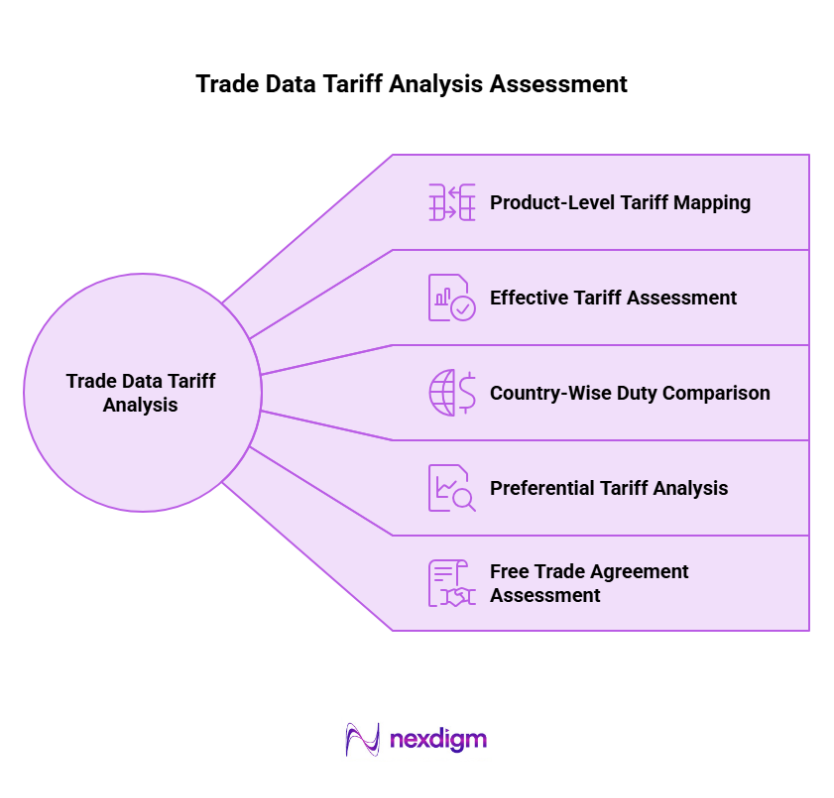
- Product-Level Tariff Mapping: Nexdigm maps products and HS codes against applicable duties to identify tariff exposure and compare market-access costs across specific product categories.
- Country-Wise Duty Comparison: Comparing tariff treatment across destination and source countries to identify markets or origins offering more favorable cost structures.
- Effective Tariff Assessment: Examining applicable tariff measures and preferential treatments to estimate the actual duty burden affecting imported products.
- Preferential Tariff Analysis: Nexdigm identifies preferential arrangements and evaluates whether eligible products can receive reduced duties under applicable trade agreements.
- Free Trade Agreement Assessment: Nexdigm evaluates relevant FTAs and their tariff schedules to determine potential savings and market-access advantages for qualifying products.
Through comprehensive tariff and trade agreement assessments, Nexdigm enables organizations to reduce landed costs, optimize sourcing strategies, enhance market competitiveness, and make well-informed decisions across global trade networks.
Nexdigm’s Trade Data Assessment Offering Competitive Advantage
Beyond evaluating tariff structures, businesses must understand how trade policies influence long-term competitiveness and operational risk. Nexdigm’s assessment helps organizations with:
- Tariff Volatility Exposure: Nexdigm assesses products and supply chains exposed to changing tariff measures, helping businesses anticipate potential cost fluctuations and trade disruptions.
- Competitive Position Benchmarking: Evaluation of how tariff structures impact relative cost competitiveness compared to key industry players operating across different sourcing and destination markets.
- Market Access Risk Assessment: Nexdigm identifies trade policy barriers and duty-related challenges that may affect expansion plans, export potential, and overall market attractiveness.
- Trade Diversification Opportunities: Analyzing alternative trade corridors and sourcing geographies to reduce dependence on high-cost or high-risk markets.
With the following advantages, Nexdigm enables organizations to develop proactive trade strategies, strengthen supply-chain resilience, and sustain competitive advantages in evolving global markets.
Nexdigm’s Case
Nexdigm supported an India-based industrial-products company by analyzing product-wise import-export data across key markets. The resulting insights contributed to a 27% increase in qualified export opportunities and 8% improvement in price realization, while helping sharpen product prioritization.
To take the next step, simply visit our Request a Consultation page and share your requirements with us.
Harsh Mittal
+91-8422857704