

Companies evaluating international expansion increasingly need to look beyond geological reserves. Resource quality, commodity demand, infrastructure, permitting, fiscal terms, operating costs, processing capacity, and geopolitical exposure can materially change the attractiveness of a country. A resource-rich jurisdiction is valuable only when its deposits can be developed, processed, financed, and connected to end markets competitively.
Investment is also becoming more selective. Global nonferrous exploration spending reached US$12.4 billion in 2025, while the top three mining countries accounted for 77% of production for key energy minerals, up from 73% in 2020. At the same time, gold exploration budgets increased 11% to US$6.15 billion, while copper exploration reached a 12-year high of US$3.27 billion. These shifts demonstrate why country selection needs to consider both resource potential and where capital is actually flowing.
For mining companies, investors, resource developers, and industrial businesses, global mining market entry strategy consulting can help identify jurisdictions where resource potential, demand, investment conditions, and project economics align.
Resource Abundance Is Only the Starting Point
A country may possess significant mineral resources but still present challenges around infrastructure, permitting, power availability, skilled labor, community relations, or processing capacity. Conversely, established mining jurisdictions may offer mature infrastructure and expertise but face higher costs or increasing competition for attractive deposits. The relevant question is therefore not simply “Where are the minerals?”, but “Where can those minerals be developed competitively and at an acceptable level of risk?”
Commodity Demand Is Reshaping Country Attractiveness
Demand is increasingly influencing where mining investment is directed. Copper is supported by electrification and grid investment, while lithium, graphite, nickel, cobalt, and rare earths remain strategically relevant to batteries, energy technologies, electronics, and advanced manufacturing. Exploration patterns reflect these differences. In 2025, copper exploration budgets increased 2% to US$3.27 billion, while uranium and rare-earth exploration budgets increased 9% and 3%, respectively. This makes commodity-specific country screening more useful than applying a single attractiveness score across the global mining landscape.
Nexdigm’s Expertise in Understanding Trade Flow and Market Entry Strategies
Navigating global mining markets requires a clear understanding of how minerals move through international supply chainsn and which jurisdictions offer the most attractive investment conditions. Nexdigm offers trade-flow analysis, and strategic assessment to help mining companies identify and prioritize high-potential expansion opportunities through:
- Trade Flow and Supply Chain Intelligence: Analysis of global production hubs, export-import flows, supplier concentration, processing networks, and trade corridors to understand how minerals and metals move across global markets.
- Demand and Market Opportunity Assessment: Evaluation of commodity demand trends, consumption centers, end-use industries, and growth drivers to identify markets with strong long-term potential.
- Investment and Competitiveness Analysis: Assessment of investment activity, regulatory environments, infrastructure readiness, operating conditions, and market accessibility to determine the attractiveness of mining jurisdictions.
With the analysis, Nexdigm helps mining companies, investors, and resource developers identify attractive markets, mitigate risks, and develop informed global expansion strategies.
Why Trading Companies Partner with Nexdigm
Mining market entry decisions involve significant capital commitments, long development timelines, and complex market dynamics. Businesses partner with Nexdigm for its ability to combine industry knowledge and strategic analysis into actionable expansion recommendations through:
- Integrated Market and Trade Intelligence: Nexdigm evaluates resource potential, trade flows, demand trends, competitive dynamics, and investment activity to provide a comprehensive view of market attractiveness.
- Data-Driven Decision Making: Nexdigm combines quantitative analysis with industry expertise to help businesses assess opportunities objectively, prioritize markets, and reduce investment uncertainty.
- Commercial and Operational Perspective: Assess not only market potential but also the practical factors that influence success, including infrastructure, regulations, supply chains, and operating conditions.
By combining deep industry understanding with rigorous market analysis, Nexdigm helps trading companies, investors, and resource developers identify high-potential opportunities, mitigate risks, and make informed expansion decisions in an evolving global mining landscape.
Nexdigm’s Trade Flow Analysis Service Offering
A comprehensive trade flow analysis helps mining companies understand how minerals move across global markets, where supply is concentrated, and which regions are driving future demand. Nexdigm focuses on the following critical areas:
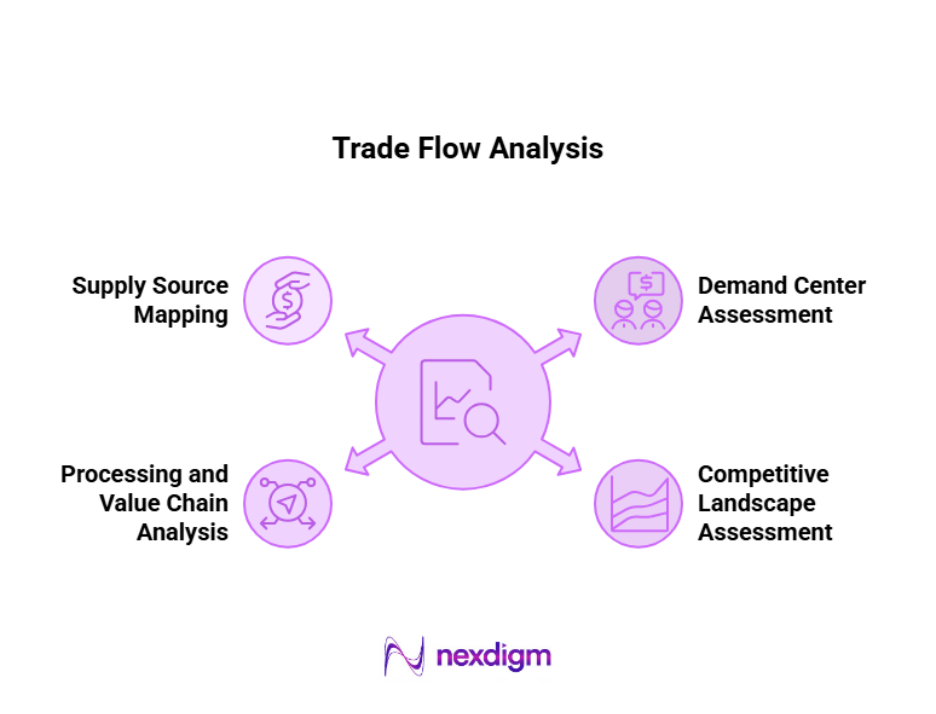
- Supply Source Mapping: Identify major producing countries, export leaders, supplier concentration, and production trends to understand global mineral supply dynamics.
- Demand Center Assessment: Analyze key consuming regions, industrial demand drivers, energy-transition requirements, and emerging markets shaping future mineral consumption.
- Processing and Value Chain Analysis: Evaluate refining, beneficiation, and downstream processing capabilities to understand where value addition occurs across the mining ecosystem.
- Investment and Competitive Landscape Assessment: Assess exploration activity, capital flows, project pipelines, and competitive intensity to identify markets attracting industry investment.
By focusing on these key areas, Nexdigm’s trade flow analysis enables mining companies, investors, and resource developers to identify attractive markets, anticipate industry shifts, and make informed expansion decisions.
Nexdigm’s Case
Nexdigm supported a manufacturer by analysing monthly trade flows to identify market shifts ahead of annual reporting cycles. The analysis helped increase export volumes by 18%, boost distributor orders by 24%, and reduce inventory gaps by 15%. The results demonstrate how timely trade-flow intelligence can strengthen demand forecasting, market prioritization, and supply-chain decisions.
To take the next step, simply visit our Request a Consultation page and share your requirements with us.
Harsh Mittal
+91-8422857704