

A market-entry plan can become outdated before a company has completed its first year of expansion. A major supplier may add capacity, a customer may diversify its sourcing, freight costs may change, or a regulatory measure may alter the economics of an established trade route. Companies that rely on annual market reports alone can miss these changes until they begin affecting sales or margins.
Trade intelligence helps businesses monitor the external conditions that influence commercial decisions. Its purpose is not to predict every market movement, but to identify relevant changes early enough for management to respond.
Why Static Market Assessments Lose Value
A market assessment captures conditions at a particular point in time. It may accurately describe demand, competition, and market access when completed, yet those conditions can change through new investment, policy shifts, price movements, or supply disruption.
UN Trade and Development’s January 2026 outlook identified geopolitical fragmentation, changing supply chains, digital and green transitions, and tighter national regulations as forces reshaping international trade. The organisation also highlighted the growing importance of non-tariff measures, which affect a substantial share of global trade. For exporters, these developments mean that market access and competitive conditions require continued attention after entry.
The practical issue is that not every change deserves a response. A temporary monthly fluctuation may have little commercial significance, while a new certification requirement or a competitor’s capacity expansion could alter the market-entry case materially. Trade intelligence provides a structured way to distinguish between the two.
Monitor the Changes That Affect Your Business
An effective intelligence programme starts with a defined set of commercial questions. An exporter may need to know whether its target markets are importing more of its product, whether competitors are gaining share or whether a new source is becoming price competitive. A procurement team may be more concerned about supplier concentration, alternative origins and the risk of a trade route becoming unreliable.
Monitoring should therefore focus on signals that could change a decision, rather than collecting every available statistic.
- Demand: Changes in import quantities, product mix and the activity of relevant customer industries.
- Competition: New suppliers, changing market shares, capacity announcements, and shifts in product positioning.
- Market access: Tariffs, registration requirements, technical standards, and other regulatory changes.
- Supply exposure: Concentration by source country, dependence on specific routes and the availability of substitutes.
- Economics: Price benchmarks, freight costs, currency movements and changes in delivered-cost competitiveness.
The appropriate indicators will differ by industry. A commodity buyer may need frequent price and shipment monitoring, while a manufacturer selling specialised industrial equipment may place greater weight on customer investment plans and supplier qualification.
Turn Monitoring Into an Early-Warning System
The benefit of trade intelligence benefits is clearest when monitoring is connected to a response process. A dashboard that reports changes without identifying their commercial implications simply creates another source of information for management to ignore.
Each important indicator should have a reason for being monitored, a threshold that warrants investigation, and a person responsible for assessing the result. If a key supplier’s share rises sharply, the response may be to examine capacity, pricing, and alternative sources. If imports into a target market decline, the team should determine whether the cause is weaker demand, inventory adjustment, local substitution, or a temporary interruption.
The system should also distinguish between a signal and a confirmed explanation. A change in trade flows may justify investigation, but it does not establish why buyers changed their behaviour. Company disclosures, industry reports, customer conversations and local market research help verify the cause.
Decide How Often to Review Each Signal
Not every indicator requires the same monitoring frequency. Commodity prices, shipping disruptions, and rapidly changing trade restrictions may require frequent review. Supplier market share, customer-industry demand and production capacity may be better assessed quarterly or when a major event occurs.
A useful review process should address three questions: What has changed? Why might it matter commercially? What action, if any, is justified? This keeps the programme focused on decisions rather than producing repetitive reports.
Companies should also retain a record of earlier signals and the actions taken. Over time, this helps determine which indicators genuinely anticipate commercial changes and which generate unnecessary alerts.
Build Intelligence into Commercial Planning
Trade intelligence should inform pricing, sales planning, procurement, market entry, and risk management. A company considering a new distributor may use it to identify changes in import demand and supplier competition. A sourcing team may use it to investigate dependence on one origin before a disruption occurs. An exporter may revise its country’s priorities when a new regulation increases compliance costs.
The process should connect analysis to clear responsibilities. Commercial teams validate customer implications; procurement evaluates supply alternatives; finance tests the economics and regulatory specialists assess compliance requirements. This prevents intelligence from remaining isolated within a research function.
Nexdigm’s Trade Intelligence Response Framework
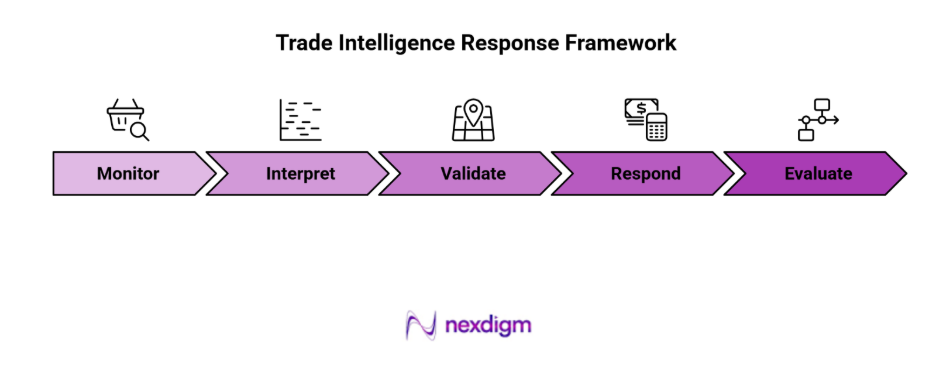
- Watch: Track the trade, supplier, regulatory and cost indicators most relevant to the business.
- Interpret: Separate material changes from routine fluctuations and investigate plausible causes.
- Verify: Check the signal against independent sources, company information, and customer evidence.
- Respond: Adjust sourcing, pricing, market priorities or risk controls when the evidence warrants action.
- Learn: Review whether the response improved commercial outcomes and refine the indicators accordingly.
Nexdigm’s Case Study
An industrial chemicals importer reviewed its sourcing strategy after a delivery disruption exposed its dependence on established suppliers. An assessment of 5 source countries found that 2 accounted for approximately 75% of its imports, highlighting a concentration risk. By examining alternative origins, import trends and freight exposure, the company identified 2 potential supplier markets for further evaluation. Technical qualification and commercial negotiations were completed before the next procurement cycle, giving the purchasing team an alternative supply route and reducing its reliance on emergency sourcing when disruptions occurred.
To take the next step, simply visit our Request a Consultation page and share your requirements with us.
Harsh Mittal
+91-8422857704