

Global trade is becoming more dynamic, making reliable intelligence increasingly important for businesses on both sides of international transactions. The WTO expects merchandise trade volume to grow 3.9% in 2026 and 4.1% in 2027. In the first half of 2026, merchandise trade volume already grew 3.5%, despite major disruptions to energy, fertilizer, and transport flows.
For importers and exporters, the challenge is no longer simply knowing how much a country trades. They need to understand which products are moving, who is buying, who is supplying, what prices are being achieved, and where trade relationships are changing. This is where trade intelligence for importers and exporters can convert large volumes of cross-border data into practical commercial decisions.
Why Importers Need More Than Supplier Lists
Importers need to balance price, quality, reliability, geographic diversification, and supply continuity. A supplier offering the lowest quoted price may not represent the strongest sourcing opportunity once trade volumes, shipment consistency, market presence, and alternative suppliers are considered.
Organizations can analyze supplier countries, companies, products, trade values, volumes, pricing, and sourcing patterns to help importers identify credible alternatives, benchmark existing suppliers, and understand changing procurement landscapes.
Why Exporters Need More Than Market Size
For exporters, a large economy does not necessarily translate into an attractive destination. Actual import activity can provide a more specific indication of product demand, while buyer concentration and supplier competition can indicate the difficulty of entering a market.
Businesses uses country-wise and product-wise trade intelligence to identify high-potential markets, active buyers, growing import demand, competitor presence, and pricing opportunities, helping exporters prioritize markets based on actual trade activity.
Nexdigm’s Expertise in Offering Trade Intelligence Services
Transforming trade data into actionable business intelligence requires more access to import-export records. Nexdigm combines trade analytics, market intelligence, and commercial assessments to help importers and exporters identify opportunities through:
- Supplier and Sourcing Intelligence: Analyzing supplier networks, trade flows, sourcing patterns, and pricing dynamics to help importers identify reliable suppliers, benchmark existing partners, and diversify procurement strategies.
- Buyer and Market Opportunity Intelligence: Nexdigm evaluates import demand, buyer activity, purchasing trends, and competitive landscapes to help exporters identify high-potential markets and target relevant buyers more effectively.
- Trade Pricing and Competitor Benchmarking: Assessing trade values, transaction patterns, and competitor activity to provide pricing benchmarks and market positioning insights that support stronger commercial decision-making.
With this approach, Nexdigm enables importers and exporters to uncover growth opportunities, build resilient trade relationships, and make data-driven sourcing and market expansion decisions.
The Growing Need of Trade Intelligence for Importers and Exporters
In a global marketplace characterized by shifting demand patterns, changing supplier networks, and evolving trade relationships, businesses need more than basic import-export data to make informed decisions. Trade intelligence provides visibility into:
- Identifying Better Markets: Trade intelligence helps businesses uncover high-potential markets by analyzing demand trends, import activity, growth patterns, and emerging trade opportunities.
- Finding the Right Suppliers and Buyers: Businesses can identify active suppliers and importers with proven trade activity, supporting more targeted sourcing and customer acquisition strategies.
Nexdigm’s Trade Intelligence for Importers and Exporters Assessment
Nexdigm’s trade intelligence for importers and exporters can assess multiple dimensions. It transforms complex import-export data into actionable commercial insights, helping organizations identify attractive markets through:
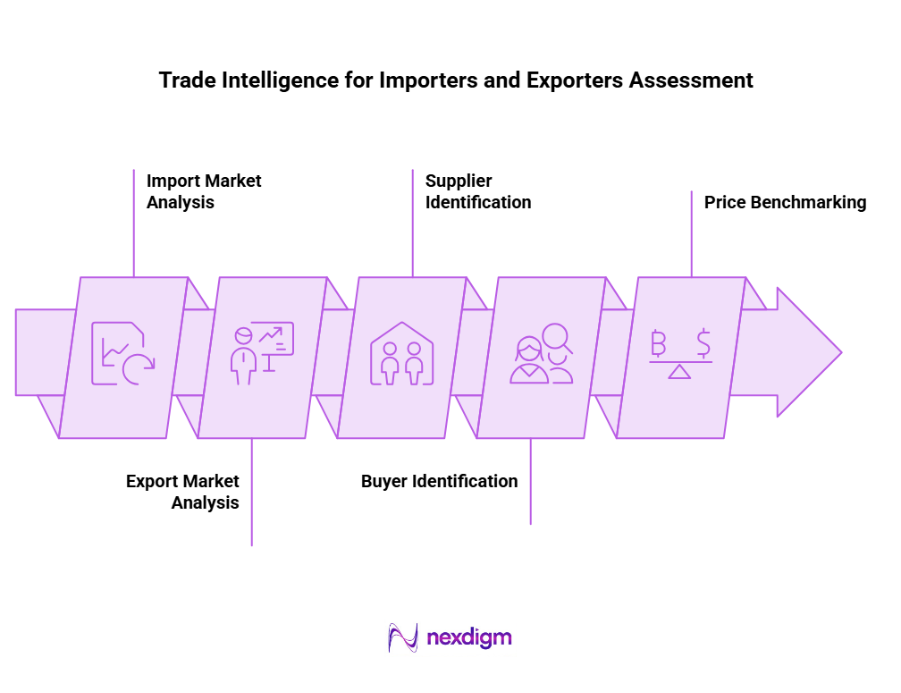
- Import Market Analysis: Nexdigm evaluates import values, volumes, growth, products, and origins to identify demand patterns and attractive markets for sourcing or commercial expansion.
- Export Market Analysis: Examination of destination markets, export trends, product movements, and supplier positions to identify opportunities for exporters seeking new international customers.
- Supplier Identification: Nexdigm maps active suppliers by country, company, product, and trade activity to identify potential sourcing partners and alternative supply bases.
- Buyer Identification: Identification of active importers and purchasing companies to help exporters prioritize accounts with demonstrated product-purchasing activity.
- Price Benchmarking: Nexdigm compares trade values and volumes to estimate unit-price benchmarks across suppliers, products, countries, and markets.
With this approach, the assessment helps organizations optimize sourcing strategies, identify high-potential customers and markets, strengthen competitive positioning, and uncover new opportunities for sustainable growth in global trade.
Applications of Nexdigm’s Trade Intelligence Approach
The insights generated through Nexdigm’s Trade Intelligence Assessment can support a wide range of sourcing, market development, and commercial decision-making initiatives. By translating trade data into actionable intelligence, businesses can leverage insights into:
- Supplier Discovery and Diversification: Identifying alternative suppliers, reduce sourcing concentration risks, and strengthen procurement resilience through data-driven supplier selection.
- New Customer Identification: Discovering active importers and purchasing organizations with demonstrated buying activity, enabling more targeted business development efforts.
- Market Expansion Planning: Evaluating and prioritizing international markets based on demand patterns, trade activity, competitive intensity, and growth potential.
- Pricing and Commercial Strategy Development: Benchmarking trade prices across markets and suppliers to support pricing decisions, negotiations, and competitive positioning.
With these applications, organizations can make more informed commercial decisions, improve competitive positioning, and unlock sustainable growth opportunities in global markets.
Nexdigm’s Case
Nexdigm analyzed trade activity beyond headline value and volume, examining shipment frequency, supplier concentration, unit prices, and sourcing patterns. The resulting insights contributed to a 17% increase in demand, 13% procurement savings, and 9% market-share growth, helping the business improve sourcing economics while identifying opportunities for stronger market positioning.
To take the next step, simply visit our Request a Consultation page and share your requirements with us.
Harsh Mittal
+91-8422857704