

Global trade is generating more data, but more data does not automatically mean better decisions. The WTO expects world merchandise trade volume to grow 3.9% in 2026 and 4.1% in 2027, following 3.5% growth in the first half of 2026. Yet trade patterns remain uneven as companies respond to geopolitical disruption, changing sourcing strategies, and shifting demand.
For businesses, this creates a practical question: should decisions rely on shipment records or primary market research? Shipment data can show what moved, where it moved, who traded it, and how volumes or values changed. Primary research can explain why customers buy, how distributors behave, what competitors are doing, and what market participants expect next.
The stronger approach is often to combine both. This is the basis of trade intelligence vs market research as a strategic question not choosing one over the other, but understanding where each creates value.
What Does Shipment Data Can Reveal
Trade data provides an external view of actual commercial activity. Import-export records can reveal product movements, trading companies, origin countries, destination markets, shipment frequency, volumes, and indicative unit values.
However, a shipment record does not necessarily explain the reason behind a movement. An increase in imports could reflect genuine demand, inventory rebuilding, supplier substitution, price changes, or temporary supply disruption.
Understanding the Importance of Primary Research
Primary research provides the context that transactional data cannot fully capture. Interviews, distributor discussions, warehouse audits, mystery shopping, and on-ground research can reveal customer preferences, channel behaviour, pricing practices, sourcing decisions, and competitive dynamics. Partnering with a firm can help businesses combine trade data with the research catalogue to validate what trade movements mean commercially.
How Nexdigm Combines Trade Intelligence and Primary Research for Better Decisions
While shipment data provides visibility into actual trade activity, businesses often need deeper context to understand the drivers behind market movements, buyer behavior, and competitive dynamics. Nexdigm bridges this gap by integrating trade intelligence vs market research insights, through:
- Trade Data-Led Opportunity Identification: Nexdigm leverages import-export data, shipment records, trade flows, and pricing trends to identify markets, suppliers, buyers, and emerging commercial opportunities.
- Primary Research-Based Market Validation: Nexdigm supplements trade intelligence with stakeholder interviews, distributor assessments, customer feedback, and channel insights to validate market attractiveness and demand potential.
- Commercial Insight Development: By combining transactional data with on-ground intelligence, Nexdigm helps businesses understand the factors influencing demand, pricing, sourcing decisions, and competitive positioning.
Through the integration of trade intelligence and primary research, Nexdigm enables organizations to move beyond what is happening in the market and understand why it is happening, supporting more confident market-entry, sourcing, investment, and growth decisions.
Nexdigm’s Trade Intelligence and Research Assessment Framework
While combining shipment data with primary research provides deeper market visibility, businesses also need a structured approach to convert these insights into actionable decisions. Nexdigm integrates trade intelligence and market research through a step-by-step assessment framework that evaluates opportunities through the following steps:
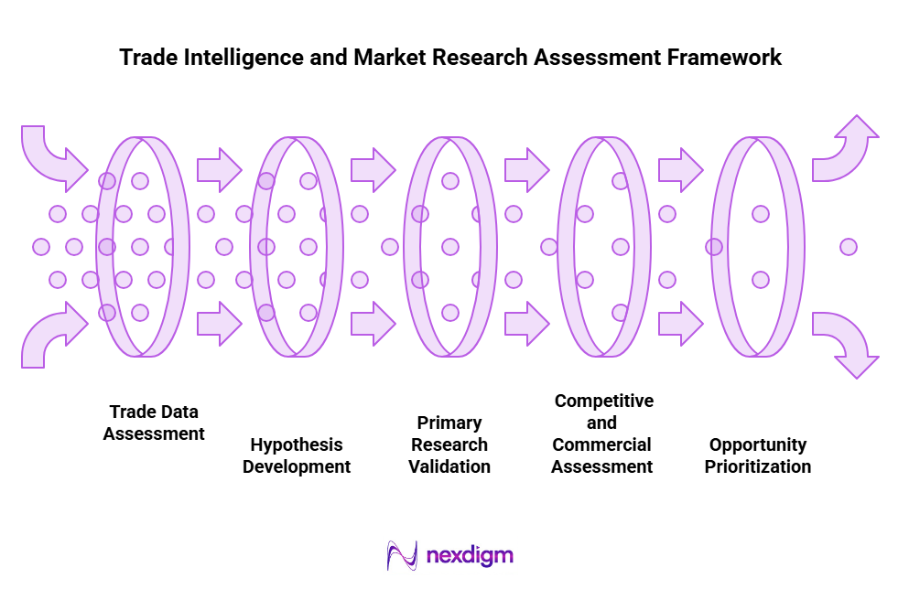
- Trade Data Assessment: Nexdigm analyzes import-export activity, shipment records, trade flows, pricing patterns, buyer behavior, and supplier movements to identify market trends, demand shifts, and emerging opportunities.
- Hypothesis Development: Based on trade intelligence findings, Nexdigm develops key hypotheses around market attractiveness, customer demand, supplier dynamics, competitive positioning, and potential growth opportunities.
- Primary Research Validation: Nexdigm conducts stakeholder interviews, distributor discussions, customer interactions, channel assessments, and market investigations to validate the insights identified through trade data analysis.
- Competitive and Commercial Assessment: Nexdigm evaluates competitive intensity, pricing dynamics, customer preferences, distribution structures, and market-entry barriers to understand the commercial realities of the opportunity.
- Opportunity Prioritization: Insights from trade intelligence and primary research are combined to rank opportunities based on demand potential, feasibility, competitive landscape, and strategic fit.
By following a structured assessment process that combines trade intelligence with on-ground market validation, Nexdigm helps businesses move beyond data interpretation to confident decision-making, reducing uncertainty in market entry, sourcing, investment, and growth strategies.
Nexdigm’s Framework Transforming Intelligence into Confident Business Decisions
After validating market realities through trade intelligence and primary research, Nexdigm helps businesses prioritize opportunities and develop actionable growth strategies to make confident decisions through:
- Opportunity-to-Investment Alignment: This assesses whether a market opportunity is worth pursuing based on its potential returns, required investment, and alignment with the company’s strategic objectives.
- Channel and Go-to-Market Readiness: This evaluates how effectively a business can reach customers in the target market by analyzing distribution channels, partner networks, and route-to-market options.
- Competitive Advantage Sustainability: This examines whether the business can establish and maintain a strong market position through differentiation, pricing strength, product capabilities, or supplier advantages.
Together, these assessments help businesses move beyond opportunity identification and develop a clear, actionable strategy for market entry, expansion, sourcing, or investment decisions.
Nexdigm’s Case
Nexdigm supported an industrial company by analyzing shipment frequency, supplier concentration, unit prices, and sourcing patterns rather than relying only on headline trade values. The engagement identified a 17% demand increase, 13% procurement savings, and 9% market-share growth, demonstrating the value of connecting trade signals with commercial decision-making.
To take the next step, simply visit our Request a Consultation page and share your requirements with us.
Harsh Mittal
+91-8422857704