
A trade route is only as reliable as the connections that support it. A shipment may move quickly across the ocean yet lose days waiting for customs clearance, inland transport, transshipment or warehouse handling. Identifying these delays requires a route-level view that connects time, cost, capacity and border procedures.
Map The Full Shipment Journey
Begin by tracing a shipment from origin to destination, including every transport mode, transfer point, border crossing and handover. Analyse the full journey rather than treating ocean freight, trucking or customs as separate cost centres.
Record planned and actual transit times at each stage. Where possible, distinguish driving or sailing time from waiting, dwell time and administrative processing. This reveals whether delays arise from limited transport capacity, congestion, documentation, operating schedules or poor coordination between providers.
The World Bank’s Logistics Performance Indicators 2.0, introduced in 2025, use shipment-level operational data from maritime, aviation and postal operators to examine connectivity, speed and reliability. The findings highlight how transshipment and border procedures can impose time penalties and how unpredictability can concentrate at ports and inland checkpoints.
Identify The Real Cost Drivers
Route comparison should include more than the quoted freight rate. A lower-priced route can become more expensive once delays, handling, storage, insurance, inventory financing and missed delivery windows are considered.
Build a comparable cost profile for each route:
- Main-carriage and inland transport charges.
- Customs brokerage, duties and border-related fees.
- Port, terminal, transshipment and handling charges.
- Storage, demurrage, detention and other delay-related costs.
- Inventory carrying costs and the cost of unreliable delivery.
Not every charge is visible in the initial quotation. Collect invoices and shipment records and distinguish recurring charges from exceptional disruption costs. Compare routes using the same shipment size, service level, product requirements and delivery assumptions.
Turn Route Intelligence into Action
Effective trade logistics analysis links shipment milestones and transport costs to route design, border performance and service reliability. The aim is to identify which part of the journey offers the greatest practical opportunity for improvement.
For example, recurring delays at one border may justify advance document checks or a different clearance process. A congested transshipment hub may warrant evaluating an alternative port, but the new route must be assessed for sailing frequency, total distance, inland access and capacity. Rerouting is not automatically faster or cheaper.
UN Trade and Development’s 2025 Review of Maritime Transport describes how rerouting around the Cape of Good Hope increased travel distances and contributed to delays, higher costs and volatile freight markets. Its analysis also highlights the role of port congestion and operational inefficiencies in reducing effective shipping capacity.
Trade Logistics Efficiency Framework
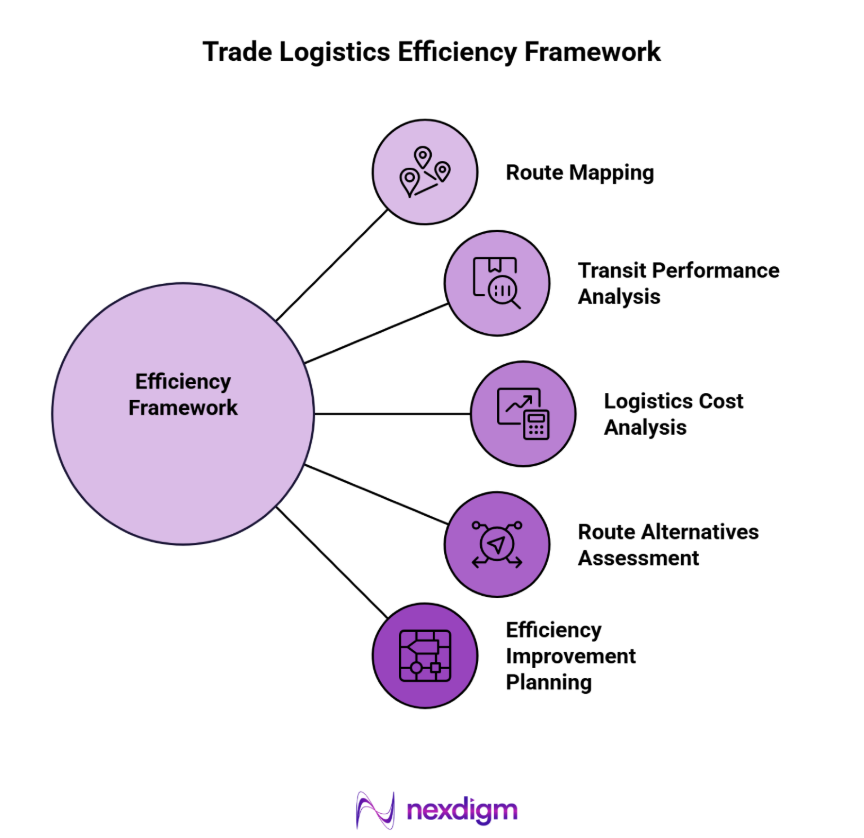
- Route Mapping: Document transport legs, border crossings, transfer points and delivery destinations.
- Transit Performance Analysis: Measure journey times, dwell periods, clearance delays and reliability.
- Logistics Cost Analysis: Compare freight, handling, customs, storage and inventory costs.
- Route Alternatives Assessment: Evaluate alternative corridors, transport modes and operating arrangements.
- Efficiency Improvement Planning: Prioritise changes based on cost savings, delivery reliability and implementation feasibility.
Nexdigm’s Case Study: Comparing Export Corridors
An exporter compared two shipping corridors across 40 consignments. The lower quoted-freight route incurred repeated storage and transshipment charges, raising its total delivered cost. The company revised its route criteria to include delay variability and end-to-end cost before reallocating selected shipments.
To take the next step, simply visit our Request a Consultation page and share your requirements with us.
Harsh Mittal
+91-8422857704