

In a rapidly evolving global economy, growth is no longer determined by product quality or market demand. Companies today must make strategic decisions about where to expand, whom to source from, and which trade routes can support cost-effective operations. As geopolitical shifts, supply chain disruptions, regulatory changes, and evolving consumer demand reshape global conditions, organizations need a data-driven approach to identify the markets, suppliers, and trade corridors that can speed-up sustainable growth. This is where Trade Strategy Consulting plays a critical role, helping businesses navigate complexity and transform trade decisions into competitive advantages.
The Market Selection Challenge
Expanding into new markets can provide significant revenue opportunities, but entering the wrong market can result in increased costs, compliance risks, and operational inefficiencies. Businesses must evaluate potential markets through multiple aspects:
- Market size and growth potential
- Trade agreements and tariff structures
- Regulatory environment
- Political and economic stability
- Consumer demand trends
Hence, a Trade Strategy Consulting helps organizations prioritize high-potential markets while keeping a check on expansion risks.
Why Supplier Networks Have Become Important
The rapid transformation, in recent years, has demonstrated that supplier selection is no longer a simple process. It is a strategic business decision. Many companies are adopting diverse supplier ecosystems that enhance resilience. Key supplier evaluation criteria now include:
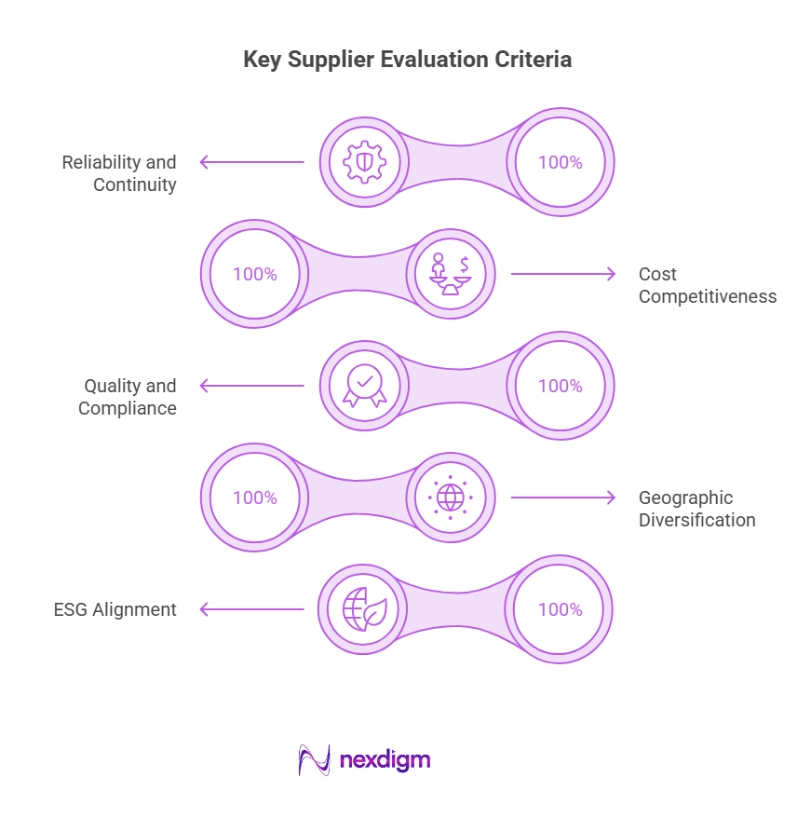
- Reliability and Continuity: Organizations must assess a supplier’s ability to maintain operations during economic, geopolitical, or environmental disruptions.
- Cost Competitiveness: While cost remains important, businesses increasingly focus on total landed cost rather than just unit pricing.
- Quality and Compliance: Suppliers must meet international standards, industry certifications, and sustainability requirements, to help with global expansion.
- Geographic Diversification: Multi-country sourcing strategies can reduce concentration risks associated with a single region.
- ESG Alignment: Environmental, Social, and Governance (ESG) considerations have become important supplier-selection parameters, particularly for companies operating in regulated markets.
Businesses that strategically optimize these evaluation criteria, gain greater flexibility, and improve their ability to respond to changing market conditions.
The Growing Importance of Trade Corridor Intelligence
Trade corridors form the base of international commerce by connecting production hubs with consumption markets. The efficiency of these corridors directly impacts costs, delivery timelines, and competitiveness. Leading global trade corridors continue to evolve due to infrastructure investments, trade agreements, and shifting manufacturing bases. Important factors when evaluating trade corridors include:
- Customs clearance efficiency
- Transportation costs
- Transit times
- Regional trade agreements
- Geopolitical stability
- Supply chain security
Organizations that align their supply chain strategies with emerging trade corridors can unlock substantial cost efficiencies while improving service levels.
Trade Corridor Intelligence for Driving Sustainable Growth
With a rapidly changing trade environment, businesses can no longer rely on reacting to only when challenges arise. Instead, successful organizations are using data, technology, and scenario planning to make smarter, forward-looking decisions. They are identifying the markets with the highest growth potential, finding ways to reduce supplier risks while keeping costs under control, optimizing trade routes for greater efficiency and resilience, and assessing how regulatory or geopolitical changes could affect future operations.
By combining trade intelligence with market insights, companies gain a clearer understanding of where to invest, how to strengthen their supply chains, and which opportunities are most likely to deliver long-term value. This strategic approach helps businesses stay competitive, adapt to uncertainty, and build more resilient operations. As a result, Trade Strategy Consulting has become an essential capability for organizations seeking sustainable global growth while confidently navigating an increasingly complex trade landscape.
How Nexdigm Helps Businesses with Trade Strategy
As global trade becomes more complex, organizations need a trusted partner to make strategic decisions. Nexdigm helps businesses navigate evolving trade landscapes through a comprehensive study and advisory services designed to support growth, compliance, and operational efficiency. Nexdigm’s approach focuses on helping businesses:
- Identify and prioritize high-potential markets: Analyze market growth opportunities and business conditions to help organizations focus resources on markets with the highest expansion potential.
- Evaluate supplier networks and sourcing strategies: Assess supplier capabilities, cost structures, geographic diversification, and operational resources to develop sourcing strategies.
- Assess trade corridor opportunities and logistics optimization: Evaluate trade routes, transportation networks, customs processes, and infrastructure capabilities to improve supply chain efficiency.
- Mitigate geopolitical and supply chain risks: Identify potential regulatory, economic, and geopolitical disruptions, enabling businesses to build resilient supply chains and implement effective risk management strategies.
- Develop long-term trade and market expansion strategies: Create data-driven expansion strategies aligned with business objectives, helping organizations achieve sustainable growth while adapting to evolving global trade conditions.
By combining trade, market intelligence and industry-specific insights, Nexdigm enables businesses to make informed decisions. Nexdigm’s Trade Strategy Consulting capabilities help organizations build sustainable growth across trade ecosystems.
Nexdigm’s Case
Nexdigm supported a manufacturer in assessing priority markets, supplier ecosystems, and high-potential trade corridors. The analysis guided sourcing and expansion decisions across regional hubs. Illustrative outcomes included a 14% reduction in procurement costs, 21% faster supplier onboarding, and an 18% increase in export revenue within twelve months of implementation.
To take the next step, simply visit our Request a Consultation page and share your requirements with us.
Harsh Mittal
+91-8422857704