

Fleet sourcing decisions influence logistics costs, operational flexibility, capital requirements, and service reliability. According to ICRA’s 2026 assessment, fuel accounts for approximately 50–60% of fleet operators’ total operating costs in India, highlighting the financial importance of fleet utilisation and cost management. Additionally, an International Transport Workers’ Federation report indicates that road transport carries around 70% of India’s domestic freight demand.
These conditions make fleet capacity planning an important business consideration. Companies must determine whether owning vehicles, leasing them, or outsourcing transportation offers the right balance of control and cost efficiency. A structured transport fleet sourcing strategy can help businesses evaluate these models, understand their financial implications, and build a sourcing mix aligned with operational requirements.
Key Considerations When Choosing a Fleet Sourcing Model
Selecting a sourcing arrangement requires businesses to consider how different models support their transportation needs. Two important considerations include:
- Fleet Utilisation Requirements: Determine whether vehicle demand is consistent enough to justify ownership or whether leasing and outsourcing offer better flexibility during fluctuating demand.
- Internal Management Capabilities: Evaluate whether the business has the resources to manage vehicles, drivers, maintenance, and compliance or would benefit from external service providers.
Assessing these factors helps logistics companies select sourcing arrangements that balance operational control, resource availability, and cost efficiency.
Managing Fleet Sourcing Risks and Dependencies
Each sourcing model introduces different operational dependencies. Owned fleets require ongoing investment and asset management, leased vehicles involve contractual commitments, and outsourced transportation creates reliance on external service providers. Logistics companies should assess vehicle availability, service continuity, contract flexibility, and supplier reliability before finalizing their sourcing arrangements.
Preparing Fleet Sourcing Arrangements for Future Business Requirements
Fleet sourcing decisions should account for more than immediate transportation demand. Businesses must consider expansion plans, changing delivery volumes, technology developments, and evolving customer expectations. Reviewing sourcing arrangements periodically can help identify capacity gaps and reassess the balance between owned, leased, and outsourced vehicles. Nexdigm can support this evaluation through market intelligence and supplier research, helping logistics companies understand emerging sourcing options and align fleet arrangements with future operational priorities.
Nexdigm’s Role in Supporting Strategic Fleet Sourcing Decisions
Nexdigm brings market research, procurement intelligence, and supplier assessment capabilities to help logistics companies evaluate fleet sourcing arrangements. Our research-led transport fleet sourcing strategy approach can support businesses through:
- Fleet Market Research: Analysis of transportation markets, fleet ownership trends, leasing options, and outsourced logistics models to understand available sourcing alternatives.
- Supplier and Service Provider Assessment: Evaluation of vehicle leasing companies, fleet operators, and third-party logistics providers across commercial offerings, service coverage, and operational capabilities.
- Cost and Commercial Benchmarking: Comparison of acquisition costs, lease structures, transportation rates, and contractual terms to identify potential efficiencies and strengthen procurement decisions.
Through these capabilities, Nexdigm can help businesses develop informed fleet sourcing priorities aligned with operational needs and long-term growth plans.
Nexdigm’s Framework for Evaluating Fleet Sourcing Models
Nexdigm can help logistics companies assess fleet sourcing options through a structured framework that considers commercial, operational, and supplier-related factors. The steps followed within the framework model are:
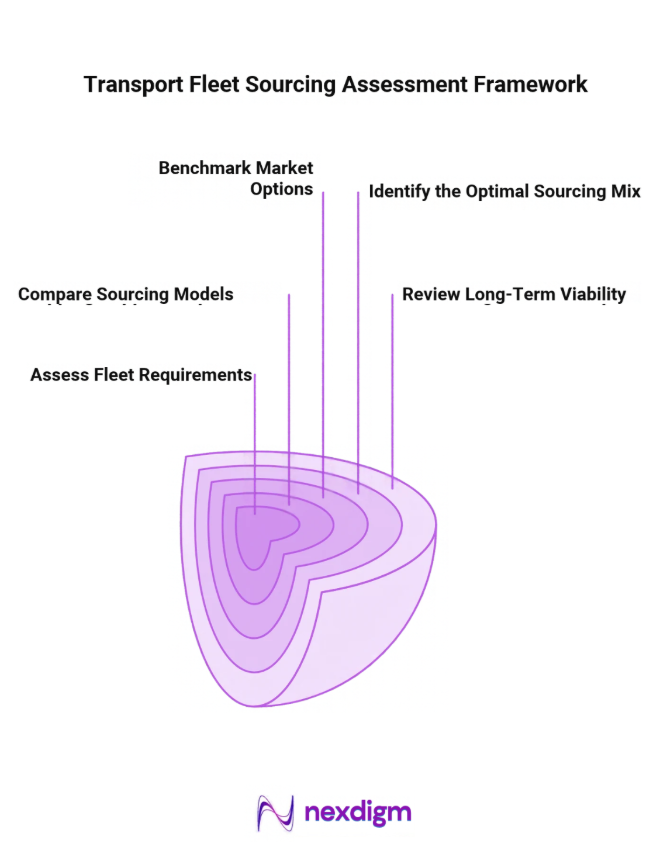
- Step 1. Assess Fleet Requirements: Examine route profiles, vehicle utilisation, transportation volumes, delivery frequency, and future capacity requirements.
- Step 2. Compare Sourcing Models: Evaluate owned, leased, and outsourced arrangements across acquisition costs, recurring expenses, contractual commitments, and operational control.
- Step 3. Benchmark Market Options: Compare leasing providers, transport operators, service offerings, pricing structures, and geographic coverage.
- Step 4. Identify the Optimal Sourcing Mix: Determine where ownership, leasing, or outsourcing may be more suitable based on cost efficiency, flexibility, and service requirements.
- Step 5. Review Long-Term Viability: Assess scalability, supplier reliability, contract flexibility, and the ability to accommodate changing business requirements.
This framework can help procurement teams establish a balanced sourcing model while aligning fleet investments with business priorities.
Business Benefits of Nexdigm’s Structured Fleet Sourcing Framework
A well-defined sourcing approach can help logistics companies improve transportation efficiency while managing capital commitments and operational dependencies. With Nexdigm’s market research and procurement insights, businesses can achieve several benefits:
- Better Cost Management: Compare ownership, leasing, and outsourcing expenses to identify cost efficiencies and manage long-term transportation expenditure.
- Improved Fleet Flexibility: Align vehicle availability with changing shipment volumes, seasonal demand, and expansion requirements.
- Stronger Supplier Selection: Evaluate leasing providers and transport operators based on pricing, service coverage, and operational capabilities.
- Optimized Capital Allocation: Identify where vehicle ownership is justified and where alternative sourcing models can reduce upfront investment.
- Greater Operational Resilience: Diversify sourcing arrangements to reduce dependence on individual suppliers and improve transportation continuity.
Nexdigm’s research-led support can help businesses translate these benefits into practical sourcing priorities and more informed fleet procurement decisions.
Nexdigm’s Case
A regional logistics company reviewed its transportation model to reduce fixed fleet costs and improve vehicle availability. Nexdigm’s research compared ownership, leasing, and outsourced transport options. The assessment identified 19% potential savings in sourcing costs, 14% improvement in vehicle availability, and 15% scope for reducing supplier concentration, supporting a more flexible fleet sourcing structure.
To take the next step, simply visit our Request a Consultation page and share your requirements with us.
Harsh Mittal
+91-8422857704