

Infrastructure development strategies shape long-term logistics competitiveness across regions by improving transport connectivity, warehousing access, multimodal integration, and supply chain efficiency. Strong roads, rail networks, ports, airports, logistics parks, and digital systems help businesses reduce transit time, lower operating costs, and expand distribution reach.
For companies entering new markets, a strong market entry strategy must assess infrastructure readiness, regional connectivity, regulatory conditions, investment requirements, partner availability, and scalability. A well-planned transport infrastructure logistics entry strategy supports faster market access, resilient operations, improved service reliability, and stronger competitiveness across regional and international supply chains.
Global infrastructure needs are projected across 56 countries and 7 sectors up to 2040, with transport forming a key investment area. The latest logistics performance dataset covers 2023–2024, while trade-route analysis shows containers spend an average of 44 days between export-port entry and destination-port exit, highlighting the need for stronger infrastructure planning.
Market Entry Strategy Through Transport Infrastructure Development
Market entry strategy through transport infrastructure development helps businesses assess connectivity, logistics capacity, regulatory readiness, investment needs, partner availability, and scalability for efficient regional expansion:
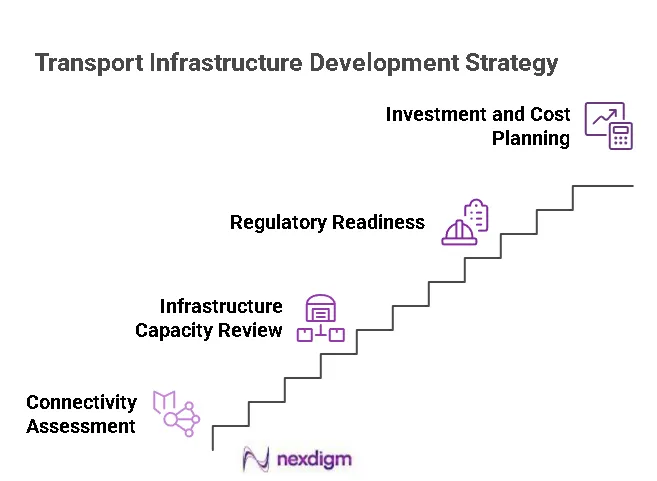
- Connectivity Assessment: Evaluate road, rail, port, and airport access to determine logistics reach and regional market entry feasibility.
- Infrastructure Capacity Review: Assess transport capacity, warehousing availability, cargo handling systems, and distribution infrastructure needed for efficient logistics operations.
- Regulatory Readiness: Review permits, compliance requirements, transport regulations, safety standards, and documentation needed before entering new markets.
- Investment and Cost Planning: Estimate infrastructure costs, operating expenses, logistics charges, and investment needs for sustainable market entry decisions.
Nexdigm Scalability Assessment for Long-Term Regional Logistics Growth
Nexdigm scalability assessment for long-term regional logistics growth helps businesses evaluate infrastructure capacity, transport connectivity, warehousing availability, partner readiness, demand growth, and operational flexibility. This supports phased expansion, improved market entry planning, efficient resource allocation, reduced bottlenecks, and stronger logistics competitiveness across regions.
Nexdigm Infrastructure Capacity Review for Long-Term Logistics Competitiveness
Nexdigm infrastructure capacity review for long-term logistics competitiveness helps assess transport networks, warehousing capacity, cargo handling systems, connectivity, bottlenecks, and scalability to strengthen regional logistics performance.
- Transport Network Capacity: Nexdigm reviews road, rail, port, and airport capacity to assess logistics movement efficiency and regional competitiveness.
- Warehousing Availability: Nexdigm evaluates storage space, location suitability, inventory handling systems, and expansion potential for long-term logistics growth.
- Cargo Handling Systems: Nexdigm assesses loading, unloading, sorting, storage, and dispatch systems to identify process gaps and productivity improvements.
- Connectivity and Access: Nexdigm reviews access to suppliers, logistics hubs, distribution centers, and customer markets across target regions.
Nexdigm’s case:
Nexdigm helped a logistics company review infrastructure capacity for long-term regional competitiveness. By assessing transport networks, warehousing availability, cargo handling systems, connectivity gaps, and scalability, Nexdigm helped improve route efficiency by 19%, reduce identified bottlenecks by 26%, and increase projected logistics capacity by 30%.
To take the next step, simply visit our Request a Consultation page and share your requirements with us.
Harsh Mittal
+91-8422857704