

Transport management platforms are expanding as logistics providers pursue greater efficiency, cost optimization, and operational control across increasingly complex freight networks. As part of a market entry strategy, these platforms help businesses plan routes, manage carriers, track shipments, optimise loads, and monitor transport costs from the start of market operations.
A strong Transport management software market entry strategy enables companies to reduce manual processes, improve delivery reliability, and scale transportation activities across new regions. By using digital tools for planning, visibility, and performance management, businesses can build more agile, cost-effective, and data-driven logistics operations in competitive markets.
The need for a Transport management software market entry strategy is supported by strong digital logistics growth. The global transportation management system market was valued at USD 18.70 billion in 2025 and is projected to reach USD 44.84 billion by 2034, growing at a CAGR of 9.8%.
The broader logistics software market is also expected to grow from USD 17.47 billion in 2026 to USD 31.74 billion by 2034, reflecting rising demand for route optimization, cost control, and transport visibility.
Using Transport Management Platforms to Improve Market Entry Execution
Using transport management platforms improves market entry execution by optimizing routes, managing carriers, tracking shipments, controlling freight costs, and supporting reliable delivery operations across new target markets.
-
Route Optimization
Identifies efficient delivery routes, reduces travel time, lowers fuel costs, and supports faster market entry execution.
-
Carrier Management
Evaluates carrier availability, service quality, pricing, and reliability to strengthen transport operations in new markets.
-
Shipment Visibility
Tracks freight movement, delivery milestones, and delays in real time to improve control and customer communication.
-
Freight Cost Control
Monitors transport spending, compares rates, and identifies cost-saving opportunities during early market expansion.
Nexdigm Data and Reporting Framework for Freight Cost Visibility
Nexdigm can help design reporting frameworks that track freight spend, carrier charges, route costs, delivery exceptions, fuel impact, and cost variances. This enables businesses to improve freight cost visibility, identify savings opportunities, strengthen transport controls, and support cost-efficient market entry execution across new logistics operations.
Nexdigm Performance Governance for Transport Management Software Enabled Logistics Efficiency
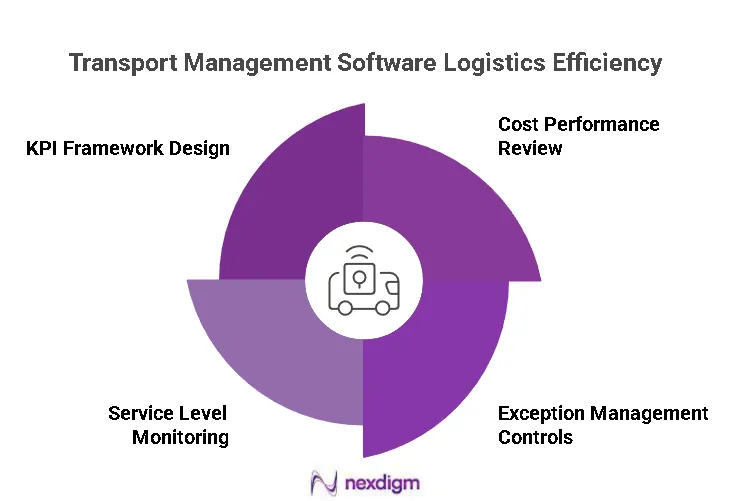
Nexdigm can define KPIs, reporting cadence, service levels, exception controls, and performance reviews to improve TMS-enabled logistics efficiency, cost control, delivery reliability, and operational accountability:
-
KPI Framework Design
Defines delivery accuracy, freight cost, carrier reliability, turnaround time, and route efficiency metrics for performance governance.
-
Service Level Monitoring
Tracks agreed delivery timelines, shipment milestones, exception rates, and carrier commitments to maintain logistics service reliability.
-
Cost Performance Review
Monitors freight spend, route costs, fuel impact, and cost variances to identify efficiency improvement opportunities.
-
Exception Management Controls
Establishes escalation processes for delays, missed pickups, failed deliveries, and system mismatches to improve operational responsiveness.
Nexdigm’s case:
Nexdigm supported a logistics company strengthen performance governance for TMS-enabled operations across six distribution routes. By defining KPIs, service-level controls, dashboard reporting, exception escalation, and review cadence, Nexdigm helped the company improve delivery reliability by 28%, reduce freight cost variance by 15%, cut exception response time by 35%, and enhance operational accountability across transport teams.
To take the next step, simply visit our Request a Consultation page and share your requirements with us.
Harsh Mittal
+91-8422857704