

Transportation operations involve multiple activities, including shipment planning, carrier selection, freight booking, route optimisation, tracking and delivery management. When these activities are managed through disconnected systems or manual processes, organisations can face higher transportation costs, limited shipment visibility and inconsistent service performance.
A Transport Management System (TMS) helps businesses coordinate these activities through a centralised digital platform. However, software providers differ in their optimisation capabilities, carrier networks, integration options and reporting features. Selecting the right platform requires an assessment of both technical functionality and operational suitability.
Why TMS Vendor Evaluation Matters
A TMS supports the planning and execution of transportation activities across inbound and outbound supply chains.
Depending on the platform, its capabilities may include automated carrier selection, freight rate comparison, load consolidation, route planning, shipment tracking, freight auditing and performance reporting.
For organisations managing multiple carriers, distribution centres and transportation modes, these capabilities can improve coordination and provide greater control over logistics expenditure.
A vendor evaluation should consider:
- Route optimisation: Ability to identify efficient routes based on distance, delivery schedules, vehicle capacity and transportation constraints.
- Carrier management: Carrier onboarding, rate management, tendering and performance monitoring.
- Shipment visibility: Real-time tracking, milestone updates and exception alerts.
- System integration: Connectivity with ERP, warehouse management and order management systems.
- Reporting capabilities: Freight expenditure, delivery performance and carrier scorecards.
- Scalability: Ability to support increasing shipment volumes, additional locations and new transportation modes.
Comparing Route Optimisation and Carrier Management
Route optimisation is one of the most important capabilities of a TMS. The platform should consider delivery locations, vehicle capacity, traffic conditions, delivery windows and operational constraints when generating transportation plans.
However, procurement teams should distinguish between basic route planning and advanced optimisation.
Basic systems may calculate routes using distance and delivery points, while more advanced platforms can support multi-stop routing, dynamic replanning, load consolidation and automated carrier selection.
Carrier management capabilities should also be evaluated in detail.
Important requirements include:
- Carrier onboarding: Ability to maintain supplier profiles, documentation and service capabilities.
- Rate management: Support for contract rates, spot quotations, surcharges and freight agreements.
- Automated tendering: Ability to assign shipments and communicate booking requests to carriers.
- Performance monitoring: Comparison of delivery reliability, freight costs and service-level compliance.
- Carrier integration: Support for electronic data interchange (EDI), APIs and carrier portals.
A platform should also support manual intervention when automated recommendations do not match operational requirements.
Evaluating Visibility and System Integration
Shipment visibility helps organisations monitor transportation activities from dispatch through delivery.
A suitable TMS should provide shipment status updates, estimated arrival times, delivery confirmations and alerts for delays or other exceptions.
Procurement teams should assess whether visibility depends on manual carrier updates or whether the platform receives information automatically through integrated systems.
Integration is equally important. A TMS should connect with existing enterprise applications to exchange order information, shipment details, carrier rates and delivery records.
The evaluation should cover:
- ERP and order management integration.
- Warehouse management system connectivity.
- EDI and API availability.
- Data synchronisation and error handling.
- Role-based access and security controls.
- Historical reporting and data retention.
Implementation complexity should also be considered. A platform with extensive functionality may still create operational difficulties if it requires major changes to existing workflows.
TMS Vendor Evaluation Framework
A structured transport management system vendor analysis should assess vendors across functional, technical and commercial requirements.
The evaluation should follow six stages:
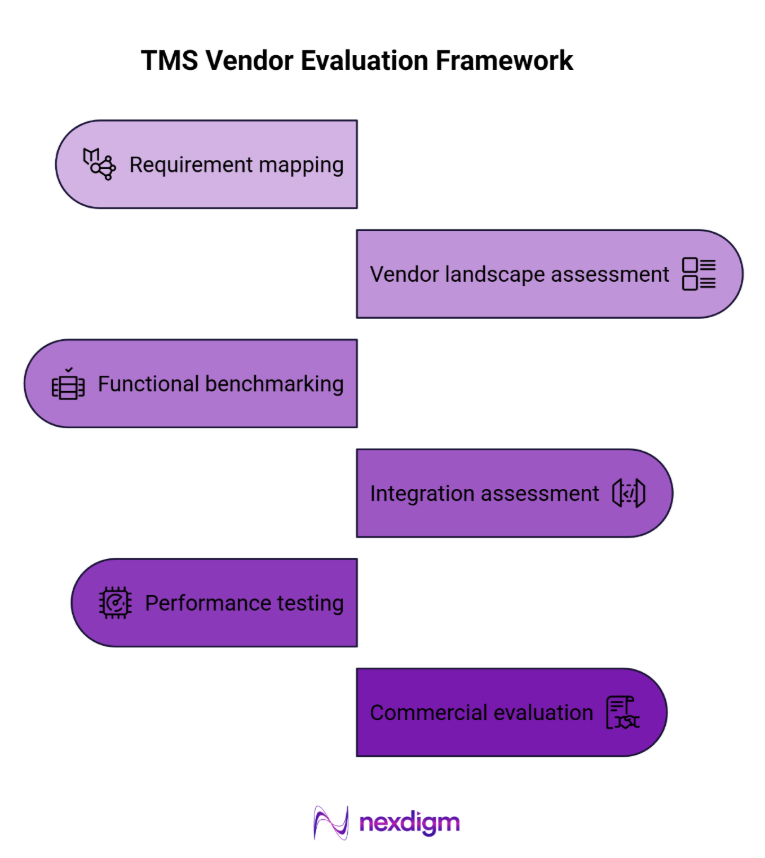
- Requirement mapping: Identify shipment volumes, transport modes, carrier arrangements and operational workflows.
- Vendor landscape assessment: Map TMS providers based on functionality, industry coverage and deployment model.
- Functional benchmarking: Compare route optimisation, carrier management, freight auditing and shipment planning.
- Integration assessment: Evaluate ERP connectivity, API availability, data exchange and implementation requirements.
- Performance testing: Use representative shipment scenarios to test route recommendations, visibility and system response.
- Commercial evaluation: Compare licensing, implementation, maintenance, support and scalability costs.
Nexdigm can support organisations through TMS market research, vendor benchmarking, technology due diligence and procurement assessments. These exercises help businesses compare platform capabilities, understand implementation requirements and identify solutions aligned with transportation operations.
Nexdigm’s Case Study
Nexdigm assessed 8 TMS vendors across 4 operational requirements, including route optimisation, carrier management, shipment visibility and ERP integration. The assessment shortlisted 3 platforms, identified a 20% variation in implementation costs and established 6 evaluation criteria for technology selection.
To take the next step, simply visit our Request a Consultation page and share your requirements with us.
Harsh Mittal
+91-8422857704