
India’s freight transportation network is handling growing cargo volumes, increasing the importance of reliable transport supplier relationships. According to the Ministry of Railways, Indian Railways transported 145.07 million tonnes of freight in October 2026, an 8.32% increase over October 2025. Cumulative freight loading reached 978.78 million tonnes during April–October 2026, exceeding the corresponding period’s performance in the previous year.
As businesses expand distribution networks, dependence on a limited number of transport vendors can create operational vulnerabilities. Supplier unavailability, capacity constraints, or regional concentration may affect delivery schedules and increase procurement costs. Transport vendor dependency analysis helps organizations understand these exposures, evaluate supplier alternatives, and strengthen the resilience of their transportation networks.
Why Transport Supplier Dependency Requires Attention
Transport supplier dependency develops when businesses rely heavily on a limited number of vendors, routes, or service providers to fulfil movement requirements. Although concentrated sourcing may simplify coordination and commercial negotiations, it can create vulnerabilities when suppliers face capacity shortages, financial difficulties, operational disruptions, or geographic limitations. Understanding these dependencies helps procurement teams assess the consequences of supplier unavailability and determine whether existing sourcing arrangements provide sufficient flexibility.
Where Transport Dependency Exposure Can Be Build
Supplier concentration can create exposure across transportation networks in several ways. Businesses may depend on a single vendor for critical routes, face limited fleet availability during peak demand, or operate in regions with few alternative providers. These constraints can restrict sourcing flexibility, increase disruption risks, and make it difficult to maintain delivery schedules when existing suppliers cannot fulfil requirements.
Evaluating Transport Supplier Dependencies and Alternatives
Businesses need to look beyond the number of transport vendors and understand how supplier relationships affect operational continuity. Nexdigm’s procurement research and market intelligence capabilities can help organizations examine:
- Capacity Availability: Examine fleet strength, service coverage, and operating capacity to understand whether existing suppliers can accommodate changing transportation requirements.
- Alternative Sourcing Options: Explore available transport providers and compare their capabilities to identify suitable backup suppliers and opportunities for diversification.
- Route-Level Dependency: Assess reliance on specific transport vendors across critical routes to identify locations where supplier unavailability could affect delivery continuity.
This evaluation helps businesses understand where additional supplier coverage may be required.
How Nexdigm Conducts Transport Vendor Dependency Analysis
Nexdigm’s procurement and market research capabilities can help organizations examine transport supplier concentration and identify potential sourcing vulnerabilities. Our transport vendor dependency analysis can support businesses through three areas of research:
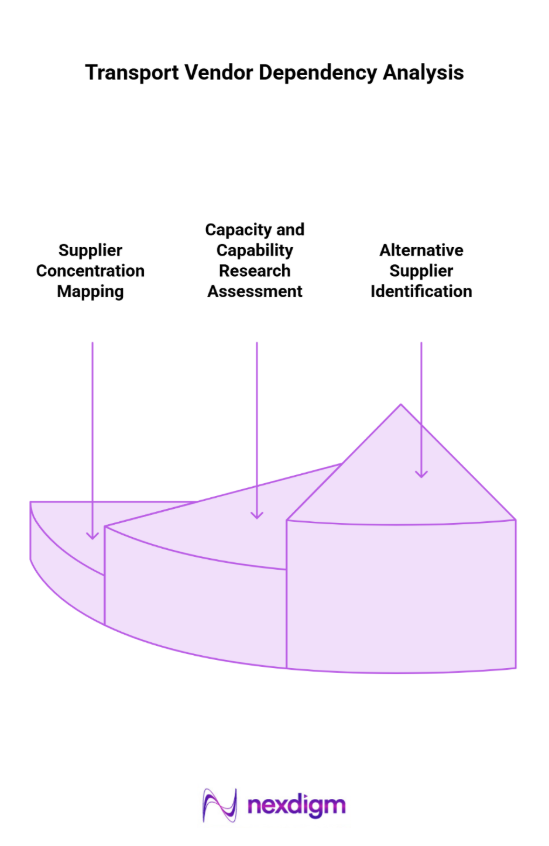
- Supplier Concentration Mapping: Examine vendor distribution across routes, regions, shipment categories, and transportation requirements to identify areas with limited supplier representation.
- Capacity and Capability Research: Assess fleet strength, service coverage, operating capacity, and market presence to understand supplier availability and potential constraints during demand fluctuations.
- Alternative Supplier Identification: Research potential transport providers, compare their service capabilities, and assess their suitability as additional or backup sourcing options.
These insights can help procurement teams understand dependency levels and evaluate opportunities to diversify their transport supplier base.
Benefits of Nexdigm’s Transport Dependency Analysis
Nexdigm’s analysis can help businesses translate supplier dependency findings into practical procurement improvements. Key benefits include:
- Improved Supply Chain Resilience: Identify critical supplier dependencies and potential disruption points to strengthen continuity planning across transportation networks.
- Greater Sourcing Flexibility: Understand alternative vendor availability and capacity to reduce reliance on a limited number of transport providers.
- Better Procurement Decisions: Use supplier and market intelligence to evaluate diversification opportunities, improve sourcing strategies, and support long-term transportation requirements.
- Stronger Negotiating Position: Gain visibility into available suppliers and market alternatives to support commercial discussions and reduce dependence on individual vendors.
Together, these benefits help businesses reduce supplier concentration, improve sourcing flexibility, and build a more resilient transport network capable of responding to changing operational demands.
Nexdigm’s Case
A consumer goods company relied on two major transport vendors for distribution across several regions. Nexdigm’s analysis reviewed route-level supplier concentration, fleet capacity, contractual commitments, and alternative providers. The assessment identified 22% of routes with high supplier dependency, mapped alternative vendors for 4 regions, and highlighted opportunities to improve transport capacity flexibility.
To take the next step, simply visit our Request a Consultation page and share your requirements with us.
Harsh Mittal
+91-8422857704