

In the commercial vehicle landscape, introducing a new truck model requires far more than attractive specifications or competitive pricing. Fleet operators are increasingly focused on profitability, uptime, operating costs, and service reliability when evaluating vehicle purchases.
There’s a need for an effective manufacturer to align their product strategy with fleet requirements, ownership economics, and aftermarket expectations. A comprehensive Truck market feasibility study is therefore essential to determine whether a new truck can achieve sustainable commercial success.
What It Takes to Win in a Competitive Truck Market
Success in today’s truck market depends on far more than vehicle performance or pricing. Fleet operators evaluate trucks based on their ability to improve profitability, maximize uptime, reduce operating costs, and deliver consistent performance throughout their lifecycle. Manufacturers must therefore align their offerings with evolving fleet requirements while ensuring strong aftermarket support and competitive differentiation.
From a Nexdigm perspective, assessing these factors requires a structured market-focused approach that combines customer demand analysis, ownership economics, competitive benchmarking, and service ecosystem readiness. This helps manufacturers determine whether a new truck offering is positioned for sustainable commercial success.
The Five Pillars of Commercial Success
The success of a new truck depends on several factors beyond vehicle performance. Fleet buyers assess the overall value a truck delivers throughout its lifecycle. A comprehensive Truck market feasibility study focuses on five key areas that influence adoption and market competitiveness:
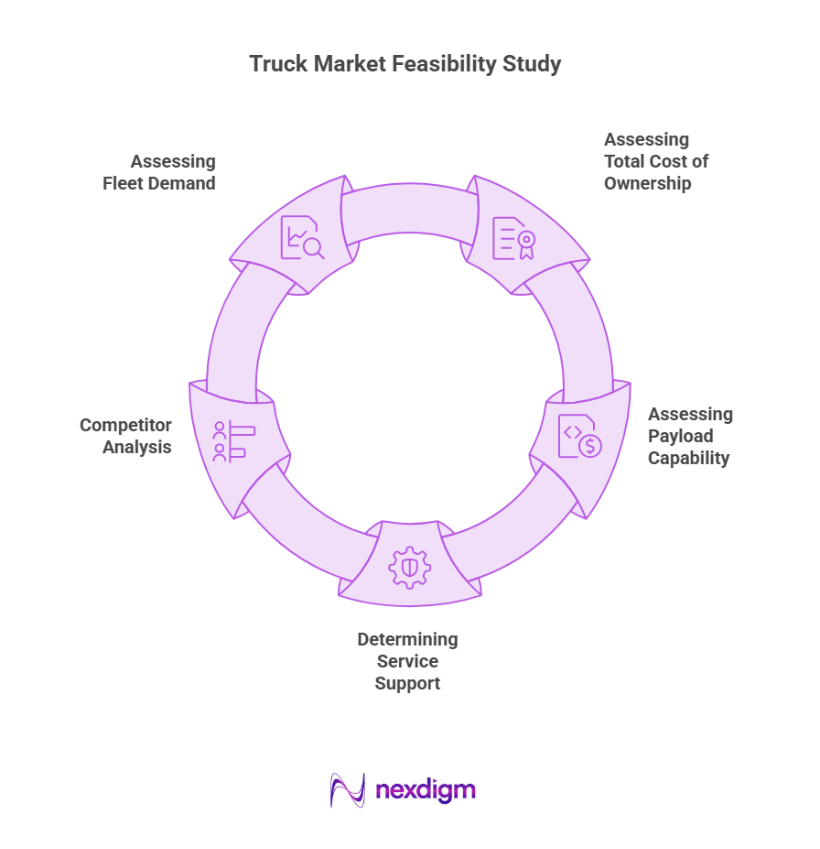
Fleet Demand: Is There a Real Market Need?
Before launching a new truck, manufacturers must first assess whether a genuine gap exists in the market. Fleet operators often seek vehicles that address specific challenges such as:
- Rising fuel costs
- Capacity utilization
- Regulatory compliance
- Route optimization
- Driver productivity
Demand can vary significantly across industries, including:
- Logistics and transportation
- Construction
- Mining
- Infrastructure
- FMCG distribution
- E-commerce fulfillment
A robust Truck market feasibility study helps determine whether customer needs are sufficiently differentiated to justify a new market entry.
Total Cost of Ownership (TCO): The Ultimate Decision Driver
For fleet operators, purchase price is only one aspect of the investment decision. What matters more is the total cost incurred throughout the vehicle’s life. TCO typically includes:
- Acquisition cost
- Fuel consumption
- Maintenance expenses
- Spare parts costs
- Insurance
- Financing costs
- Residual value
A truck with a higher upfront cost can often gain market acceptance if it delivers superior long-term operating economics.
Why TCO Matters
Fleet owners increasingly compare vehicles based on:
- Cost per kilometer
- Vehicle uptime
- Fuel efficiency
- Repair frequency
Manufacturers capable of demonstrating meaningful TCO advantages often gain stronger adoption among commercial customers.
Payload Capability: Improving Revenue Potential
Payload directly influences fleet profitability. The greater the cargo carrying capacity within regulatory limits, the higher the potential revenue per trip. When evaluating a new truck offering, fleet operators typically examine:
- Gross vehicle weight rating
- Chassis design
- Body configurations
- Load optimization
- Weight efficiency
A lighter and better-engineered vehicle can often create substantial operational benefits through increased cargo capacity.
Commercial Impact
Even marginal payload improvements can generate significant annual revenue gains across large fleets operating high-frequency transportation routes.
Service Support: The Often-Overlooked Differentiator
Many promising vehicle launches fail not because of product shortcomings but due to inadequate service infrastructure. Fleet operators place significant emphasis on:
- Workshop accessibility
- Spare parts availability
- Service response times
- Predictive maintenance capabilities
- Technical support networks
Downtime directly affects profitability, making reliable service support a critical purchasing factor.
Competition: Standing Out in a Mature Market
The commercial vehicle industry is highly competitive, with established manufacturers benefiting from brand recognition, dealer networks, and customer loyalty. For a new offering to succeed, it must clearly differentiate itself through:
- Lower operating costs
- Better fuel efficiency
- Higher payload capability
- Advanced technology
- Improved safety features
- Stronger service support
The ability to communicate a compelling value proposition is often as important as the product itself.
Evaluating Truck Market Opportunities with Nexdigm
Vehicle manufacturers and investors often face complex decisions before committing resources to a new truck program. This is where Nexdigm can provide strategic value through comprehensive Truck Market Feasibility Study and Market Opportunity Assessment.
Market Opportunity Assessment
Understanding market attractiveness is the starting point for any successful launch strategy. Nexdigm can support businesses through:
- Market sizing and segmentation
- Customer demand assessment
- Industry trend evaluation
- Regional growth opportunity analysis
- Competitive landscape mapping
These insights help organizations identify promising markets and prioritize investments effectively.
Why It Matters
A data-driven understanding of demand enables manufacturers to align product development and go-to-market strategies with actual customer requirements.
Truck Demand and Fleet Economics Analysis
Demand alone does not determine success. Organizations must also understand customer purchasing behavior and fleet economics. Nexdigm can assist in evaluating:
- Fleet replacement cycles
- Vehicle utilization trends
- Ownership cost expectations
- TCO benchmarks
- Industry-specific purchasing criteria
Why It Matters
A strong value proposition must address the economic realities faced by fleet operators, not just technical specifications.
Nexdigm’s Case
Nexdigm assisted an automotive player in evaluating a new truck offering as India’s commercial vehicle segment grew 13% in FY26, supported by fleet renewal and freight demand. The study assessed TCO, payload, service support, and competition, identifying winning strategies.
To take the next step, simply visit our Request a Consultation page and share your requirements with us.
Harsh Mittal
+91-8422857704