

Truck supplier selection has become more complex as logistics operators balance payload, route conditions, vehicle availability, operating costs, and changing powertrain options. The International Energy Agency (IEA) reports that electric trucks exceeded 400,000 sales globally in 2025, representing 9% of all truck sales and more than double the previous year’s volume. The IEA also notes that electric truck production reached approximately 440,000 units, with more than 90% manufactured in China.
These shifts are reshaping supplier capabilities, product portfolios, and sourcing considerations across markets. For fleet operators, truck supplier benchmarking provides a structured way to compare manufacturers beyond purchase price and identify suppliers whose vehicles, service networks, and commercial terms align with operational requirements across fleet sizes and operating conditions.
Why Truck Supplier Selection Depends on Operating Context
A truck that performs well on highways may be unsuitable for congested urban routes, construction deliveries, or temperature-controlled distribution. Supplier evaluation must therefore account for vehicle configuration, payload, engine or battery performance, fuel efficiency, maintenance access, and uptime support. Comparing manufacturers against actual duty cycles helps logistics companies distinguish product strengths from broad brand reputation and select partners capable of supporting fleet requirements over the vehicle’s expected service life.
Key Considerations When Comparing Truck Suppliers
Before committing to a manufacturer, logistics companies should assess how well each supplier meets their business requirements. A structured comparison should focus on these areas:
- Fleet Compatibility: Determine whether the supplier offers vehicle models and configurations suited to the company’s fleet composition, cargo requirements, and operating conditions.
- Supply and Service Coverage: Examine vehicle availability, delivery timelines, dealership reach, maintenance facilities, and spare-parts support across key operating regions.
Evaluating these factors together helps businesses distinguish between suppliers that meet immediate purchasing needs and those capable of supporting long-term fleet operations.
How Nexdigm Helps Logistics Companies Benchmark Truck Manufacturers
Nexdigm supports logistics companies through truck supplier benchmarking, comparing manufacturers across market presence, product portfolios, technical capabilities, and commercial offerings. The research can assess vehicle specifications, payload capacity, powertrain options, pricing, warranty terms, dealership networks, and after-sales support. These insights help procurement teams evaluate supplier strengths, identify suitable manufacturers, and shortlist partners aligned with fleet requirements and long-term operating priorities.
Understanding Competitive Gaps Across the Truck Supplier Landscape
Nexdigm can help logistics companies assess differences between truck manufacturers through focused market research:
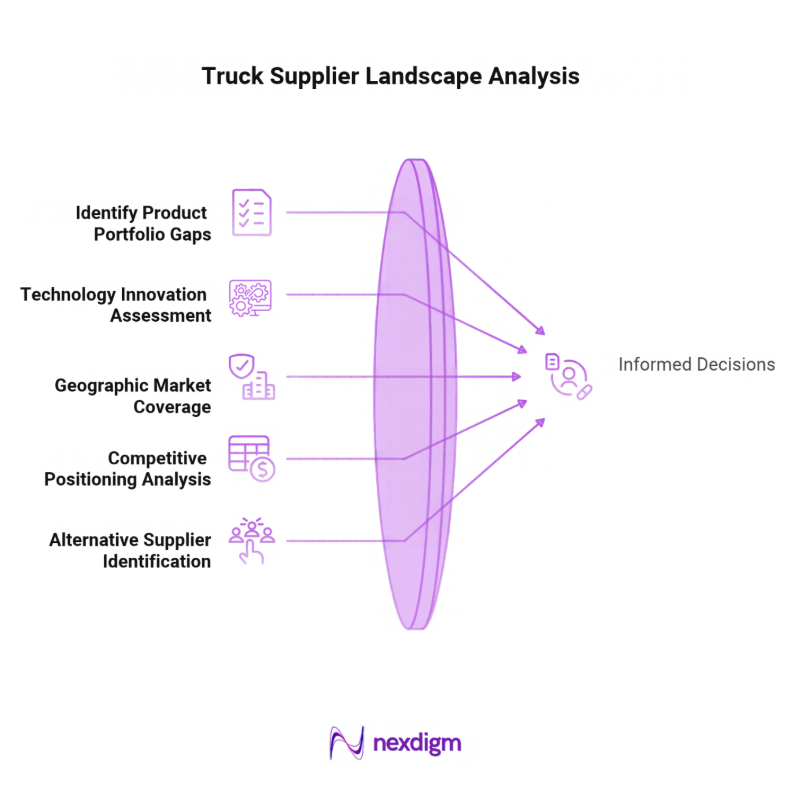
- Product Portfolio Gaps: Identify differences in vehicle categories, payload capacities, configurations, and specialised truck offerings across manufacturers.
- Technology and Innovation: Compare powertrain options, fuel technologies, safety features, and investments in emerging vehicle technologies.
- Geographic Market Coverage: Examine manufacturers’ presence across regions, dealership networks, distribution reach, and service availability.
- Competitive Positioning: Evaluate supplier strengths, market presence, product differentiation, and relative positioning against competing manufacturers.
- Alternative Supplier Identification: Identify manufacturers whose offerings may better address specific fleet requirements, sourcing priorities, or operational gaps.
These insights can help procurement teams recognise competitive differences, explore suitable alternatives, and refine their truck sourcing strategies.
Nexdigm in Helping Logistics Companies Monitor Truck Supplier Market Developments
Changes in the commercial vehicle market can influence supplier competitiveness, product availability, and procurement priorities. Nexdigm can help logistics businesses track these developments through ongoing market research and analysis:
- New Model Launches: Track new truck introductions, product upgrades, and changes in manufacturer portfolios.
- Supplier Expansion: Monitor manufacturers entering new markets, expanding production capacity, or strengthening dealership networks.
- Pricing Developments: Examine changes in vehicle pricing, financing offers, and commercial terms across suppliers.
- Technology Shifts: Follow developments in electric trucks, alternative fuels, and vehicle technologies that may influence future sourcing choices.
This market visibility can help procurement teams anticipate changes, reassess supplier options, and keep sourcing strategies aligned with evolving industry conditions.
Nexdigm’s Case
A logistics company wanted to review its truck supplier base to support fleet expansion across regional distribution and long-haul operations. With Nexdigm’s research support, the assessment compared manufacturers across vehicle specifications and after-sales capabilities. The analysis identified potential cost optimisation through supplier comparison, 17% scope to improve supplier coverage, and 14% potential improvement in vehicle-category alignment. These insights helped the company refine its supplier shortlist and align sourcing decisions with its fleet and route requirements.
To take the next step, simply visit our Request a Consultation page and share your requirements with us.
Harsh Mittal
+91-8422857704