

Truck transport rate benchmarking helps businesses compare freight charges across lanes where regional differences can range from 15% to 25%. By evaluating distance, fuel exposure, tolls, capacity availability, delivery density, vehicle type, and backhaul potential, companies can identify pricing gaps and negotiate more effectively.
Structured pricing analysis also supports lane-level cost control, carrier selection, contract design, and margin protection. With reliable benchmarks, shippers and transport providers can develop competitive rate structures, improve budget accuracy, reduce pricing inconsistencies, and respond confidently to changing market conditions across regional and long-haul networks consistently.
Current market indicators support disciplined benchmarking: U.S. national van spot rates reached $2.43 per mile in February 2026, while Europe’s Q1 contract-rate index rose to 140.1, up 3.2 points quarterly, reinforcing stronger lane comparisons, negotiations, and pricing decisions for operators.
Strategic Truck Transport Pricing Analysis Across Regional Lanes
Strategic truck transport pricing analysis evaluates regional lane costs, capacity patterns, service requirements, and market conditions to build competitive rate structures, strengthen negotiations, protect margins, and improve network performance consistently. Core elements of truck transport pricing analysis are:
- Capacity Availability Mapping: Assess truck supply, seasonal shortages, carrier dependence, and equipment availability to identify rate pressure and strengthen procurement decisions across constrained lanes.
- Delivery Density Assessment: Measure stop frequency, shipment concentration, urban complexity, and delivery windows to ensure route intensity is accurately reflected in regional transport rates.
- Regional Cost-to-Serve Analysis: Allocate driver time, tolls, fuel, maintenance, detention, and handling costs by lane to establish a defensible foundation for pricing decisions.
- Fuel Surcharge Calibration: Align surcharge formulas with regional diesel indices, review frequencies, and consumption patterns to improve cost recovery and maintain transparency across customer contracts.
Nexdigm’s Data-Led Assistance for Truck Transport Pricing Decisions
Nexdigm’s Data-Led Assistance for Regional Lane Pricing Decisions combines truck transport rate benchmarking, pricing analysis, competitive pricing analysis, lane benchmarking, and freight cost analytics to help businesses optimize regional transport rates. Leveraging route-level cost assessment, market intelligence, pricing strategy development, carrier benchmarking, and margin analysis, Nexdigm enables organizations to improve pricing accuracy, strengthen negotiations, protect profitability, and make data-driven commercial decisions across diverse transport corridors.
Nexdigm’s Integrated Truck Benchmarking and Pricing Strategy Blueprint
Nexdigm’s Integrated Truck Rate Benchmarking and Pricing Strategy Blueprint combines lane economics, market intelligence, cost analysis, and governance to strengthen regional pricing decisions, margins, negotiations, and transport network competitiveness consistently. Blueprint Strategies used by Nexdigm’s experts are:
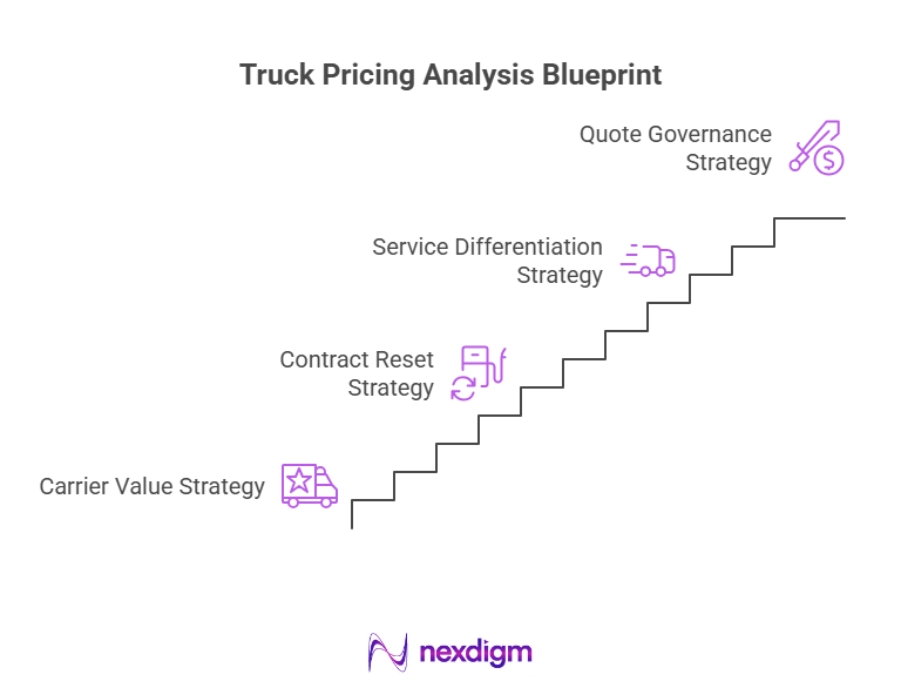
- Carrier Value Strategy: Benchmark carrier rates alongside reliability, claims performance, equipment availability, and service responsiveness to prioritize providers delivering superior total commercial value.
- Contract Reset Strategy: Define rate-review triggers linked to fuel indices, toll changes, labor costs, and capacity conditions to keep long-term transport contracts commercially sustainable.
- Service Differentiation Strategy: Price standard, expedited, specialized, and time-critical transport services according to handling complexity, reliability commitments, delivery urgency, and customer value expectations.
- Quote Governance Strategy: Introduce approval limits, discount controls, pricing floors, and escalation protocols to reduce inconsistent quotations and prevent avoidable margin erosion across regions.
Nexdigm’s Case
In a recent engagement, Nexdigm helped a truck transport provider strengthen lane pricing through rate benchmarking, cost analysis, and pricing governance. The initiative improved quote conversion by 12%, increased average margins by 10%, reduced pricing turnaround and improved contract retention.
To take the next step, simply visit our Request a Consultation page and share your requirements with us.
Harsh Mittal
+91-8422857704