
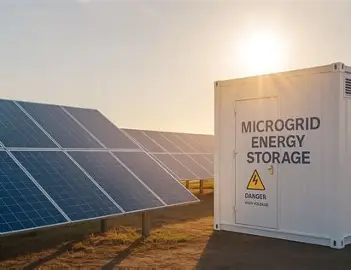
The UAE Battery Energy Storage for Microgrids Market is witnessing rapid growth, supported by the country’s commitment to the UAE Net Zero 2050 Strategic Initiative and clean-energy investments exceeding AED 600 billion (USD 163 billion). The UAE operates more than 45 GW of installed power-generation capacity and is expanding renewable energy through projects such as the Mohammed bin Rashid Al Maktoum Solar Park, which is expected to reach 5 GW capacity. Growing demand from smart cities, data centers, airports, industrial zones, and critical infrastructure is accelerating adoption of battery-backed microgrids. Advanced lithium-ion storage systems, AI-enabled energy management platforms, and solar-plus-storage solutions are increasingly deployed to improve energy resilience, optimize renewable energy utilization, and reduce dependence on conventional power generation across commercial and industrial applications.
Key Market Drivers for the UAE Battery Energy Storage for Microgrids Market
Renewable Energy Expansion Accelerates Storage Demand
The UAE is rapidly expanding renewable energy generation through projects such as the Mohammed bin Rashid Al Maktoum Solar Park, which is expected to reach 5 GW capacity, making it one of the world’s largest solar parks. As solar penetration increases, battery storage systems are becoming critical for balancing electricity supply, mitigating intermittency, and supporting stable microgrid operations. Solar-plus-storage projects are increasingly being adopted across commercial and industrial facilities to improve energy resilience and reduce dependence on conventional generation.
Smart Cities and Critical Infrastructure Strengthen Market Growth
Major developments such as Masdar City, Expo City Dubai, and various smart infrastructure projects are driving demand for resilient and sustainable energy systems. Data centers, airports, hospitals, military facilities, and industrial complexes increasingly require uninterrupted power supply and energy optimization solutions. Battery-backed microgrids provide enhanced reliability, peak-load management, and backup power capabilities, making them attractive investments across critical infrastructure applications.
Industrial Diversification and Energy Security Create New Opportunities
The UAE’s economic diversification strategy continues to drive investment in advanced manufacturing, logistics, technology parks, and industrial zones. Facilities operating in remote or energy-intensive locations increasingly deploy battery energy storage systems alongside solar generation to improve operational efficiency and reduce electricity costs. This trend is creating strong demand for advanced lithium-ion and next-generation battery technologies integrated within microgrid environments.
Government Initiatives Supporting the UAE Battery Energy Storage for Microgrids Market
The UAE government continues to support deployment of battery energy storage systems through the UAE Net Zero 2050 Strategic Initiative, under which more than AED 600 billion (approximately USD 163 billion) has been allocated toward clean energy and sustainability investments. National programs supporting renewable energy expansion, grid modernization, hydrogen development, and smart infrastructure are encouraging the adoption of battery-backed microgrids. Additionally, the UAE Energy Strategy 2050 targets a significant increase in clean-energy utilization, creating favorable conditions for battery storage deployment across utility, commercial, and industrial sectors.
Competitive Landscape of the UAE Battery Energy Storage for Microgrids Market
The UAE Battery Energy Storage for Microgrids Market is highly competitive and supported by growing investments in solar energy, smart cities, industrial infrastructure, and data centers. Competition is increasingly focused on battery performance, storage duration, lifecycle efficiency, energy-management software, and microgrid integration capabilities. Major participants including Tesla Energy, BYD, Huawei Digital Power, Sungrow, Schneider Electric, Siemens, Hitachi Energy, Fluence, and ABB continue to strengthen their presence in the UAE energy-storage sector. Companies are increasingly offering integrated solar-plus-storage solutions, AI-powered energy management platforms, and grid-support technologies to meet evolving customer requirements.
Major Challenges Facing the UAE Battery Energy Storage for Microgrids Market
High Upfront Capital Investment Requirements
Although battery costs continue to decline globally, large-scale battery storage projects still require substantial upfront investment. Financing and project economics remain important considerations for commercial and industrial users.
Harsh Climate and Thermal Management Requirements
Extreme temperatures in the UAE can affect battery performance, efficiency, and lifespan. Effective thermal management systems and advanced battery chemistries are increasingly important for ensuring long-term operational reliability.
Future Outlook
The UAE Battery Energy Storage for Microgrids Market is expected to witness strong growth through 2035, supported by clean-energy investments exceeding AED 600 billion, solar generation projects surpassing 5 GW, and increasing demand for resilient energy infrastructure. Expansion of smart cities, hyperscale data centers, industrial zones, airports, and logistics facilities will continue to strengthen demand for microgrid-based energy storage systems. Additionally, growing adoption of lithium-ion batteries, AI-enabled energy-management platforms, virtual power plant technologies, and hybrid renewable-energy microgrids is expected to create significant opportunities for storage providers, system integrators, and technology developers across the UAE’s rapidly evolving energy ecosystem.
Consultants at Nexdigm, in their latest publication “UAE Battery Energy Storage for Microgrids Market Outlook to 2035” analyse the sector By Energy Storage Technology (Lithium Iron Phosphate (LFP), Nickel Manganese Cobalt (NMC) and Lithium Titanate (LTO)), By End-User Application (Utility-Scale Microgrid Integration and Commercial and Industrial Facilities) and By Power Capacity Tier (Below 100 kWh, 100 kWh to 1 MWh and 1MWh to 10MWh).
Nexdigm suggests that businesses in the UAE Battery Energy Storage for Microgrids Industry prioritize lithium-ion battery systems, solar-plus-storage microgrids, AI-enabled energy management platforms, and resilient power solutions to capitalize on AED 600 billion+ clean-energy investments, 5 GW+ solar capacity expansion, growing smart-city developments, and increasing demand for reliable, low-carbon energy infrastructure across commercial, industrial, and utility applications.
To take the next step, simply visit our Request a Consultation page and share your requirements with us.
Harsh Mittal
+91-8422857704