

A university entering a new city or region competes with institutions that may already have established reputations, alumni networks, employer relationships and local trust. A new campus cannot assume that a familiar brand or a broad programme catalogue will be enough to attract students. It needs a reason for prospective students to choose it over institutions they already know.
Differentiation is most credible when it reflects a genuine market gap and can be delivered consistently. A university must decide which learners it intends to serve, what it can offer that competitors do not, and whether the proposition justifies the investment required to enter.
What the Higher Education Market Reveals
India’s higher education enrollment reached 4.50 crore students in 2023–24, according to the Ministry of Education’s All India Survey on Higher Education.
The gross enrollment ratio for the 18–23 age group reached 30%.
These figures indicate the scale of higher education participation, but they do not show where an incoming university can win students or what those students will pay for.
The relevant market is narrower:
eligible students in the target geography who are considering the proposed programmes and can realistically access the institution.
Their alternatives may include public universities, private colleges, specialist institutions, online degrees or moving to another city.
A university should therefore avoid defining its position only through general claims about quality, innovation or industry relevance. These claims are difficult to distinguish when competing institutions make similar promises.
Differentiation needs to be visible in the programme offer, learning experience, student support, employer connections or access model.
Four Ways to Build a Distinct University Proposition
- Specialised programmes: A university may focus on disciplines aligned with regional industries, emerging occupations or underserved academic areas. Specialisation can attract a clear student segment, but it depends on faculty depth, programme approvals and sufficient enrollment.
- Employer-connected education: Internships, applied projects, industry-led modules and employer participation can strengthen the connection between study and work. These features require real partnerships and reliable delivery, not simply an advisory board listed on a website.
- Distinctive student experience: Academic advising, flexible course pathways, accessible faculty, research opportunities and effective administration can differentiate an institution in a crowded market. Operational consistency matters because students experience these services throughout their studies.
- Alternative access models: Blended delivery, flexible schedules, satellite facilities or partnerships with local institutions may help a university reach learner who cannot relocate or attend conventional daytime classes.
The choice should reflect the target market. A research-intensive university and a career-focused regional institution may both succeed, but they need different investments and measures of performance.
University Competitiveness Market Entry Strategy: How to Test Differentiation
A university competitiveness market entry strategy should establish whether the proposed proposition is distinctive, relevant to students and commercially supportable.
The assessment needs to compare competing institutions by programme portfolio, fees, entry requirements, faculty, facilities, delivery modes, employer connections and student outcomes. It should then identify where the proposed university has a credible advantage and where it would be entering a market with little room for differentiation.
Student research is equally important. Prospective applicants may say they value international exposure or advanced facilities, but their final choices may be driven by fees, location and job prospects. Interviews, preference research, competitor analysis and application data can help distinguish stated interest from likely enrollment.
A university should also test whether its differentiators are affordable to deliver. Specialist laboratories, international partnerships and intensive career services may strengthen the proposition, but they add costs. The financial model must establish whether expected enrollment and fees can support them.
University Market Differentiation Framework
The University Market Entry Differentiation Framework links competitive positioning to investment decisions.
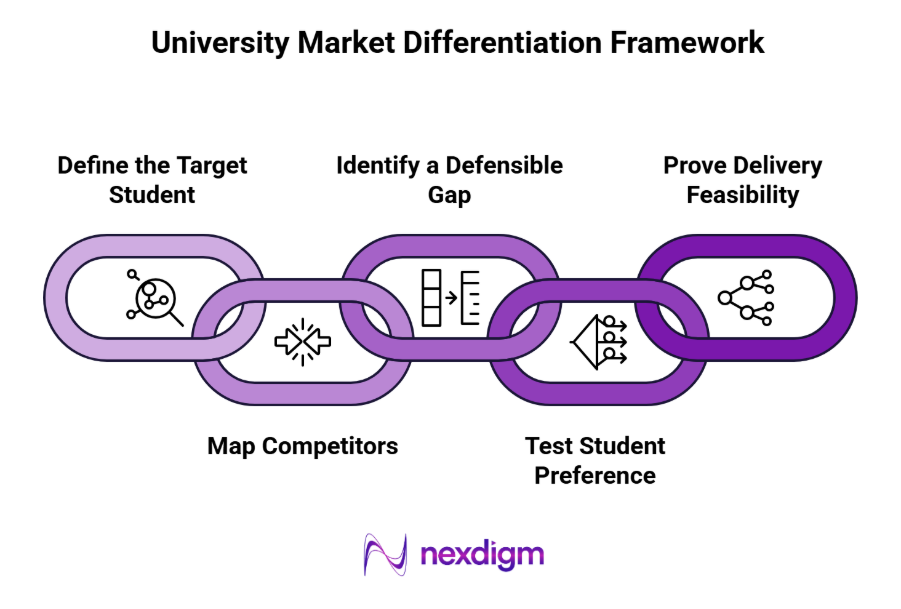
- Define the Target Student: Identify the programmes, geographies, academic profiles and career goals the university will serve.
- Map Competitors: Compare direct alternatives on price, programme quality, accessibility, outcomes and reputation.
- Identify a Defensible Gap: Find unmet needs that align with the university’s academic strengths and delivery capabilities.
- Test Student Preference: Validate the proposition through interviews, surveys, competitor comparisons and enrollment modelling.
- Prove Delivery Feasibility: Assess faculty, approvals, facilities, partnerships and the cost of maintaining the promised experience.
Differentiation should be specific enough that a student can explain why the university fits their needs. If the proposition could describe almost any institution, it is unlikely to support a strong market entry.
Nexdigm Case Study: Positioning a University for Entry
Nexdigm compared five universities and proposed programmes across a new target region. The assessment identified a gap in applied programmes connected to local industry, while broad general-degree offerings faced stronger competition. The institution prioritised three specialist programmes and made launch sequencing dependent on faculty recruitment and employer partnerships.
To take the next step, simply visit our Request a Consultation page and share your requirements with us.
Harsh Mittal
+91-8422857704