

University enrollment potential cannot be determined by looking at population or overall higher-education participation alone. Institutions must understand how many prospective students are actually addressable, which competitors already serve them, and how mobility influences their destination choices. UNESCO estimates that global higher-education enrollment reached 269 million students in 2024, more than twice the level recorded in 2000, while approximately 7.3 million students study outside their country of origin. These trends indicate substantial opportunity, but market size does not automatically translate into institutional enrollment.
A structured University enrollment market assessment helps institutions estimate realistic capture potential by evaluating student demand, competitive intensity, programme fit, affordability, geographic reach, institutional positioning, and mobility patterns. For universities considering expansion, new programmes, campuses, or recruitment strategies, understanding the difference between total market demand and realistically capturable demand is critical.
Market Size Does Not Equal Enrollment Potential
A large student population may appear attractive, but actual enrollment potential depends on the addressable segment. Programme relevance, tuition affordability, admission requirements, location, delivery format, and student preferences can significantly reduce the practical market size.
Institutions therefore need to distinguish between the total student pool, targetable population, qualified prospects, and realistically convertible students. This provides a more useful basis for capacity planning and growth decisions.
Competition and Mobility Shape the Addressable Market
Students rarely evaluate one institution in isolation. They compare universities based on reputation, programme quality, affordability, location, employability, delivery options, and perceived career outcomes. International mobility adds another dimension, allowing students to consider institutions beyond their domestic markets.
UNESCO estimates that internationally mobile students have more than tripled since 2000, reaching approximately 7.3 million in 2024. This makes competitor mapping and student mobility analysis increasingly important when estimating an institution’s potential enrollment share.
Nexdigm’s Role in Understanding Enrollment Potential
Determining realistic enrollment potential requires more than applying a standard market-share assumption. Nexdigm brings expertise in education market intelligence, demand assessment, competitive analysis, student segmentation, and strategic advisory to help institutions evaluate their addressable markets.
Nexdigm can examine student demographics, enrollment trends, programme demand, competitor capacity, tuition levels, mobility patterns, geographic catchments, and institutional positioning. This creates a more evidence-based view of where prospective students are located, which segments are accessible, and what factors may influence conversion.
Nexdigm’s University Enrollment Market Assessment Framework
Nexdigm’s University enrollment market assessment can provide a structured framework for estimating realistic enrollment opportunities across markets and student segments. This is done by focusing on areas such as:
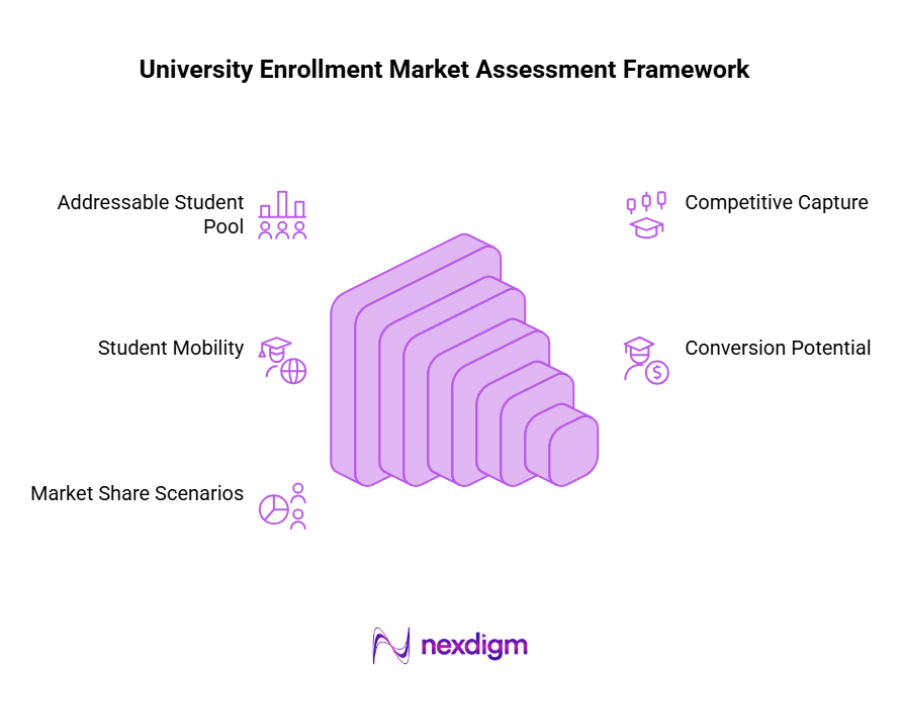
- Addressable Student Pool: Define the relevant student population based on geography, academic eligibility, programme interests, demographics, and affordability.
- Competitive Capture: Evaluate competing institutions, programme capacity, pricing, positioning, and market presence to understand the existing enrollment landscape.
- Student Mobility: Assess domestic and international movement patterns to determine where students are choosing to study and what drives those decisions.
- Conversion Potential: Consider awareness, admissions requirements, programme fit, affordability, location, and institutional attractiveness when estimating realistic enrollment conversion.
- Market Share Scenarios: Develop conservative, base, and growth scenarios to illustrate potential enrollment outcomes under different competitive and demand conditions.
This approach helps institutions avoid relying on broad market-size assumptions and instead build more realistic enrollment scenarios.
Nexdigm’s Market Assessment Building Sustainable Enrollment Strategy
Once potential enrollment has been estimated, institutions need to determine how that opportunity can be converted into actual students. Nexdigm can connect enrollment analysis with practical institutional priorities through:
- Recruitment Planning: Identify priority geographies and student segments for targeted recruitment investment.
- Programme Strategy: Align programme portfolios with areas where student demand and institutional capabilities overlap.
- Capacity Planning: Support decisions around faculty, infrastructure, campus capacity, and delivery models based on expected enrollment.
- Market Expansion: Evaluate whether new locations, partnerships, or international recruitment channels can expand the addressable student pool.
- Competitive Positioning: Identify gaps in competitor offerings that could create opportunities for differentiation.
This creates a direct link between market potential, enrollment targets, and institutional action.
Why Institutions Choose Nexdigm as Their Strategic Partner
Nexdigm’s analysis can help institutions examine several variables before setting enrollment expectations. A university with strong demand but limited awareness may require a different strategy from one operating in a highly competitive market. Similarly, an institution offering high-demand programmes may still face constraints if pricing, admissions requirements, or delivery models do not match student expectations.
Nexdigm’s Case Study
Nexdigm supported a university evaluating enrollment potential across selected domestic and international markets. The assessment modeled three enrollment scenarios, mapped 18 priority catchment areas, and identified a 22% addressable-demand gap. The findings helped refine recruitment priorities and focus expansion planning on markets with stronger student-capture potential.
To take the next step, simply visit our Request a Consultation page and share your requirements with us.
Harsh Mittal
+91-8422857704