

University expansion is often framed around rising enrolment. But the strategic opportunity for a university depends on which students are entering higher education, what they intend to study, where they are willing to study and what programmes institutions can deliver sustainably.
India’s higher education system enrolled 4.50 crore students in 2023–24, up from 3.42 crore in 2014–15. The higher education gross enrolment ratio reached 30.0%, compared with 23.7% a decade earlier. The system included 1,289 universities and 48,246 colleges.
The scale of participation is clear. The growth opportunity is more selective.
The Next Growth Market May Be a Segment, not a Campus
A university deciding where to expand has several possible growth levers. It can add programmes, increase capacity in existing disciplines, target new student segments, expand geographically or develop new delivery formats.
These choices address different sources of demand.
The undergraduate market remains the largest, accounting for about 76.8% of higher-education enrolment in 2023–24. Postgraduate enrolment represented approximately 12.9%.
Within these broad categories, programme-level demand is also uneven. Arts accounted for the largest share of undergraduate enrolment, followed by Science, Engineering and Technology, and Commerce. At postgraduate level, Social Sciences and Management were among the largest fields.
A university therefore needs to ask a more specific question than whether higher education is growing: which student-programme combinations offer sufficient demand to justify additional capacity?
Four Growth Pools Deserve Separate Analysis
- Emerging undergraduate demand
Growing participation can create opportunities in undergraduate programmes, particularly where local capacity is limited, or existing programmes do not align with student preferences. - Professional and employment-linked programmes
Programmes associated with technology, management, healthcare, business and other employment-oriented fields may attract students whose decisions are influenced strongly by perceived career outcomes. - Postgraduate specialisation
Postgraduate demand can be narrower but potentially more specialised, making programme reputation, faculty expertise and industry linkages particularly relevant. - Underrepresented student segments
Women, regional students and other groups with changing participation patterns can represent meaningful sources of enrolment growth when programmes and delivery models address their access requirements.
The appropriate growth strategy depends on the institution’s existing capabilities. A university with strong STEM faculty may pursue a different opportunity from one with established strengths in social sciences or professional education.
STEM Shows Why Aggregate Numbers Can Mislead
STEM enrolment reached 1,01,88,988 students in 2023–24, representing roughly 22.6% of total higher-education enrolment. Women accounted for about 44% of STEM enrolment.
But STEM itself is not a single market. Science and Engineering & Technology have different student profiles, faculty requirements, infrastructure needs and career pathways.
That distinction matters for investment decisions. A university assessing a new engineering programme cannot assume that growth in overall STEM participation translates directly into demand for that programme.
Programme-level analysis needs to examine student preferences, competing institutions, fees, capacity, faculty availability and employment outcomes.
Geography Can Change the Growth Case
Higher education expansion is also shaped by where students are willing to study.
A university in a major urban centre competes within a dense institutional ecosystem. A regional institution may face a different mix of local demand, migration patterns, affordability and programme availability.
The opportunity can therefore lie in a specific student catchment rather than the national market. Understanding where students currently travel for particular programmes can reveal gaps that aggregate enrolment data cannot.
From Student Growth to Programme Strategy
For institutions evaluating university market assessment consulting, the objective is to identify the student segments and programmes where additional capacity has a defensible demand case, while accounting for competition and institutional capabilities.
Nexdigm’s University Growth Assessment
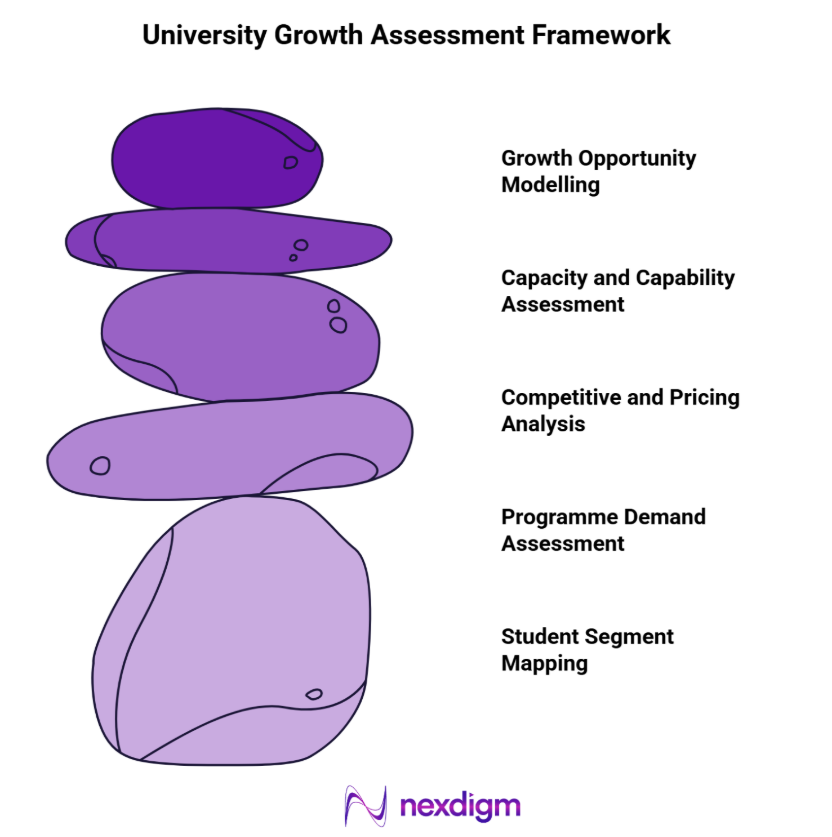
- Student Segment Mapping
Analyse prospective students by geography, academic background, income, demographic profile and programme preference. - Programme Demand Assessment
Evaluate enrolment trends, student preferences, competitive offerings and unmet demand across disciplines. - Competitive and Pricing Analysis
Compare universities and programmes on fees, capacity, positioning, facilities and market presence. - Capacity and Capability Assessment
Assess faculty, infrastructure, accreditation requirements and institutional capabilities needed to launch or expand programmes. - Growth Opportunity Modelling
Develop enrolment and revenue scenarios to assess the commercial potential of different programmes and student segments.
Nexdigm’s Case Study: Prioritising Programme Expansion
Evaluation of six disciplines by learner interest, competitor seat capacity, pricing benchmarks, and staffing viability narrowed the expansion pipeline to three programmes, spotlighting an underserved segment where local seat availability trailed projected demand by 34%.
Nexdigm can support universities and education investors with student research, programme demand analysis, competitive benchmarking, geographic assessment and growth-market modelling.
To take the next step, simply visit our Request a Consultation page and share your requirements with us.
Harsh Mittal
+91-8422857704