

University demand is expanding globally, but growth is increasingly differentiated by geography, programme type, student profile, and mobility patterns. UNESCO reports that global higher-education enrollment reached 269 million students in 2024, more than double the level recorded in 2000. The global tertiary enrollment ratio also reached 44% in 2024, although participation remains highly uneven between income groups.
International mobility is expanding alongside overall demand, with approximately 7.3 million students studying abroad, more than three times the number in 2000. These trends create opportunities across undergraduate, postgraduate, STEM, professional, international, and lifelong-learning segments.
For universities, understanding where enrollment is accelerating and which student groups are most likely to seek specific programmes can support decisions around programme development, capacity planning, recruitment strategies, partnerships, and geographic expansion.
Where Student Demand Is Shifting
Overall enrollment growth does not tell the full story of university opportunity. Demand can vary significantly by country, degree level, discipline, affordability, and student mobility. STEM, postgraduate, professional, international, and career-focused programmes may attract different student profiles and growth patterns, making segment-level analysis increasingly important for institutions planning future academic capacity.
Which Student Segments Are Driving Growth
Student demand is evolving across demographics, academic disciplines, and geographies, creating new opportunities for institutions to strengthen enrollment strategies. A structured assessment helps universities identify where growth is occurring and align programme offerings with emerging student preferences.
- Emerging Demand Segments: Identify student groups, disciplines, and degree levels showing stronger enrollment growth or changing preferences.
- Geographic Opportunities: Compare domestic and international markets based on student pools, affordability, mobility, competition, and programme demand.
- Programme and Career Alignment: Assess demand for programmes linked to high-growth industries, evolving workforce requirements, and career outcomes that increasingly influence student decision-making.
Together, these perspectives help institutions understand where student demand is developing and where future enrollment opportunities may be strongest.
Nexdigm’s Education Sector Industry Specific Expertise
Nexdigm supports education institutions and stakeholders in navigating changing market conditions through industry-focused research, market intelligence, and strategic advisory. Its work helps organizations understand evolving student demand, assess market attractiveness, evaluate competitive landscapes, and identify areas for sustainable growth. By combining sector knowledge with data-led analysis, Nexdigm helps institutions make informed decisions around programme development, student recruitment, capacity planning, partnerships, and geographic expansion.
Nexdigm Delivering Expertise Through University Market Assessment
As student demand becomes more diverse across markets and programme categories, institutions need a clearer view of the factors shaping enrollment potential. Nexdigm brings expertise in University Market Assessment and strategic advisory to help education institutions evaluate changing student markets.
Its approach can examine enrollment trends, student demographics, mobility patterns, programme preferences, affordability, competitor offerings, and market attractiveness. By connecting these factors, Nexdigm helps institutions identify high-potential student segments and markets, supporting decisions around programme expansion, capacity planning, recruitment, partnerships, and geographic growth.
Nexdigm’s University Market Assessment
Nexdigm’s University Market Assessment provides a structured view of market demand, student segments, competitive positioning, and growth potential across selected education markets. The assessment can help institutions through:
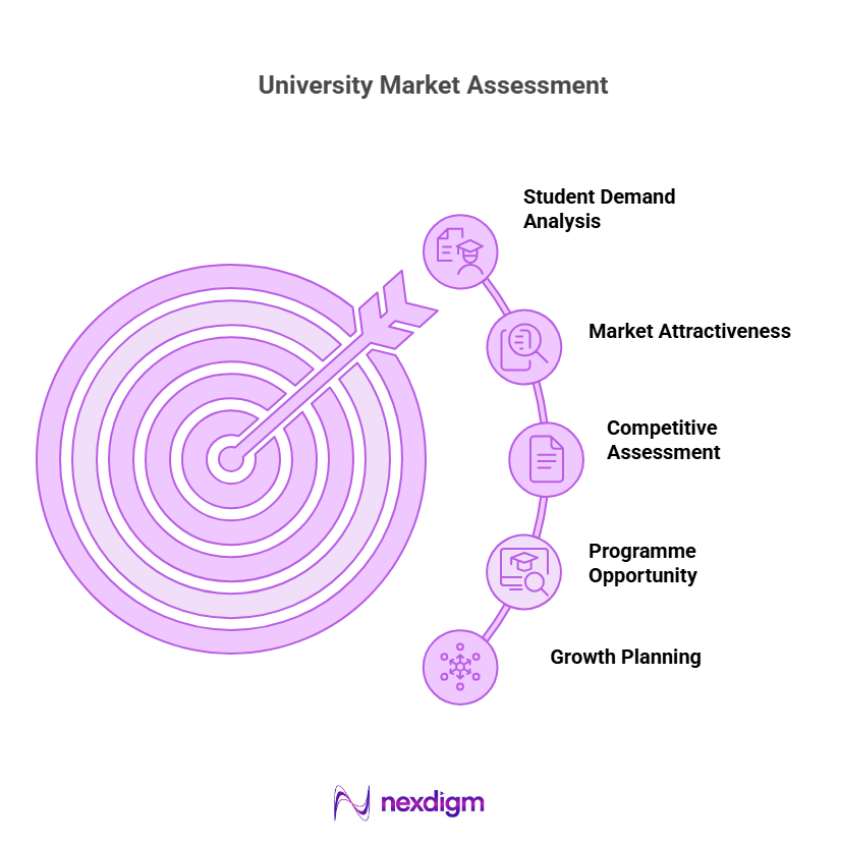
- Student Demand Analysis: Examines enrollment trends, demographics, mobility, affordability, and student preferences across relevant segments.
- Market Attractiveness: Evaluates population trends, education participation, economic conditions, and future growth potential across target markets.
- Competitive Assessment: Reviews universities, programme offerings, positioning, pricing, capacity, and competitive intensity.
- Programme Opportunity: Identifies disciplines and degree categories where demand may support new or expanded offerings.
- Growth Planning: Translates market findings into opportunities for programme expansion, recruitment, partnerships, capacity development, and geographic entry.
By connecting these dimensions, Nexdigm helps institutions move from understanding student demand to making more informed decisions about where and how to pursue growth.
Benefits of Nexdigm’s University Market Assessment
Nexdigm’s assessment can help institutions convert market intelligence into clearer growth and planning priorities, in the following ways:
- Identifying High-Potential Markets: Pinpoint geographies where student pools, participation rates, and demand trends support future enrollment growth.
- Prioritizing Student Segments: Understanding which student groups and programme categories offer stronger opportunities for recruitment and expansion.
- Strengthening Programme Planning: Aligning new or expanded programmes with market demand, career trends, and evolving student preferences.
- Improving Competitive Positioning: Understanding competitor offerings, pricing, capacity, and positioning to identify areas for differentiation.
- Supporting in Investment Decisions: Providing evidence for decisions around capacity, infrastructure, partnerships, recruitment, and geographic expansion.
Together, these benefits help institutions pursue growth opportunities with a clearer understanding of market demand, competitive conditions, and student needs.
Nexdigm’s Case
Nexdigm supported an education institution evaluating expansion opportunities across multiple student markets. The assessment analyzed 12+ geographies, reviewed 30+ demand and competition indicators, and identified priority markets, helping narrow expansion options by 38% and enabling more focused decisions around programmes, recruitment, and capacity.
To take the next step, simply visit our Request a Consultation page and share your requirements with us.
Harsh Mittal
+91-8422857704