

University program demand is increasingly shaped by the connection between what students want to study and what employers need. Institutions therefore need to assess more than enrollment history when deciding which programs to launch, expand, redesign, or discontinue.
Recent study estimates that global higher-education enrollment reached 269 million students in 2024, while the World Economic Forum’s Future of Jobs Report 2025 identifies AI, big data, cybersecurity, and technological literacy among the fastest-growing skill areas. These developments are influencing both student choices and institutional program strategies.
A strong University program demand assessment connects student interest with employer requirements, career outcomes, affordability, program availability, and competitive intensity. For universities, this provides a stronger basis for determining where program demand is likely to remain sustainable rather than simply responding to short-term enrollment movements.
Where Program Demand Is Moving
Student preferences are shifting toward programs perceived to offer stronger career relevance, employability, and adaptability. Technology, healthcare, business, engineering, sustainability, and interdisciplinary fields are increasingly influenced by changes in workforce requirements and emerging skills.
However, demand differs across markets. A program that is highly attractive in one geography may face limited demand elsewhere because of differences in industry structure, income levels, employer requirements, student preferences, and competing offerings. Understanding these differences is essential before committing institutional resources.
What Makes a Program Attractive?
Program attractiveness is created by the interaction of several factors rather than student interest alone.
- Student Interest: Enrollment intent, application trends, subject preferences, demographics, and student motivations reveal the potential size of the interested population.
- Career Relevance: Employer demand, emerging occupations, salary potential, placement outcomes, and required skills indicate whether a program can maintain long-term appeal.
- Market Competition: Existing programs, tuition levels, institutional reputation, capacity, and differentiation determine how easily a new or expanded program can attract students.
Together, these factors provide a more complete picture of program-level opportunity.
Nexdigm’s Expertise in Assessing Program Demand Opportunities
Nexdigm supports education institutions in evaluating program opportunities through market intelligence, student demand research, competitive benchmarking, industry analysis, and strategic advisory. Its approach connects academic-market dynamics with broader workforce and economic trends.
Rather than relying only on historical enrollment, Nexdigm assesses prospective student interest, program availability, employer requirements, career pathways, affordability, competitor positioning, and future market trends. This helps institutions determine whether demand is broad-based, emerging, underserved, or likely to face increasing competition.
Why Universities Choose to Partner With Nexdigm?
Nexdigm combines industry expertise, market intelligence, data-led research, and strategic advisory to assess program demand from multiple perspectives. Its University Program Demand Assessment approach connects student behavior with employer requirements, competitive dynamics, and future market trends, helping education institutions make program decisions based on evidence rather than assumptions.
Nexdigm’s University Program Demand Assessment
Nexdigm’s University program demand assessment can provide an integrated view of program attractiveness across student, employer, and competitive dimensions. The assessment areas involve:
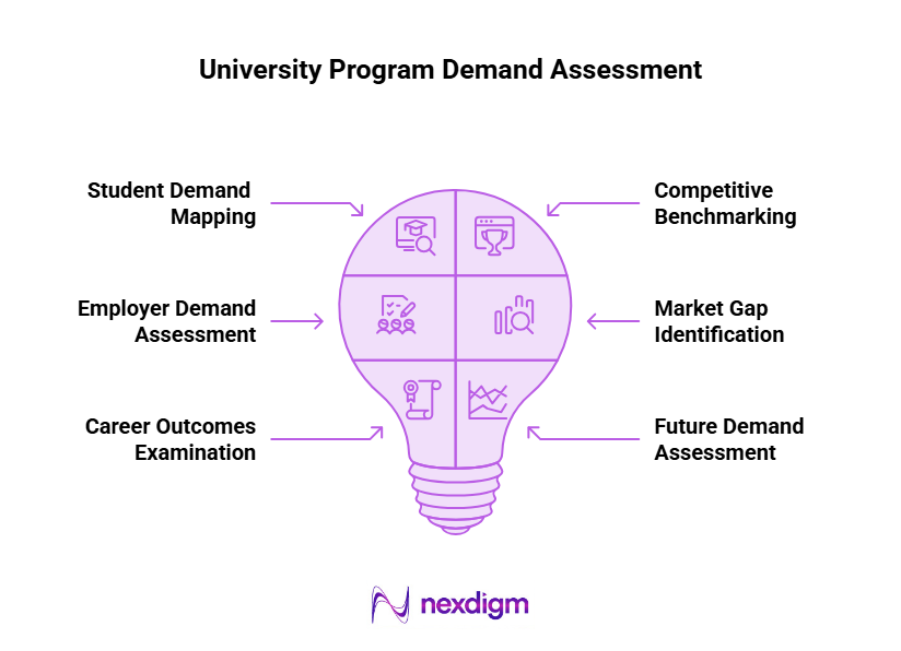
- Student Demand Mapping: Analyzing enrollment trends, applicant interest, demographics, preferences, and geographic demand for specific programs.
- Employer Demand: Assessing industry hiring needs, emerging skills, occupational growth, and employer expectations linked to relevant academic disciplines.
- Career Outcomes: Examining employability, placement trends, salary expectations, career pathways, and perceived program value.
- Competitive Benchmarking: Comparing competing programs across institutions, including fees, curriculum, capacity, positioning, and delivery models.
- Market Gap Identification: Identifying program areas where student interest exists but current institutional supply remains limited.
- Future Demand Assessment: Considering technology, industry, demographic, and economic trends that could influence program demand over time.
Each assessment area can be evaluated together to determine whether a program represents a high-potential, emerging, mature, or highly competitive opportunity.
Applications of Nexdigm’s Program Demand Assessment
Nexdigm’s assessment can support institutions across different stages of program planning and portfolio development. Such stages can be:
- New Program Launches: Evaluate demand and competitive conditions before introducing new academic program.
- Program Expansion: Identify existing program where enrollment potential and market demand justify additional capacity.
- Portfolio Optimization: Assess program for expansion, redesign, consolidation, or repositioning based on changing market conditions.
- Curriculum Alignment: Connect academic offerings with emerging employer requirements, skills, and career pathways.
- Market Expansion: Identify geographies and student segments where specific program may have stronger demand potential.
- Strategic Investment: Prioritize faculty, infrastructure, marketing, and partnership investments toward program with stronger long-term opportunities.
This allows institutions to use program demand insights not only for what to offer, but also for where, how, and at what scale to offer it.
Nexdigm’s Case Study
Nexdigm supported an education institution evaluating its program portfolio across multiple markets. The assessment reviewed 20+ academic programs, analyzed student and employer demand indicators, and benchmarked 18 competing institutions, helping identify six priority programs for expansion and curriculum enhancement.
To take the next step, simply visit our Request a Consultation page and share your requirements with us.
Harsh Mittal
+91-8422857704