

University tuition is increasingly a value decision rather than a simple affordability calculation. Students and families weigh fees against programme quality, career prospects, employability, institutional reputation, flexibility, and access to industry. This makes pricing highly dependent on what an institution offers and how its target students perceive that value.
The variation between markets is significant. OECD data shows that tuition models range from low- or no-fee systems with strong student support to high-fee systems with more limited assistance. In countries where tuition differs by study level, master’s programmes charge 29% more on average than bachelor’s programmes. OECD data also puts average public grants at around USD 5,500 per year, although support varies substantially between countries.
For universities, the challenge is therefore not simply deciding how much to charge, but understanding what students consider worth paying for. A University tuition pricing market analysis can help institutions connect pricing with affordability, perceived value, competitive positioning, and enrollment potential.
When Does Tuition Become Worth the Cost?
Students evaluate tuition against the benefits they expect to receive. Career outcomes, programme reputation, faculty, industry exposure, campus experience, flexibility, and international opportunities can all influence perceived value.
This creates an important distinction between price and price justification. Two institutions may charge similar fees but generate very different student perceptions depending on their positioning and outcomes.
Nexdigm can help institutions identify the attributes that matter most to their target segments and assess how those attributes support the proposed tuition level.
The Price Value Equation in Higher Education
Affordability is only one side of the pricing decision. The other is the value students associate with the education they receive.
- Financial Value: Students consider tuition alongside financing, scholarships, expected earnings, employability, and career progression.
- Experience Value: Programme quality, faculty, facilities, industry exposure, flexibility, reputation, and student support influence the perceived educational experience.
Understanding both dimensions can help institutions develop pricing strategies that are more closely aligned with student expectations.
Nexdigm’s University Pricing Strategy Expertise
Nexdigm brings together education-sector expertise, market intelligence, pricing analysis, competitive benchmarking, and strategic advisory to help institutions make evidence-based tuition decisions.
Its approach looks beyond competitor fees to understand the factors supporting or limiting a price point. This can include affordability, programme demand, career outcomes, competitor positioning, student preferences, scholarship structures, and institutional differentiation.
The result is a broader view of pricing as part of the institution’s overall market proposition, rather than as an isolated financial decision.
Why Universities Partner With Nexdigm
Nexdigm combines sector knowledge, market research, competitive intelligence, and strategic analysis to help institutions understand the market behind the price. Its approach enables universities to identify price-sensitive segments, evaluate premium opportunities, benchmark competitors, assess scholarship requirements, and understand how tuition may influence enrollment. This supports pricing decisions grounded in market evidence and student value perception.
Nexdigm’s University Tuition Pricing Market Analysis
Nexdigm’s University tuition pricing market analysis can assess pricing opportunities through six interconnected lenses, such as:
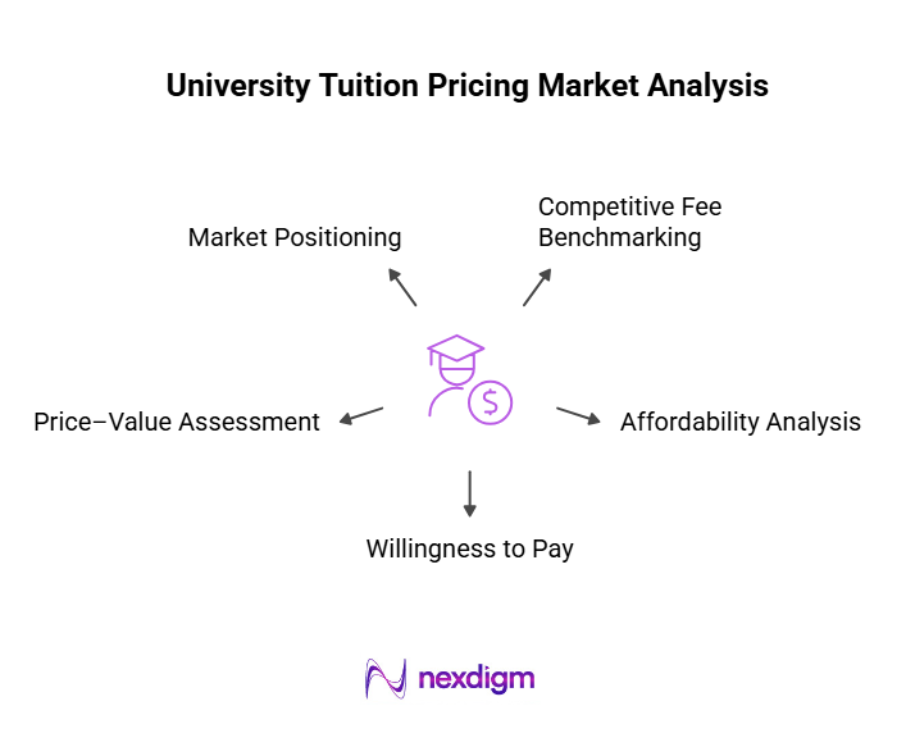
- Competitive Fee Benchmarking: Compare tuition, additional fees, scholarships, and payment structures across relevant institutions and programmes.
- Affordability Analysis: Assess household economics, financing availability, scholarship dependence, and price sensitivity across priority student segments.
- Willingness to Pay: Examine how students respond to different tuition levels and programme attributes.
- Price–Value Assessment: Evaluate whether career outcomes, academic quality, facilities, and industry links support the proposed price.
- Market Positioning: Determine whether the institution should occupy a premium, competitive, accessible, or differentiated pricing position.
Together, these dimensions help institutions understand where pricing can support both market attractiveness and financial sustainability.
Nexdigm’s University Pricing Insights Creating Meaningful Impact
Nexdigm’s pricing analysis can translate market evidence into decisions that directly influence enrollment, revenue, student mix, and programme positioning. By understanding how different segments respond to tuition and value propositions, universities can make pricing choices through:
- Stronger Enrollment: Align tuition with student affordability and perceived programme value to improve enrollment potential.
- Better Revenue Outcomes: Identify pricing points that balance student demand with sustainable institutional revenue.
- Sharper Positioning: Use price-value insights to differentiate programmes and strengthen market positioning.
- Smarter Scholarships: Direct financial aid toward segments where support can meaningfully influence enrollment decisions.
- Greater Sustainability: Build pricing models that can remain competitive as student expectations and market conditions evolve.
This enables universities to move from simply benchmarking tuition to using pricing intelligence as a strategic lever for sustainable growth.
Nexdigm’s Case Study
Nexdigm supported an education institution reviewing tuition positioning across 12 programme categories. The engagement benchmarked 24 competing institutions, evaluated three pricing scenarios, and identified five programme segments with stronger price-value alignment, helping refine the institution’s fee and scholarship strategy.
To take the next step, simply visit our Request a Consultation page and share your requirements with us.
Harsh Mittal
+91-8422857704