

An upskilling platform competes with more than other learning websites. Its alternatives include free tutorials, internal company training, professional certifications and the option of learning nothing until a new skill becomes necessary. To persuade customers to pay, the platform must offer something more useful than access to information.
An individual may want a promotion, a career change or proof of technical competence, employer may need to prepare hundreds of employees for a new system without disrupting daily operations. The strongest platforms understand these differences and build their products around them.
What Do Learners and Employers Pay For?
Learners often begin with a skill gap, but they purchase a route towards an outcome. A course in data analytics becomes more attractive when it includes applied projects, feedback and a portfolio that can be presented during interviews. A cybersecurity programme gains credibility when its assessment reflects the tasks associated with the intended role.
Learner Outcomes Report, based on more than 52,000 respondents across 179 countries, found that 91% of surveyed learners reported at least one positive career outcome after completing a course or programme. The findings are self-reported and specific to Coursera’s learner base, but they illustrate the importance of career outcomes in the value proposition.
Employers evaluate the proposition differently. They may look for evidence of improved productivity, faster onboarding, fewer errors or employees who can use new technology effectively. A large course catalogue is useful only if employees can find relevant content and managers can establish whether the training made a difference.
Upskilling Platform Market Assessment: Five Drivers of Willingness to Pay
An Upskilling platform market assessment should distinguish between a feature that attracts attention and a benefit that justifies expenditure.
- Relevant skills: Content should map to current job requirements, emerging capabilities or clearly defined career pathways.
- Credible outcomes: Assessments, applied projects, recognised credentials and employer feedback help demonstrate that learners can use what they have learned.
- Convenient delivery: Flexible schedules, mobile access, manageable modules and learning paths suited to different proficiency levels reduce participation barriers.
- Personalisation and support: Skill diagnostics, targeted recommendations, instructor access and timely feedback can help learners navigate large content libraries.
- Evidence for buyers: Employers need usable reporting on participation, proficiency, completion and, where possible, performance after training.
These drivers do not carry equal weight in every market.
A professional seeking a recognised qualification may prioritise credential credibility. Company purchasing training for frontline employees may place greater weight on mobile access, language options and minimal time away from work.
Choosing a Sustainable Revenue Model
Consumer subscriptions can generate recurring revenue, but only when learners continue to see reasons to return. Low engagement can make even a modest monthly fee feel wasteful. Single-course purchases are easier to understand but may produce less predictable revenue.
Enterprise contracts can provide larger commitments, although the sales cycle may involve procurement, security reviews, integrations and approval from several stakeholders. Providers also need to distinguish licences purchased from licences actively used. A large contract is not necessarily evidence of strong learner engagement.
Blended models can combine self-paced content with instructor-led sessions, mentoring or assessments. They may support higher prices, but additional delivery costs must be included when calculating margins.
Upskilling Platform Value Proposition Framework
The Upskilling Platform Commercial Viability Framework helps test whether a product can attract paying customers and retain them.
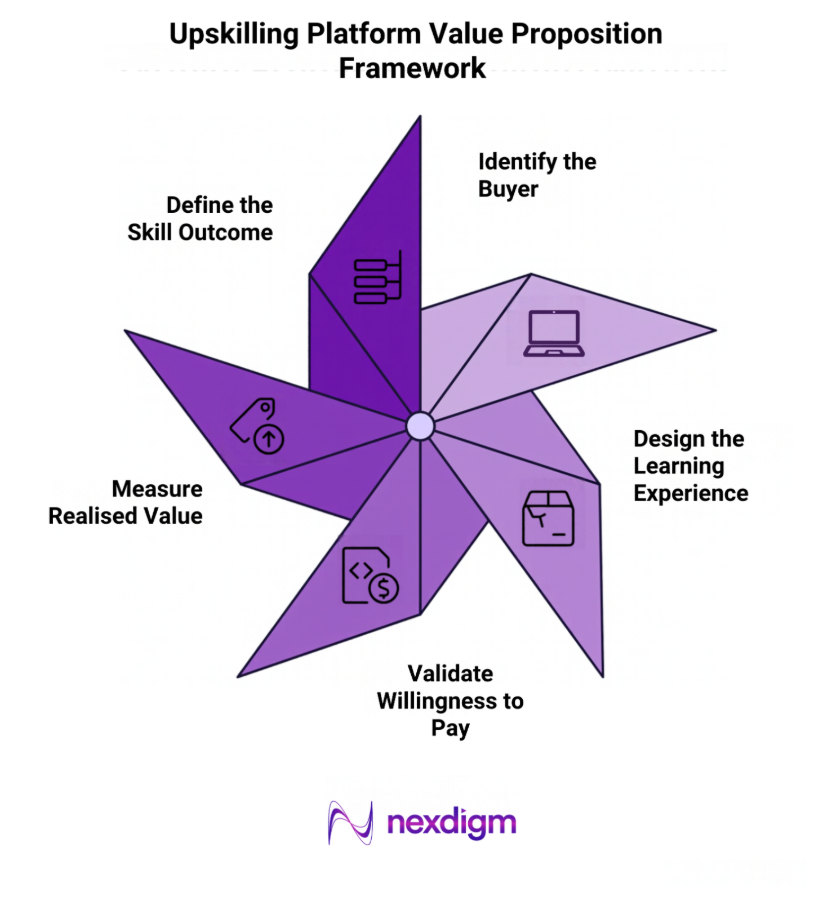
- Identify the Buyer: Separate individual learners, employers and institutional buyers, including their budgets and purchase triggers.
- Define the Skill Outcome: Specify the capability the programme develops and how learners will demonstrate it.
- Design the Learning Experience: Match content, support and assessment to the target user’s time, proficiency and delivery requirements.
- Validate Willingness to Pay: Test pricing, competing alternatives, contract terms and the cost of acquiring customers.
- Measure Realised Value: Track active use, completion, demonstrated proficiency, renewals and customer-reported outcomes.
A platform should expand its catalogue only when new programmes serve a defined audience or strengthen an existing learning pathway. More content can increase operating costs without improving the reason customers pay.
Nexdigm Case Study: Evaluating Platform Commercial Potential
Nexdigm assessed 18 upskilling platform propositions across individual subscriptions and enterprise learning. 6 met the initial criteria for identifiable buyer demand, differentiated delivery and viable pricing. 3 were prioritised for commercial validation, with employer-focused skills pathways and measurable proficiency reporting forming the core of the proposed offer.
To take the next step, simply visit our Request a Consultation page and share your requirements with us.
Harsh Mittal
+91-8422857704