

A large discovery can remain commercially marginal if recovery is technically difficult, wells decline rapidly or the field sits far from processing and export systems. Upstream feasibility begins by separating hydrocarbons in place from recoverable resources and booked reserves. It then tests whether a production profile can generate enough cash flow, after capital, operating costs, fiscal take and transport, to meet the sponsor’s return threshold under plausible prices.
Resource classification matters because proven, probable and possible volumes do not carry the same confidence. Reservoir quality, fluid properties, pressure support, water depth, well productivity and recovery factor shape the development concept. Appraisal wells and seismic can reduce uncertainty, but their value depends on whether new information could change the investment decision. A production curve should show plateau timing, decline, reinvestment and abandonment obligations, rather than a single lifetime-volume estimate.
Build the Cost and Market-Access Chain
Cost models should separate exploration, appraisal, development, operating, transport and decommissioning expenditure. Offshore fields add subsea equipment, floating production or fixed platforms, marine logistics and weather exposure; remote onshore fields may require roads, gathering lines and security. Benchmark costs per well or barrel are useful for screening but must be adjusted for local service capacity, inflation, water depth, reservoir complexity and schedule risk. A project with shared infrastructure can have a lower cost base than a standalone field of similar size.
Market access converts production into a realized netback. Identify whether output can enter a pipeline, processing plant, export terminal or domestic market, and whether spare capacity is available when the field starts. Gas projects require special attention to offtake, gas quality, pipeline interconnection and payment security. Oil projects still face crude-quality discounts, shipping costs and constraints at the receiving refinery. A stranded-reserve problem can persist even when benchmark prices are high.
Fiscal terms can change the marginal barrel. Royalties, production sharing, income taxes, cost recovery limits, local-content requirements and stabilization clauses should be modeled explicitly. Calculate returns at multiple price, volume, cost and start-date assumptions. The break-even price for positive cash flow is not the same as the price that meets an investor’s hurdle rate. A robust project remains resilient to delays and downside production, not just profitable in the base case.
Make the Decision Conditional
A feasibility recommendation should state the conditions under which to proceed: appraisal success, a signed offtake, confirmed pipeline access, a cost cap, fiscal clarity or a minimum reserve threshold. Nexdigm’s assessment can connect subsurface assumptions with commercial and infrastructure evidence, so a client knows which uncertainties are worth buying down before committing development capital.
Upstream Project Viability Assessment Framework
A focused upstream project feasibility study should test the project through four linked conditions:
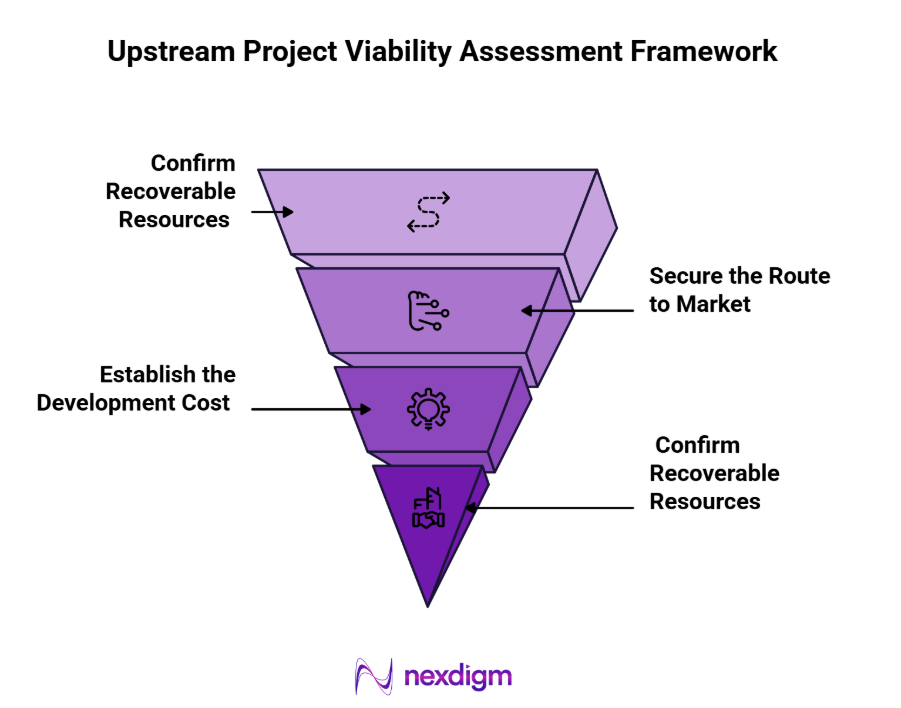
- Confirm Recoverable Resources
Establish the confidence and quality of recoverable reserves, expected production profile and key subsurface uncertainties. The objective is to determine how much production can realistically support the development case. - Establish the Development Cost
Model wells, facilities, gathering, processing, operating expenditure and decommissioning, with adjustments for field complexity, location and infrastructure-sharing opportunities. - Secure the Route to Market
Test pipeline, processing, export or domestic-market access, including available capacity, transport costs, offtake arrangements and expected realised netback. - Stress-Test Project Returns
Model oil or gas prices, production rates, capital costs, delays and fiscal terms to establish the conditions under which the project meets its investment hurdle.
Nexdigm can bring these elements together to distinguish between uncertainties that can be resolved through further appraisal and those that could fundamentally undermine project economics. This allows sponsors to define clear investment gates before committing full development capital.
Nexdigm Case Study
Nexdigm evaluated an upstream field using recoverable-volume estimates, a phased well plan, gathering access and fiscal terms across three oil-price scenarios. The base case cleared the sponsor’s return hurdle only with first oil within 30 months and shared processing secured. The assessment supported funding for appraisal and transport agreements before full development approval.
To take the next step, simply visit our Request a Consultation page and share your requirements with us.
Harsh Mittal
+91-8422857704