

A large resource estimate can attract attention, but it does not establish a commercially attractive upstream opportunity. Investors and operators need to know how much resource can be recovered, at what cost, on what schedule and with what route to market. A smaller field near existing infrastructure may offer stronger economics than a larger, technically difficult discovery with no export access.
The supply context underlines why resource and development decisions require careful comparison. The International Energy Agency estimates that around 230 billion barrels of discovered oil resources and 40 trillion cubic metres of gas resources have yet to be approved for development. Bringing a conventional upstream project from exploration licensing to first production has taken nearly 20 years on average in recent years, according to the IEA. Resource potential therefore needs to be assessed alongside project timing, development cost and access to infrastructure.
The same resource can have very different economics depending on the setting. The IEA reports average observed post-peak decline rates of 4.2% for onshore oil fields and 10.3% for deep offshore oil fields. These figures do not determine the attractiveness of a specific project, but they show why field type, operating conditions and sustaining investment matter when comparing opportunities.
Compare the Full Development Proposition
A credible upstream opportunity market assessment begins with resource confidence. Separate prospective resources from discovered volumes, and distinguish discovered resources from reserves that have been independently assessed as commercially recoverable. Review the geological evidence, appraisal history, expected recovery factor and range of production profiles. Large headline volumes should not obscure uncertainty about reservoir quality or deliverability.
The next test is cost. Estimate exploration, appraisal, development and operating costs across the field’s life. Account for well count, drilling complexity, water depth, facilities, subsea systems, processing and decommissioning. Compare the breakeven price under realistic production and cost scenarios, then stress-test changes in prices, timing and recovery. A low-cost resource can lose its advantage if infrastructure is delayed or production ramps up more slowly than expected.
Access determines whether production can reach a buyer. Assess the distance and capacity of pipelines, processing plants, export terminals and available transport options. Identify whether infrastructure is operational, under construction or only proposed. For gas, examine processing, pipeline connection and LNG access alongside domestic demand. For oil, test export capacity, quality differentials, transport costs and the reliability of market access.
Fiscal and regulatory terms complete the picture. Royalties, taxes, production-sharing terms, licensing conditions and local-content obligations can alter project returns. The assessment should also consider contract stability, permitting schedules, environmental requirements and security conditions. These factors should be modeled as project costs and timing risks, not left as narrative caveats.
Framework: Resource-to-Commerciality Screen
Nexdigm can compare upstream opportunities through five ordered tests. Each stage screens out projects that look promising on one dimension but fail on a more fundamental commercial constraint.
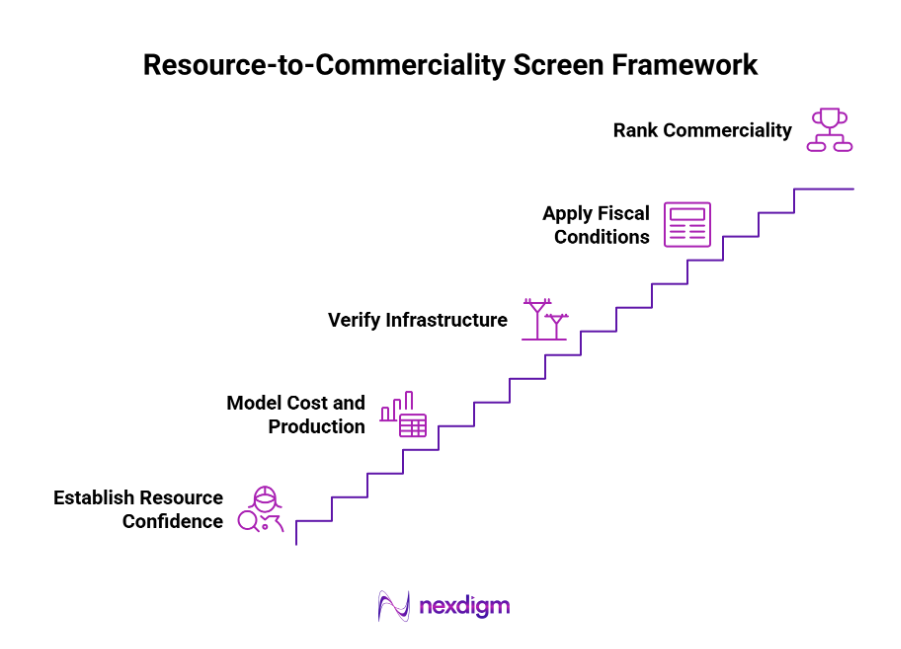
- Establish Resource Confidence
Classify resource maturity and data quality. Review geology, appraisal wells, recovery assumptions and the range of potential production outcomes. - Model Cost and Production
Build development and operating cost cases around realistic well counts, facilities, production profiles and project schedules. Calculate breakeven and test sensitivity to price, delay and recovery. - Verify Infrastructure and Market Access
Map required gathering, processing and export infrastructure. Confirm capacity, ownership, tariffs, connection dates and alternatives if the preferred route is delayed. - Apply Fiscal and Operating Conditions
Model the applicable fiscal regime, local-content requirements, permits, environmental obligations and security constraints. Translate each into cost, time or execution risk. - Rank Risk-Adjusted Commerciality
Compare projects on expected returns, downside exposure, time to first production and unresolved access requirements. Prioritize opportunities where resource quality, economics and access reinforce one another.
Nexdigm Case Study
Nexdigm modelled 12 upstream blocks across three basins, comparing resource confidence, development cost, fiscal terms and export access. The screen identified 4 blocks with viable economics under the base case; 2 depended on pipeline upgrades. We recommended advancing appraisal on the 2 accessible blocks and deferring the rest pending infrastructure clarity.
To take the next step, simply visit our Request a Consultation page and share your requirements with us.
Harsh Mittal
+91-8422857704