

Urban delivery costs can differ significantly across cities because of congestion, labor rates, route density, access restrictions, fuel exposure, and customer service expectations. Effective urban logistics delivery price comparison combines pricing analysis with cost-to-serve modeling, carrier benchmarking, delivery-speed assessment, and geographic segmentation.
This approach reveals the cost gap, validates market-specific rates, and supports more accurate commercial decisions. Businesses can redesign delivery zones, allocate carriers efficiently, and establish scalable pricing structures that protect margins while maintaining reliable service across diverse metropolitan networks and changing demand conditions effectively.
A 2026 delivery operation cut daily routes from 30–40% to 16–20% after adopting dynamic routing, while maintaining or improving capacity. The result lowered driving and sorting labor, improved delivery accuracy, and strengthened pricing analysis across a complex urban network.
Commercial Pricing Analysis for Scalable Metropolitan Delivery Operations
Commercial pricing analysis helps metropolitan delivery networks compare city-specific costs, design scalable rate structures, and maintain reliable service across complex, high-density urban markets sustainably. Strategic steps of the analytical process are:
- Identify Urban Cost Pressure Zones: Pinpoint districts with high fulfilment expenses, congestion premiums, and operational bottlenecks to prioritize pricing adjustments and improve commercial performance across metropolitan areas.
- Benchmark Neighborhood Delivery Rates: Compare delivery costs, order density, service expectations, and carrier rates across neighborhoods to uncover hidden pricing disparities and optimization opportunities.
- Build Demand-Sensitive Pricing Design: Design pricing mechanisms that respond to changing demand, time windows, and delivery urgency, helping businesses improve margins without compromising customer satisfaction.
- Reallocate Deliveries Across Networks: Assess hub locations, route structures, and carrier capabilities to redistribute delivery volumes efficiently and support scalable metropolitan expansion strategies.
- Create an Urban Pricing Command Center: Centralize pricing intelligence, market benchmarks, and operational metrics in a unified dashboard to enable faster decisions and continuous pricing optimization.
Nexdigm’s Strategic Guidance for City-Wise Urban Delivery Pricing Analysis
Nexdigm combines pricing analysis, urban logistics delivery price comparison, cost-to-serve modeling, delivery cost benchmarking, and pricing intelligence to help businesses optimize city-wise delivery strategies. By evaluating fulfilment costs, route economics, carrier rates, and regional demand patterns, Nexdigm supports businesses with data-driven pricing decisions, strengthens commercial negotiations and supports scalable metropolitan delivery networks through structured pricing analysis.
Nexdigm’s Urban Delivery Pricing Analysis and Benchmarking Model
Nexdigm’s model integrates city-level cost intelligence, pricing governance, market benchmarking, and performance controls to help businesses maintain competitive metropolitan delivery economics across diverse urban networks. Some major frameworks used in the model are:
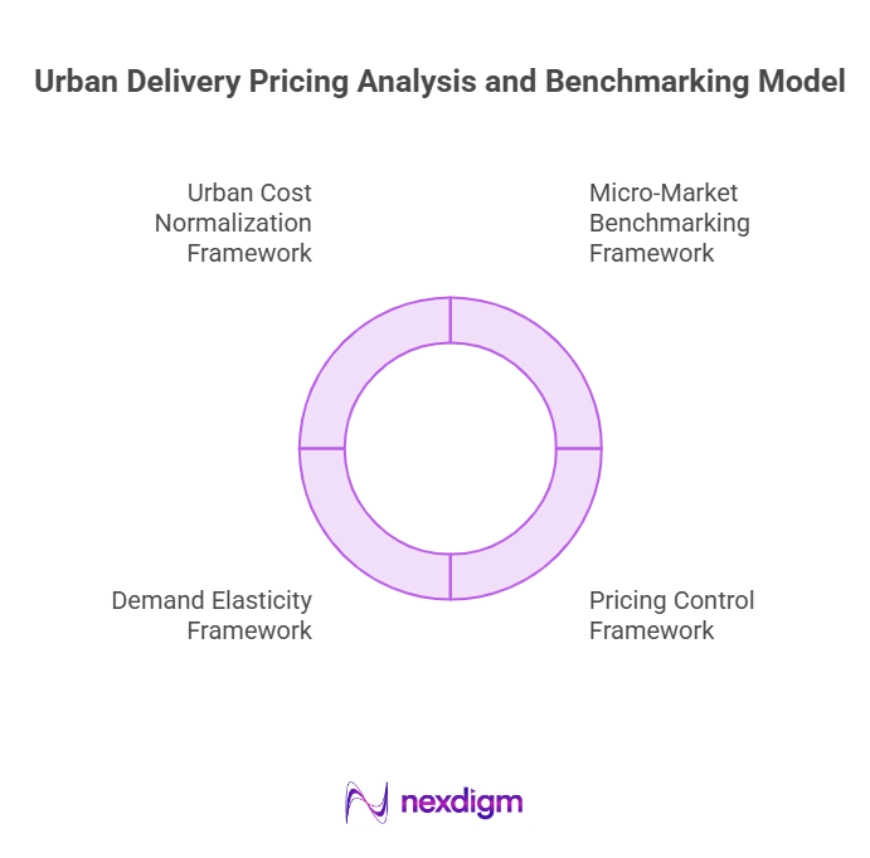
- Urban Cost Normalization Framework: This framework adjusts labor, fuel, congestion, infrastructure, and access-related costs across cities, enabling fair comparisons and preventing local market distortions from influencing pricing decisions.
- Micro-Market Benchmarking Framework: Competitors are grouped by density, demand, route complexity, and service expectations, helping businesses compare similar delivery zones and identify localized pricing gaps or competitive advantages.
- Demand Elasticity Framework: Customer response to delivery fees, speed options, and service thresholds is analyzed to determine commercially acceptable pricing levels across different cities and customer segments.
- Pricing Control Framework: Centralized dashboards consolidate city costs, carrier rates, service outcomes, and pricing variances, enabling faster decisions and consistent governance across complex urban delivery networks.
Nexdigm’s Case
Nexdigm supported a global logistics provider in benchmarking high-volume courier markets, improving delivery efficiency by 26% and reducing operational turnaround time by 21%. The engagement strengthened last-mile scalability, pricing visibility, service reliability, and data-driven commercial decision-making across metropolitan delivery networks.
To take the next step, simply visit our Request a Consultation page and share your requirements with us.
Harsh Mittal
+91-8422857704