
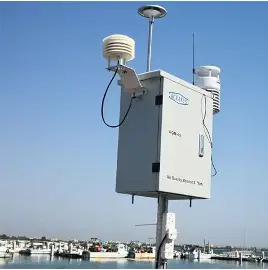
The US Ambient and Industrial Air Quality Monitoring Systems Market is witnessing strong growth, driven by stringent environmental regulations, industrial emissions monitoring requirements, and growing public awareness of air quality impacts. Ambient and industrial air quality monitoring systems are widely used to measure pollutants such as PM2.5, PM10, NOx, SO₂, CO, O₃, VOCs, and hazardous air pollutants (HAPs) across urban areas, industrial facilities, power plants, refineries, and transportation networks. With a population exceeding 340 million, over 16,000 publicly owned wastewater treatment plants, thousands of industrial facilities, and one of the world’s largest manufacturing sectors, demand for advanced air monitoring technologies is increasing across environmental, industrial, and regulatory applications.
Key Market Drivers for the US Ambient and Industrial Air Quality Monitoring Systems Market
Stringent EPA Regulations and Expanding Compliance Requirements Drive Market Growth
The U.S. Environmental Protection Agency (EPA) continues to enforce strict air-quality regulations under the Clean Air Act, driving widespread adoption of advanced monitoring systems across industries. The United States operates more than 4,000 air quality monitoring stations nationwide and monitors key pollutants including PM2.5, PM10, ozone, sulfur dioxide (SO₂), nitrogen dioxide (NO₂), carbon monoxide (CO), and lead. Growing compliance requirements for emissions-intensive sectors such as power generation, chemicals, cement, metals, and oil & gas are increasing demand for Continuous Emissions Monitoring Systems (CEMS), real-time ambient monitoring stations, and cloud-based reporting platforms.
Industrial Expansion and Energy Infrastructure Investments Create Significant Opportunities
The U.S. industrial sector contributes approximately 10–11% of GDP and includes more than 12 million manufacturing employees across thousands of facilities requiring environmental compliance and emissions management. In addition, the country operates over 900 natural gas processing plants, thousands of power generation units, and extensive petrochemical and refining infrastructure. Growing investments in industrial modernization, carbon management, and environmental compliance are driving deployment of advanced air quality monitoring technologies capable of delivering real-time emissions tracking and predictive analytics.
Smart Cities, Public Health Monitoring, and IoT Adoption Strengthen Demand
More than 80% of the U.S. population lives in urban areas, increasing the need for comprehensive ambient air-quality monitoring networks. Federal and local governments are investing in smart-city programs, environmental health initiatives, and climate resilience projects that utilize IoT-enabled sensors, AI-powered pollution forecasting tools, and cloud-connected monitoring platforms. The increasing frequency of wildfire smoke events, industrial emissions concerns, and urban pollution management programs is accelerating adoption of next-generation air quality monitoring solutions across municipalities, transportation corridors, airports, schools, and public infrastructure networks.
Government Initiatives Supporting the US Ambient and Industrial Air Quality Monitoring Systems Market
The US government actively supports air quality monitoring through the Environmental Protection Agency (EPA), federal clean-air programs, and state-level environmental agencies. The EPA operates and oversees thousands of monitoring stations nationwide while continuously updating emissions standards and air quality regulations. Significant federal funding is also being allocated toward environmental monitoring, climate resilience, air pollution reduction, and smart infrastructure programs. These initiatives continue to encourage deployment of advanced monitoring systems across industrial facilities, urban environments, power generation sites, and transportation corridors.
Competitive Landscape of the US Ambient and Industrial Air Quality Monitoring Systems Market
The US Ambient and Industrial Air Quality Monitoring Systems Market is highly competitive and technology-driven. Competition is centered on sensor accuracy, real-time analytics, cloud connectivity, AI-powered pollution forecasting, continuous emissions monitoring systems (CEMS), and remote monitoring capabilities. Major market participants including Thermo Fisher Scientific, Teledyne Technologies, Honeywell, Emerson Electric, Horiba, Siemens, Aeroqual, and TSI Incorporated continue to invest in advanced gas analyzers, particulate monitoring technologies, IoT-enabled sensors, and environmental data platforms. Growing demand from industrial facilities, environmental agencies, smart cities, research institutions, and utilities continues to drive innovation and market expansion.
Major Challenges Facing the US Ambient and Industrial Air Quality Monitoring Systems Market
High Installation and Maintenance Costs
Advanced air quality monitoring systems often require substantial investments in hardware, software, calibration equipment, communications infrastructure, and maintenance services. These costs can be significant for smaller organizations and municipalities.
Data Accuracy and Regulatory Compliance Complexity
Ensuring measurement accuracy, calibration consistency, cybersecurity, and compliance with evolving federal and state regulations remains a major challenge. Organizations must continuously upgrade monitoring systems to meet changing environmental standards and reporting requirements.
Future Outlook
The US Ambient and Industrial Air Quality Monitoring Systems Market is expected to witness robust growth through 2035, supported by a population exceeding 340 million, increasing industrial emissions monitoring requirements, and growing investments in environmental sustainability. More than 4 million miles of public roads, thousands of industrial facilities, and expanding smart-city initiatives continue to increase demand for real-time air quality monitoring solutions. Emerging technologies such as AI-powered pollution forecasting, IoT-enabled monitoring networks, drone-based atmospheric measurements, and cloud-integrated environmental analytics platforms are expected to accelerate adoption. Companies investing in next-generation sensor technologies, predictive analytics, and automated compliance solutions will be well-positioned to capitalize on the growing focus on environmental protection, industrial sustainability, and regulatory compliance.
Consultants at Nexdigm, in their latest publication “US Ambient and Industrial Air Quality Monitoring Systems Market Outlook to 2035,” analyse the sector By Monitoring Technology (Chemiluminescence Analysers, Gas Chromatography Systems and Bera Attenuation Particulate Monitors), By Installation Type (Outdoor Ambient Stations and Indoor Industrial Fenceline) and By Pollutant Target (Criteria Pollutants, Volatile Organic Compounds and Hazardous Air Pollutants).
Nexdigm suggests that businesses in the US Ambient and Industrial Air Quality Monitoring Systems Industry prioritize AI-enabled environmental analytics, IoT-integrated monitoring networks, continuous emissions monitoring systems (CEMS), and cloud-based compliance platforms to capitalize on stringent EPA regulations, expanding industrial monitoring requirements, growing smart-city investments, and increasing demand for real-time environmental intelligence across industrial, commercial, and public-sector applications.
To take the next step, simply visit our Request a Consultation page and share your requirements with us.
Harsh Mittal
+91-8422857704