
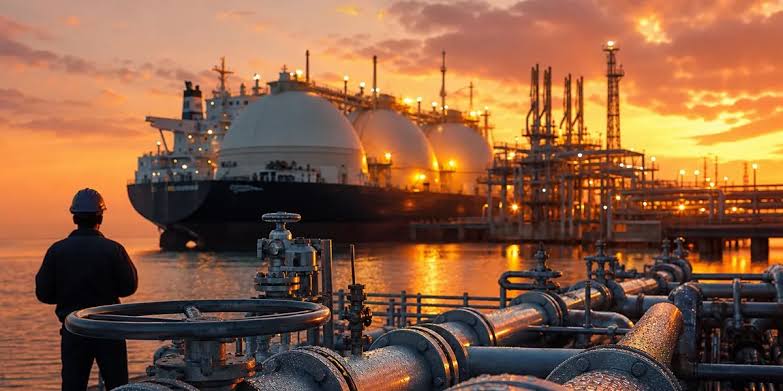
The United States has evolved into the world’s leading liquefied natural gas (LNG) exporter, supported by extensive investments in liquefaction plants, export terminals, storage facilities, and pipeline networks. The country’s LNG infrastructure plays a critical role in connecting abundant domestic natural gas resources with global energy markets. With growing demand from Europe and Asia, developers are accelerating terminal expansions along the Gulf Coast. The U.S. exported approximately 11.9 billion cubic feet per day (Bcf/d) of LNG in 2024, maintaining its position as the world’s largest LNG exporter.
Market Drivers Advancing the US LNG Infrastructure Industry
Rising Global Demand Strengthening US Export Infrastructure
Growing energy security concerns across Europe and increasing gas consumption in Asia continue to drive demand for reliable LNG supplies. European countries accounted for roughly 53% of U.S. LNG exports, while Asia’s share increased to about 33%, highlighting diverse demand centers. To support this demand, operators are expanding liquefaction and export facilities. New projects are being developed to increase loading capacity, improve storage efficiency, and strengthen supporting pipeline networks. For many U.S. energy companies, LNG has shifted from being a niche export opportunity to a major pillar of long-term growth.
Massive Capacity Expansion Across the Gulf Coast
The Gulf Coast remains the heart of America’s LNG infrastructure ecosystem. Major projects such as Plaquemines LNG, Golden Pass LNG, Rio Grande LNG, and Port Arthur LNG are driving the next wave of investment. According to the U.S. Energy Information Administration, the United States already possesses approximately 15.4 Bcf/d of LNG export capacity, with announced projects expected to add another 13.9 Bcf/d by the end of the decade. These developments are generating substantial demand for engineering services, construction activities, pipelines, compressors, and storage systems, creating opportunities across the entire LNG value chain.
Strategic Role in Global Energy Security
The U.S. LNG industry has become an important stabilizing force in the global energy market. As countries seek alternatives to traditional pipeline supplies, American LNG provides flexibility and supply diversification. Global LNG trade reached a record 56.3 Bcf/d, while U.S. LNG exports increased by 26% to 15.1 Bcf/d in 2025, demonstrating the growing influence of U.S. infrastructure on international energy flows.
Government Initiatives Supporting the US LNG Infrastructure Industry
Federal agencies including the Department of Energy (DOE) and the Federal Energy Regulatory Commission (FERC) continue to play important roles in LNG project approvals and oversight. The DOE has issued numerous long-term export authorizations, supporting infrastructure investments across the country. As of 2026, authorized LNG export volumes exceeded 55 Bcf/d, reflecting strong regulatory backing for long-term industry development.
Competitive Landscape of the US LNG Infrastructure Industry
The U.S. LNG infrastructure industry features a mix of established energy majors and specialized LNG developers. Key participants include Cheniere Energy, Venture Global LNG, Sempra Infrastructure, ExxonMobil, QatarEnergy, NextDecade, Energy Transfer, and Kinder Morgan. Competition increasingly centers on project execution, export efficiency, long-term supply contracts, and the ability to deliver LNG to global customers at competitive costs. Strategic partnerships and multi-billion-dollar investments continue to reshape the market landscape.
Challenges Facing the US LNG Infrastructure Industry
Permitting and Environmental Complexity
Despite strong market fundamentals, LNG projects often encounter lengthy permitting processes and environmental reviews. Developers must manage concerns related to emissions, land use, and community impacts, which can extend project timelines.
Pipeline and Supply Chain Constraints
Rapid construction of new LNG terminals also requires corresponding investments in pipelines and transportation infrastructure. The EIA notes that pipeline construction delays remain a potential risk for supplying new export terminals. Cost inflation, labor shortages, and equipment procurement challenges may further pressure project schedules and budgets.
Future Outlook
The outlook for the U.S. LNG infrastructure market remains highly positive as global energy demand continues to grow. Large-scale investments in liquefaction facilities, export terminals, storage assets, and interstate pipelines are expected to reshape the country’s energy landscape over the next decade. Market momentum is supported by America’s strong natural gas resource base, expanding export capacity, and strategic importance in global energy security. With LNG becoming an increasingly important bridge fuel in the global energy transition, the United States is well positioned to strengthen its leadership role while creating new opportunities across the infrastructure value chain. Forecasts indicate that U.S. LNG export volumes and capacity will continue expanding as additional projects move from construction to commercial operation.
Consultants at Nexdigm, in their latest publication “US LNG Infrastructure Market Outlook to 2035” analyze the sector By Facility Infrastructure (Brownfield Expansions, Greenfield Projects and Modular Mid-Scale Units), By Facility Status (Operational, Under Construction and Proposed and Permitting Phase) and By Geographic Region (Louisiana, Texas and Georgia).
Nexdigm suggests that businesses in “US LNG Infrastructure Industry” focusses on oilfield, desalination, construction, and industrial applications, strengthen local warehousing, develop application-specific grades, improve technical support, and build resilient sourcing networks to serve expanding energy, water, and manufacturing demand.
To take the next step, simply visit our Request a Consultation page and share your requirements with us.
Harsh Mittal
+91-8422857704