

Value-based care is changing how healthcare organizations compete. Patients compare ratings and reviews, while payers link experience scores to reimbursement and network decisions. Reputation now depends as much on perceived quality and trust as on clinical outcomes, making brand perception a core part of healthcare competition.
In this setting, structured brand perception surveys help healthcare enterprises see how patients, providers, and payers truly view their care and reliability. These insights reveal trust drivers and gaps, guiding experience improvements and clearer positioning in a market where perception shapes choice and partnerships.
Risks of Skipping Brand Perception Survey in Value-Based Care
Unclear Drivers of Trust
Healthcare brands often don’t fully know what makes patients, providers, or payers trust them. Without direct feedback, it’s difficult to see which care experiences or outcomes shape reputation and loyalty in value-based care.
Value Message Doesn’t Match Reality
Many organizations promote quality and outcomes, but without perception data, they can’t confirm if stakeholders see them that way. This disconnect weakens positioning in a market where value perception directly affects partnerships and choice.
Experience Issues Stay Hidden
Patient journeys span appointments, communication, billing, and follow-up. Without structured surveys, small frustrations across these touchpoints remain invisible, gradually affecting satisfaction, referrals, and ratings.
Harder to Stand Out
Hospitals and care networks compete on perceived quality and reliability. Without understanding how they’re viewed, enterprises struggle to clearly differentiate themselves from similar providers.
Early Reputation Risks Missed
Perception often declines before performance metrics show problems. Without ongoing surveys, warning signs like falling confidence or poor communication perceptions go unnoticed until brand damage is harder to reverse.
Nexdigm’s Approach to Healthcare Brand Insight
Understanding healthcare brand perception in value-based care means seeing how patients, providers, and payers actually experience and judge care. Nexdigm combines stakeholder surveys, care-journey mapping, satisfaction and NPS analysis, brand attribute testing, and competitor benchmarking to uncover trust drivers and perception gaps. The insights connect reputation with outcomes perception and choice, helping healthcare enterprises refine positioning and focus experience investments where they matter most.
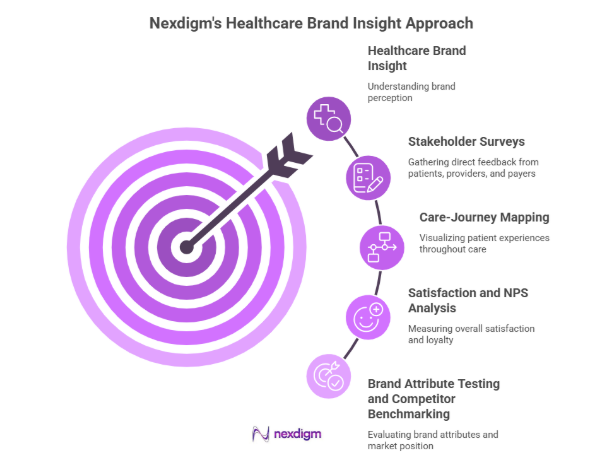
Tools and Methods Used By Nexdigm’s Healthcare Surveys
Multi-Stakeholder Feedback
Nexdigm gathers views from patients, referring physicians, and payers so brand perception reflects the real care network influencing choice and referrals. Balanced sampling ensures insights represent all key decision voices in healthcare relationships.
Care Journey Understanding
Experiences are mapped across access, visits, communication, and billing to see where frustration or confidence builds. This reveals the moments that most shape satisfaction and trust in care delivery.
Loyalty and Satisfaction Drivers
NPS and satisfaction results are connected to specific care qualities such as empathy, clarity, coordination, and outcomes confidence. Organizations see exactly which experiences increase recommendation and loyalty.
Brand Perception Clarity
Stakeholders rate attributes like quality, reliability, innovation, and value, showing how the brand is truly seen. Differences between intended and perceived positioning become clear and actionable.
Competitive Context
Perception scores are compared with peer hospitals and networks, highlighting where the brand stands out or lags. This supports stronger differentiation and positioning decisions in crowded markets.
Deeper Insight Analytics
Survey feedback and open comments are analyzed together to uncover patterns and emerging sentiment. The findings link reputation with patient choice, referrals, and value-based performance signals.
Nexdigm’s Case
A health system struggled with weak differentiation in a competitive value-based care market despite strong clinical outcomes. Nexdigm’s brand perception survey across patients, physicians, and payers revealed low awareness of care coordination strengths and inconsistent communication perceptions. Messaging and patient-journey improvements were implemented based on identified trust drivers. Within twelve months, patient recommendation scores increased by 18%, strengthening payer negotiations and referral growth.
To take the next step, simply visit our Request a Consultation page and share your requirements with us.
Harsh Mittal
+91-8422857704