
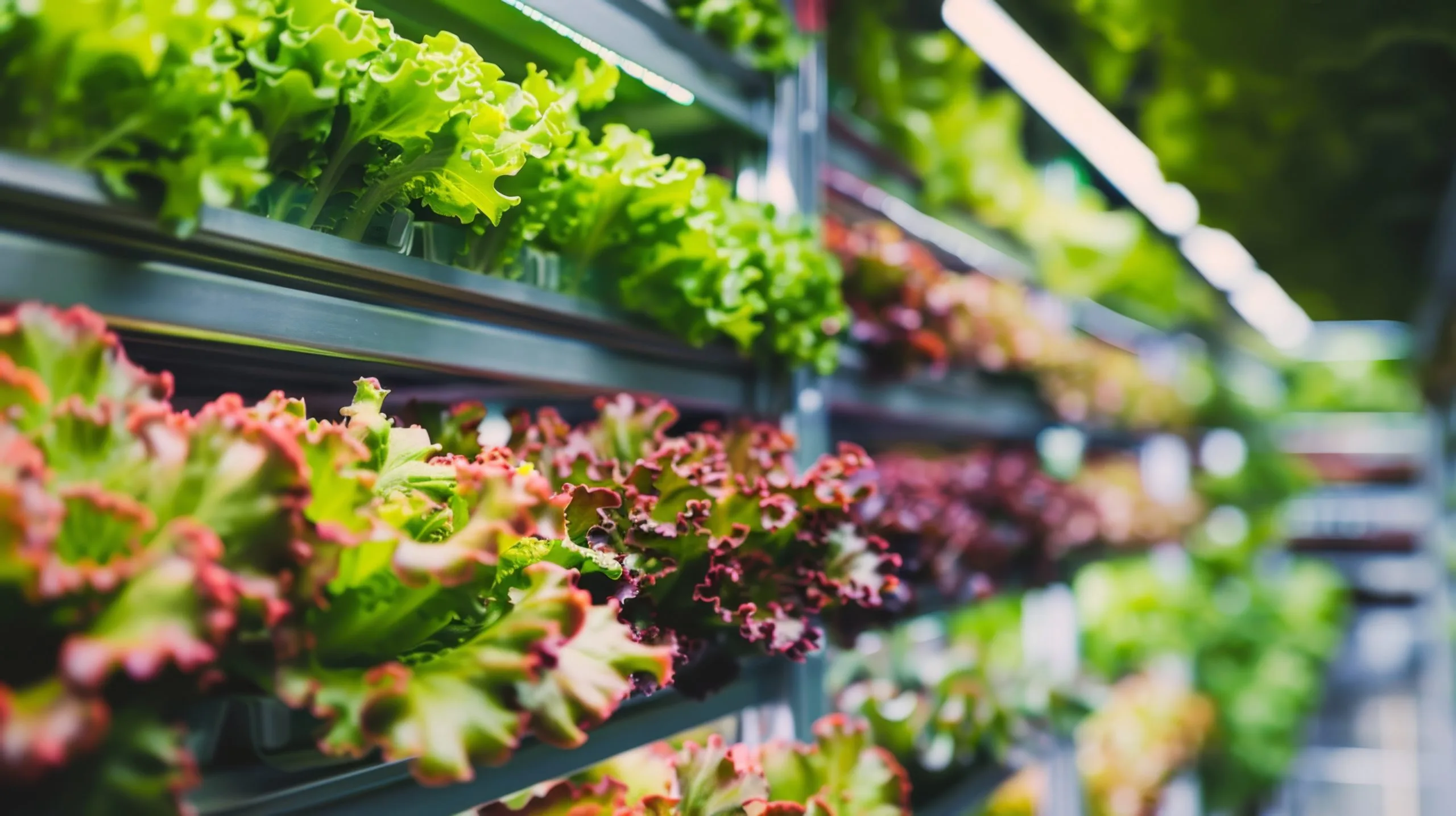
The USA vertical farming market is expanding as growers, food retailers, restaurants, investors, and technology providers look for more reliable ways to produce fresh crops closer to consumers. Vertical farming uses controlled indoor environments, stacked growing systems, LED lighting, hydroponics, aeroponics, sensors, automation, and climate control to grow crops with less land dependency. The U.S. vertical farming market generated USD 1.45 billion in revenue and is projected to reach USD 4.96 billion, growing at 16.8% CAGR. Demand is being supported by urban food security, supply-chain resilience, sustainable production, and rising interest in pesticide-light fresh produce.
Key market drivers are strengthening vertical farming demand in the USA
Urban food demand is encouraging local indoor crop production
U.S. cities are creating stronger demand for fresh, locally grown, and consistently available produce. Vertical farms can be located near urban consumption centers, helping reduce transportation distance, shorten delivery timelines, and improve freshness for leafy greens, herbs, microgreens, strawberries, and specialty crops. This is important for retailers and foodservice operators that want reliable supply throughout the year. Controlled-environment agriculture also helps reduce exposure to weather shocks, drought, floods, and seasonal disruptions. As consumers become more interested in food traceability and freshness, vertical farms can offer a clear value proposition through local production, predictable quality, and shorter supply chains.
Hydroponics and automation are improving production efficiency
Hydroponics remains one of the most widely used systems in vertical farming because it supports efficient water and nutrient delivery without soil. In one U.S. vertical farming outlook, hydroponics held 56.8% share, highlighting its importance in commercial indoor farming. Automation, LED lighting, sensors, AI-enabled climate control, and crop analytics are also improving farm productivity and consistency. These tools help operators monitor plant growth, adjust nutrient levels, manage humidity, optimize lighting, and reduce manual intervention. Another U.S. market outlook estimates the vertical farming market moving from USD 1.11 billion to USD 2.55 billion at 18.2% CAGR, showing strong momentum for technology-led cultivation.
Supply-chain resilience is increasing interest in controlled growing systems
Weather variability, labor shortages, long-distance logistics, and food waste concerns are pushing buyers to consider more predictable production models. Vertical farms can provide year-round output and help reduce dependence on distant growing regions.
Government agriculture and sustainability initiatives are supporting indoor farming adoption
Government support for climate-smart agriculture, food security, urban agriculture, water efficiency, energy innovation, and local food systems is supporting the broader environment for vertical farming in the USA. Public funding, research grants, university-led trials, and local urban agriculture programmes are helping test controlled-environment agriculture models and improve technical know-how. Sustainability policies and water conservation priorities also encourage interest in hydroponics, aeroponics, and other resource-efficient systems. While the industry is still largely private-sector driven, supportive research, innovation funding, and food system resilience initiatives can help improve adoption and reduce technical barriers over time.
Competitive landscape is shaped by growers, technology providers, and retail partnerships
The USA vertical farming market includes indoor farm operators, hydroponic system suppliers, LED lighting companies, automation providers, seed and genetics firms, climate control companies, software platforms, greenhouse technology firms, food retailers, and restaurant supply partners. Competition is shaped by yield consistency, crop quality, production cost, energy efficiency, automation capability, farm location, food safety standards, retail access, and brand trust. Companies are targeting leafy greens, herbs, microgreens, berries, tomatoes, and specialty crops. Operators that combine efficient growing systems, strong unit economics, reliable distribution, and differentiated product quality are better positioned to scale.
Market challenges continue to affect profitability and expansion
High energy and capital costs pressure business models
Vertical farms require significant investment in facilities, LED lighting, automation, climate control, software, skilled labor, and energy supply. Electricity costs can heavily affect profitability, especially for crops with lower selling prices.
Scaling beyond leafy greens remains difficult
Many vertical farms focus on leafy greens and herbs because they grow quickly and fit indoor systems well. Expanding into berries, tomatoes, and other crops requires stronger genetics, lighting control, pollination solutions, and better economics.
Future outlook
The future outlook for the USA vertical farming market remains positive, supported by urban food demand, controlled-environment agriculture, automation, water efficiency, and supply-chain resilience. A separate forecast values the U.S. market at USD 1.6 billion, reaching USD 2.6 billion at 10.6% CAGR, reinforcing the continued growth trajectory. Opportunities are expected across hydroponic farms, aeroponic systems, container farms, AI-based crop monitoring, LED lighting optimization, automated harvesting, seed genetics, retail-linked production, and premium local produce. Businesses that improve energy efficiency, crop economics, automation, and distribution partnerships will be better positioned for long-term growth.
Consultants at Nexdigm, in their latest publication “USA vertical farming market outlook to 2035,” analyze the sector By Crop Type (Lettuce, Spinach, Herbs (Basil, Mint, Cilantro, Parsley), Microgreens), By Farming Structure (Building-Based Vertical Farms,Shipping Container Farms, Greenhouse Vertical Farms)
Nexdigm suggests that businesses in the USA vertical farming market should focus on energy-efficient, scalable, and technology-enabled indoor farming solutions that support demand for fresh, locally grown, pesticide-light, and year-round produce across urban and high-density consumption markets.
To take the next step, simply visit our Request a Consultation page and share your requirements with us.
Harsh Mittal
+91-8422857704