

Value-based pricing enables financial institutions to move beyond cost-plus models and align fees, rates, and service bundles with the benefits customers genuinely value. A well-designed value based financial pricing strategy uses customer behaviour, willingness to pay, lifetime value, service preferences, and risk profiles to identify premium segments and differentiate propositions.
With strategic Pricing Analysis, institutions can quantify perceived value, design transparent tiered offerings, personalize benefits, and optimize price points. This approach strengthens customer relevance, supports premium positioning, improves retention, and increases sustainable revenue without relying solely on broad fee increases.
Recent research using open-banking data found that enhanced customer-lifetime-value modelling identified a potential value upside of 21.06%. Separately, 53% of banking customers reportedly consider switching when services feel impersonal, reinforcing the commercial case for personalized, value-led pricing analysis
Using Strategic Pricing Analysis to Capture High-Value Banking Segments
Pricing analysis helps banks identify high-value customer segments by linking willingness to pay, product usage, risk profiles, and service expectations with differentiated offers, sharper positioning, and sustainable revenue growth opportunities. Key strategies for the same include:
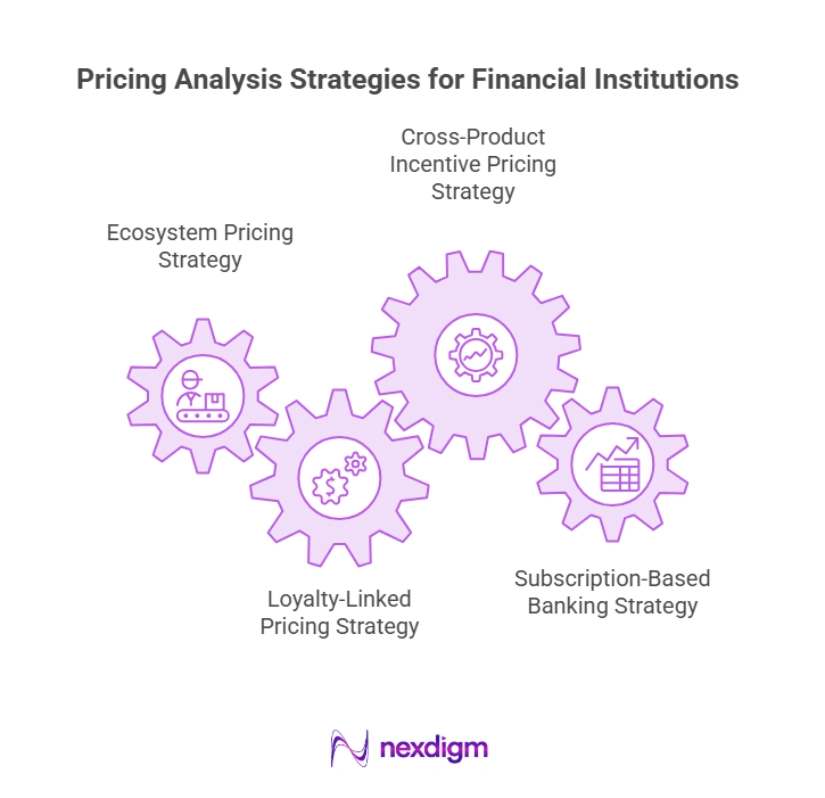
- Ecosystem Pricing Strategy: Financial institutions can combine banking, investment, insurance, travel, and lifestyle benefits within one proposition. Integrated value makes premium packages more attractive and reduces direct comparison with standalone products.
- Loyalty-Linked Pricing Strategy: Customers can receive better rates, reduced fees, or exclusive benefits as their tenure and product usage increase. This encourages retention while rewarding deeper and more profitable relationships.
- Cross-Product Incentive Pricing Strategy: Preferential pricing can be offered when customers combine deposits, cards, loans, investments, or insurance. This increases wallet share and builds broader, more stable relationships.
- Subscription-Based Banking Strategy: A fixed monthly or annual fee can provide access to a bundle of premium services. Subscription pricing simplifies customer understanding and creates predictable recurring revenue for the institution.
Nexdigm’s Strategic Assistance in Value-Based Financial Pricing Analysis
Nexdigm supports financial institutions with value-based financial pricing analysis by assessing customer willingness to pay, segment profitability, competitor benchmarks, and product value. Its pricing analysis services help design differentiated fee structures, optimise premium banking propositions, improve customer segmentation, and strengthen revenue growth. This strategic pricing approach enables data-driven decisions, sustainable profitability, and stronger positioning across high-value banking segments and markets.
Nexdigm’s Strategic Roadmap for Data-Driven Financial Pricing Analysis
Nexdigm’s strategic roadmap helps financial institutions convert customer, competitor, and profitability data into precise pricing decisions, enabling differentiated propositions, stronger margins, improved customer value, and sustainable growth across banking segments. Key roadmap steps include:
- Assess the Existing Pricing Environment: Nexdigm reviews current fees, interest structures, product economics, customer response, competitor positioning, and internal pricing practices to identify gaps, inconsistencies, and improvement opportunities.
- Define Priority Customer Segments: Customers are classified using profitability, financial behaviour, risk, relationship depth, service expectations, and willingness to pay, helping institutions focus on the most valuable opportunities.
- Develop Segment-Specific Pricing Propositions: Tailored pricing models, product bundles, fee structures, and premium benefits are designed for each segment, ensuring stronger relevance, differentiation, and perceived customer value.
- Validate Pricing Through Scenario Analysis: Nexdigm tests alternative pricing scenarios using demand sensitivity, financial modelling, competitor benchmarks, and customer research to determine potential effects on revenue, margins, acquisition, and retention.
- Execute and Optimise the Pricing Strategy: The selected pricing model is implemented through governance, technology, communication, and performance tracking, followed by continuous refinement based on market movements and customer outcomes.
Nexdigm’s case
Nexdigm supported a regional bank through competitive benchmarking, customer segmentation, and pricing analysis. The engagement refined products for high-value segments, delivering a 20% increase in market penetration, 15% growth in customer acquisition, and 10% improvement in retention within one year, strengthening profitability, customer value, and competitive positioning across markets.
To take the next step, simply visit our Request a Consultation page and share your requirements with us.
Harsh Mittal
+91-8422857704