

Competitive intelligence explains how automakers are changing vehicle design by making cars lighter and more suitable for electric and hybrid systems. A vehicle architecture study helps understand how new materials and improved engineering reduce vehicle weight and improve energy efficiency. It also compares competitor strategies in design innovation, helping companies identify best practices and stay competitive in terms of performance, cost reduction, and sustainability in the evolving automotive industry.
Electrified and lightweight vehicle architectures are enabling OEMs to achieve around 15% efficiency improvement by reducing vehicle mass and optimizing energy consumption. Industry benchmarking shows that advanced lightweight materials can cut weight by up to 20–30%, directly improving range and performance in EV platforms.
These insights help compare competitor design strategies, identify leaders in vehicle architecture innovation, and evaluate how efficiency gains translate into cost reduction, regulatory compliance, and improved market positioning in the evolving automotive ecosystem.
Competitive Intelligence on Vehicle Architecture Strategies
Vehicle architecture strategies benchmarking evaluates how OEMs optimize design, modularity, and electrification to improve efficiency, reduce costs, and strengthen competitiveness in evolving automotive markets:
Platform Standardization and Modular Design
Competitive intelligence evaluates OEM adoption of modular platforms enabling scalability cost reduction and faster vehicle development cycles across segments
Lightweight Material Integration Trends
Analysis tracks use of aluminum composites and advanced materials reducing vehicle weight improving efficiency and enhancing performance competitiveness
Electrified Architecture Development
Competitive intelligence studies EV focused architectures optimizing battery placement energy efficiency and supporting next generation electrified mobility platforms
Cost Efficiency and Development Optimization
Benchmarking identifies how architecture strategies reduce R&D duplication improve resource utilization and achieve significant development cost savings
Performance and Efficiency Benchmarking
Competitive insights compare vehicle efficiency improvements across OEMs evaluating impact of architecture choices on energy consumption and range optimization
Nexdigm’s Assessment of Electrified Vehicle Architecture Evolution
Nexdigm’s assessment of electrified vehicle architecture evolution leverages competitive intelligence, market benchmarking, and technology analysis to evaluate OEM transition toward EV-centric platforms. Its services include global benchmarking, cost and efficiency analysis, modular platform evaluation, and strategy advisory. Nexdigm helps stakeholders understand design shifts, optimize development costs, and identify competitive positioning opportunities in electrified mobility ecosystems driven by innovation and sustainability mandates.
Nexdigm’s Strategic Outlook on Next-Generation Vehicle Platforms
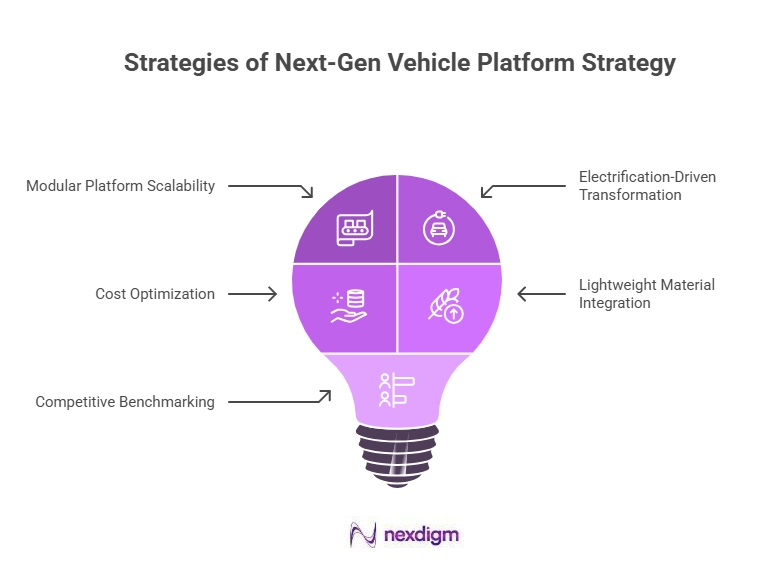
Nexdigm’s strategic outlook on next-generation vehicle platforms focuses on analyzing how OEMs are transforming vehicle architecture through modularization, electrification, and lightweight design. Using competitive intelligence, Nexdigm evaluates global benchmarking trends, cost efficiency improvements, and technology integration across platforms. The assessment helps identify how manufacturers are reducing development costs, improving scalability, and accelerating time-to-market while adapting to evolving mobility demands and sustainability-driven automotive industry transitions:
(chart)
Modular Platform Scalability Trends
Nexdigm highlights increasing adoption of modular platforms enabling OEMs to scale production efficiently across multiple vehicle segments globally
Electrification-Driven Platform Transformation
Nexdigm observes shift toward EV-centric architectures improving energy efficiency integrating batteries and reducing dependency on traditional combustion systems
Cost Optimization through Platform Consolidation
Nexdigm notes platform consolidation strategies reduce development duplication enabling significant cost savings and improved resource utilization for OEMs
Lightweight Material Integration Strategy
Nexdigm emphasizes use of advanced lightweight materials enhancing efficiency improving range and supporting next-generation vehicle performance requirements
Competitive Benchmarking of OEM Strategies
Nexdigm conducts benchmarking of global OEMs to identify best practices in platform innovation cost efficiency and technological advancement
Nexdigm’s case:
Nexdigm highlights that global OEMs adopting modular vehicle platforms achieve up to 30% reduction in development costs and nearly 20–30% faster time-to-market through shared architectures and component standardization. Competitive intelligence assessment shows these efficiencies significantly improve scalability, reduce R&D duplication, and enhance profitability across multi-segment vehicle portfolios in highly competitive automotive markets.
To take the next step, simply visit our Request a Consultation page and share your requirements with us.
Harsh Mittal
+91-8422857704