

Selecting a vehicle component vendor involves balancing commercial competitiveness with technical suitability, manufacturing capabilities and delivery-related considerations. A supplier may offer an attractive price but have limited experience with the required component. Another may have advanced engineering capabilities but operate from a location that creates additional logistical complexity.
For OEMs and automotive manufacturers, a structured comparison helps explain these differences and identify vendors that are relevant to a particular sourcing requirement.
India’s automotive component industry recorded turnover of approximately ₹6.73 lakh crore in FY2024–25. Domestic supplies to OEMs reached ₹5.70 lakh crore, while exports stood at US$22.9 billion. The market includes large Tier 1 manufacturers, specialised component producers and smaller businesses supplying individual parts and sub-assemblies.
Comparing Cost Beyond the Quoted Component Price
A quoted price provides only a partial view of a vendor’s commercial position. The total cost implications of sourcing a component may also depend on material selection, manufacturing processes, tooling requirements, packaging, logistics and production volumes.
For example, a forged component and a cast component may serve related applications but involve different production economics and technical requirements. Similarly, suppliers using different material grades or manufacturing processes may not be directly comparable even when their products appear similar.
A commercial comparison should therefore examine the assumptions behind each quotation. Relevant factors include tooling and development expenditure, minimum order quantities, material-cost exposure, freight requirements, inventory implications and the potential cost of engineering changes.
The buyer should also understand whether the vendor’s pricing position is supported by manufacturing scale, process specialisation or access to materials. This provides a more useful basis for assessing commercial competitiveness than price alone.
Technical Capability and Product Suitability
Technical assessment should be specific to the component and its intended application. For precision-engineered mechanical parts, relevant capabilities may include machining accuracy, tooling, metallurgical expertise, material processing and process control.
For electronic components, the comparison may need to cover circuit design, electronic manufacturing, sensor integration, software capabilities and testing infrastructure. For polymer and rubber components, material formulation, moulding processes and application-specific performance become more relevant.
Engineering resources also influence a vendor’s suitability. Manufacturers with product-development experience may be better positioned to support design changes, new vehicle platforms and application-specific requirements. Experience supplying comparable components can provide useful evidence of technical relevance.
Quality Evaluation Requires More Than Certification
Automotive quality credentials can indicate that a manufacturer has established management and process systems. However, certification alone does not establish the suitability of every product manufactured at a facility.
A more complete vendor comparison examines the supplier’s relevant customer approvals, product validation capabilities, testing infrastructure, traceability systems and manufacturing specialisation. Buyers should also distinguish between certifications that apply to the company, the manufacturing facility or a particular product.
Where public information is limited, the assessment should identify the need for further supplier verification. A market-level review can establish which vendors appear relevant, but it cannot independently confirm factory-level defect rates or actual delivery performance without verified operational data.
Delivery Capability and Manufacturing Geography
Delivery suitability depends on more than the distance between a supplier and an assembly plant. Production capacity, equipment availability, workforce requirements, access to upstream inputs and logistics infrastructure all influence a manufacturer’s ability to support a programme.
India’s automotive supplier base is concentrated around major manufacturing regions such as Pune, Chennai, NCR, Gujarat and Madhya Pradesh. Mapping vendor facilities against these clusters can help identify geographic advantages and regional concentration.
A supplier with several facilities may offer broader market coverage, while a specialist manufacturer operating from one location may be relevant for a particular product category. The appropriate comparison depends on the buyer’s production footprint and the component’s logistics requirements.
Building a Comparable Vendor Shortlist
A useful vehicle component vendor comparison should assess each manufacturer against the same component specification, production requirement and evaluation criteria. The comparison should separate four dimensions:
- Cost: Quoted price, material exposure, tooling, freight and other sourcing-related cost factors.
- Technical capability: Product specialisation, engineering resources, manufacturing processes and technology readiness.
- Quality capability: Relevant certifications, customer approvals, testing infrastructure and traceability.
- Delivery suitability: Facility locations, capacity indicators, logistics access and expansion potential.
The relative importance of each dimension should reflect the component’s application. For a safety-critical part, technical and quality requirements may be decisive. For a standardised, high-volume component, production economics and geographic access may carry greater weight.
Vehicle Component Vendor Comparison Framework
Nexdigm can support vendor comparisons through market intelligence covering manufacturers, product capabilities, competitive positioning and regional manufacturing ecosystems.
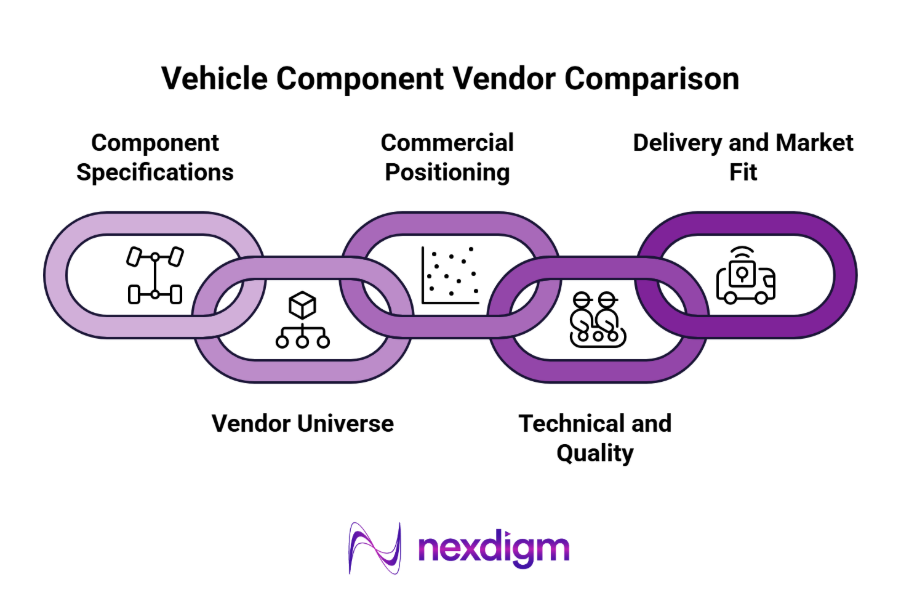
- Establish Component Specifications: Define the product application, technical requirements, expected volumes and sourcing priorities.
- Build the Vendor Universe: Identify manufacturers by component category, process capability, location and market presence.
- Compare Commercial Positioning: Examine pricing indicators, material exposure, tooling considerations and relevant cost drivers.
- Assess Technical and Quality Capabilities: Compare engineering experience, manufacturing specialisation, testing infrastructure and quality credentials.
- Evaluate Delivery and Market Fit: Map facility locations, capacity indicators, regional access and potential supply concentration before developing a shortlist.
Nexdigm Case: Comparing Vendors for Localisation
An automotive manufacturer evaluating domestic alternatives for three component categories required a comparative view of cost drivers, technical capabilities and manufacturing locations. Nexdigm assessed 26 vendors, identified eight relevant manufacturers and highlighted two categories where regional supplier alternatives remained limited.
To take the next step, simply visit our Request a Consultation page and share your requirements with us.
Harsh Mittal
+91-8422857704